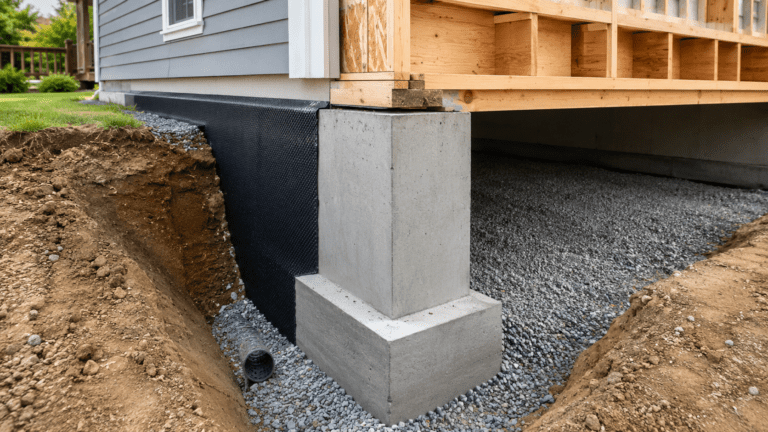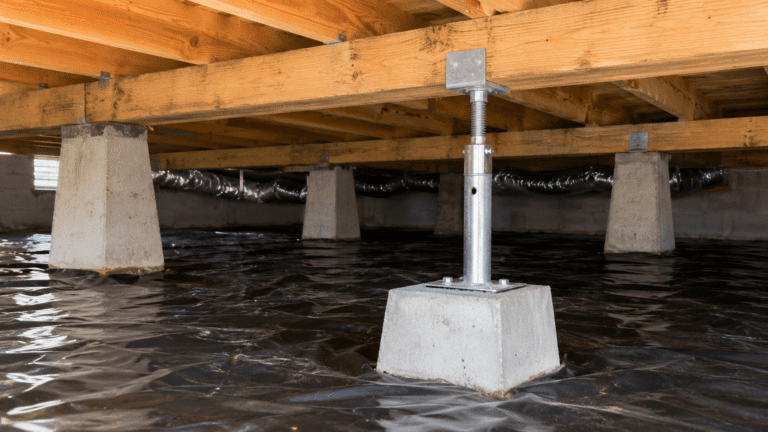
Foundation Repair: Signs, Costs, Methods & Engineer Tips (2026)
A small crack near a window, a sticky door, or a slightly uneven floor does not always mean your house is sinking like a disaster movie. Sometimes it is minor movement, humidity, or just an older house being an older house.
But the same symptoms can also point to foundation settlement, poor drainage, expansive clay, soil movement, or structural distress.
The mistake many homeowners make is jumping straight to repair methods: piers, foam lifting, crack injection, wall anchors. From an engineering point of view, that is backwards.
Quick Answer: What Is Foundation Repair?
Foundation repair means fixing problems that affect the stability, level, or durability of a home’s foundation.
Depending on the cause, repair may involve crack sealing, drainage correction, slab lifting, underpinning, helical piers, push piers, wall anchors, carbon-fibre reinforcement, waterproofing, or soil moisture control.
Most US foundation repair projects cost about $2,000 to $8,000, but major structural repairs can exceed $10,000 to $25,000+.
Foundation repair should not be selected from symptoms alone. A crack is evidence, not a diagnosis.
The 4-Part Foundation Diagnosis Framework
Before thinking about piers, underpinning, lifting, or crack injection, judge the problem using four questions.
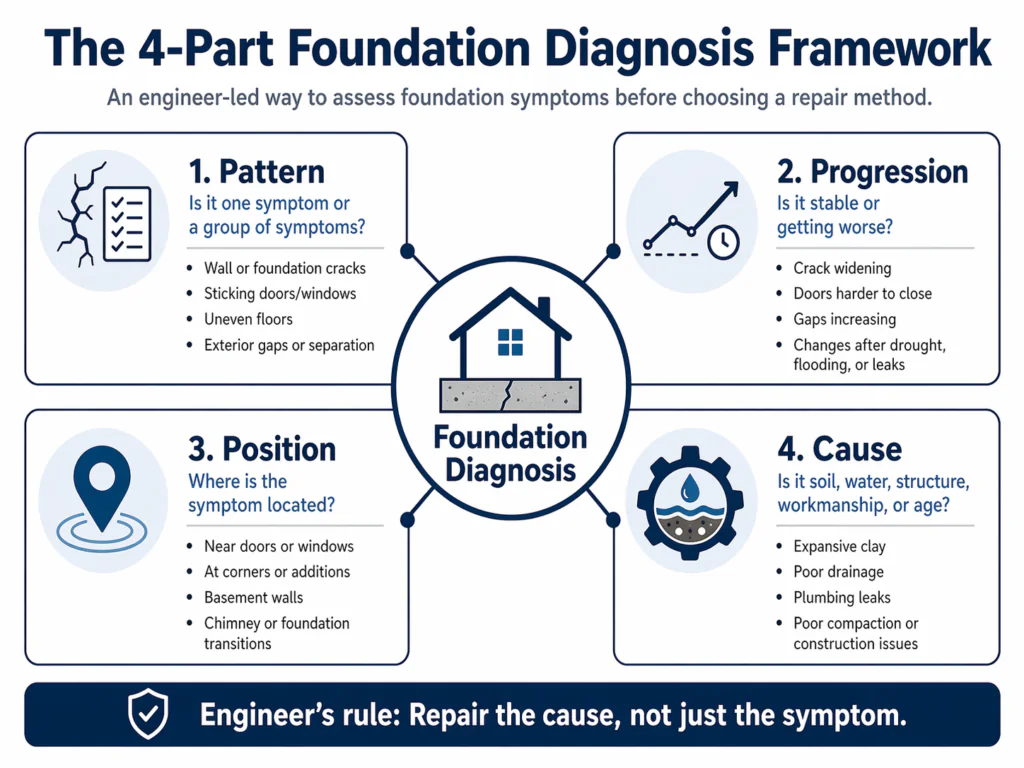
1. Pattern
Is it one isolated issue, or several symptoms in the same area?
Example:
- Stair-step crack
- Sticky door
- Sloped floor
- Exterior wall gap
That combination tells a bigger story than one crack alone.
2. Progression
Is it stable, or getting worse?
Ask:
- Is the crack wider than last year?
- Are doors harder to close?
- Are gaps increasing?
- Did symptoms appear after drought, flooding, excavation, or leaks?
Movement over time is one of the most important clues.
3. Position
Where is the problem located?
Location matters.
- Window corner diagonal crack = possible movement
- Horizontal basement crack = possible soil pressure
- Garage slab settlement = possible void or poor compaction
- Addition crack = movement between old and new structures
4. Cause
What is driving it?
Usually one or more of these:
- Expansive clay
- Poor drainage
- Plumbing leaks
- Poor compaction
- Erosion
- Tree moisture changes
- Frost action
- Weak construction detailing
Repairing the symptom without addressing the cause is why some foundation repairs fail.
Common Signs of Foundation Problems
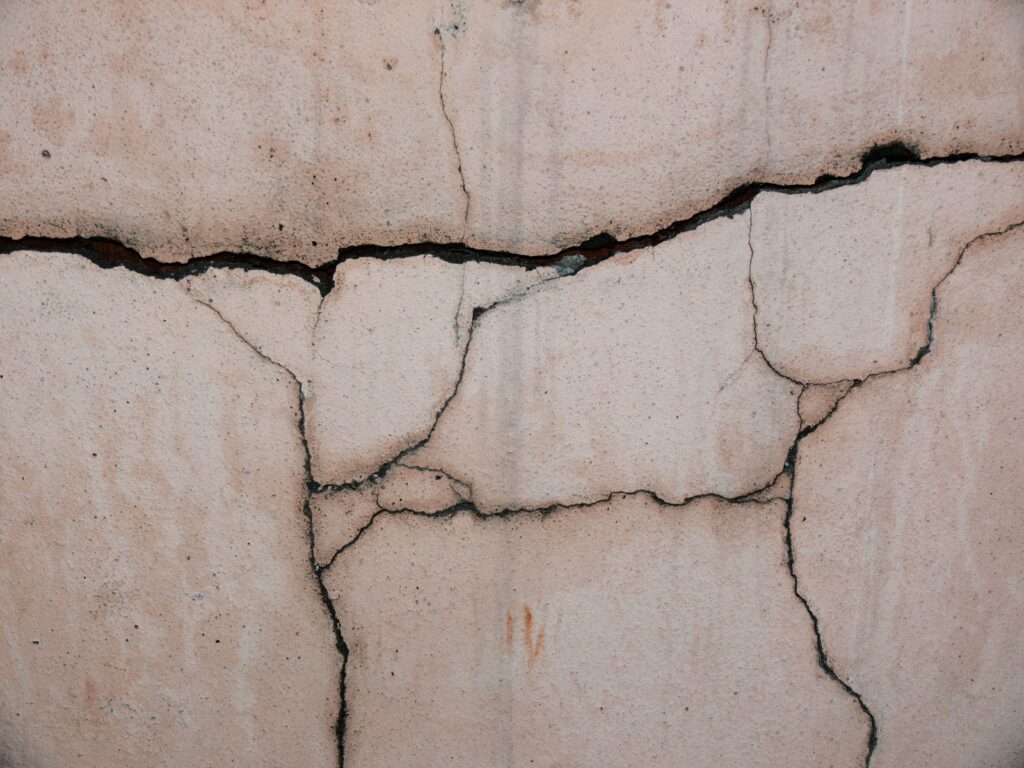
Foundation movement often appears first in the rest of the house. The foundation moves, and the finishes, openings, walls, floors, masonry, and trim reveal the evidence.
| Symptom | Lower concern when… | Higher concern when… |
|---|---|---|
| Hairline drywall crack | Isolated and stable | Widening, diagonal, or repeated after repair |
| Sticking door | Seasonal humidity issue | Several doors suddenly misalign |
| Brick crack | Small isolated mortar crack | Stair-step crack grows over time |
| Uneven floor | Old and unchanged | New, worsening, or localised |
| Basement wall crack | Small vertical crack | Horizontal crack or bowing wall |
| Window gap | Minor trim separation | Gap grows with wall movement |
| Foundation crack | Thin and unchanged | Leaking, displaced, widening, or active |
| Chimney separation | Very slight and stable | Visible gap increasing from house wall |
A single symptom does not automatically mean foundation failure. The concern increases when several symptoms appear together or when the symptoms are progressing.
If drywall is removed or damaged during foundation repair, use our drywall cost calculator to estimate the restoration cost.
Foundation Severity Checklist
Use this as an initial screening tool. It does not replace inspection, but it helps you decide how seriously to treat the issue.
| Observation | Concern Level | What it may suggest | Next step |
|---|---|---|---|
| One small hairline drywall crack | Low | Shrinkage or normal movement | Monitor |
| Small vertical concrete crack, no leakage | Low to medium | Shrinkage/minor movement | Monitor or seal |
| Crack that reopens after repair | Medium | Movement may still be active | Investigate |
| Diagonal crack from door/window corner | Medium | Differential movement possible | Document and inspect |
| Stair-step crack in brick/block | Medium to high | Foundation movement possible | Professional assessment |
| Sloping floor with sticking doors | High | Active or historic movement | Inspection recommended |
| Horizontal basement wall crack | High | Lateral soil/water pressure | Call engineer |
| Bowing or leaning foundation wall | High | Structural wall distress | Urgent assessment |
| Chimney separating from house | High | Differential settlement possible | Inspection recommended |
| Rapidly widening cracks | High | Active movement | Call professional promptly |
Crack width is useful, but it is not enough. Direction, displacement, location, leakage, progression, and associated symptoms are often more important.
Foundation Cracks: Which Ones Are Serious?
Foundation cracks are common, but they do not all mean the same thing.
Hairline cracks
Hairline cracks can occur because of concrete shrinkage, temperature change, minor movement, or curing effects. If they are stable and dry, they are often less concerning.
Still, monitor them. A hairline crack that widens or leaks should not be ignored.
Vertical cracks
Vertical cracks in poured concrete walls are often less concerning than horizontal cracks, especially if narrow and stable. However, they may still allow water intrusion.
Diagonal cracks
Diagonal cracks can suggest differential settlement, especially when they start near doors, windows, corners, or changes in foundation geometry.
Stair-step cracks
Stair-step cracks in brick or concrete block walls are more concerning because they often follow mortar joints and may indicate uneven foundation movement.
Horizontal cracks
Horizontal cracks in basement or retaining-type foundation walls are more serious because they can indicate lateral soil pressure, hydrostatic pressure, or wall bowing.
For a deeper breakdown of crack types, injection methods, warning signs, and repair costs, read our foundation crack repair guide. Call a professional if a crack is widening, leaking, displaced, horizontal, stair-stepped, or appears together with uneven floors, sticking doors, wall movement, or exterior gaps.
What Causes Foundation Problems?
Foundation problems usually come from soil movement, water, poor construction, unsuitable design, structural loading, or a combination of these.
The foundation and the soil work together. If the soil changes volume, loses strength, washes out, compresses, or was poorly prepared, the foundation can move.
1. Expansive clay soil
Expansive clay is a major foundation issue in many parts of the United States, especially in areas such as Texas, Oklahoma, and parts of the South.
Clay soils can swell when wet and shrink when dry. This shrink-swell behaviour can cause heave, settlement, cracking, and differential movement. HUD-linked research on residential foundations on expansive soils discusses the role of soil-structure interaction and unsaturated soil mechanics in understanding residential foundation behaviour.
2. Poor drainage
Poor drainage is one of the most common foundation risk factors.
Problems include:
- short downspouts
- clogged gutters
- soil sloping toward the house
- ponding water
- poor surface runoff
- leaking plumbing
- water collecting against basement walls
If gutters are clogged, use our gutter installation cost calculator to estimate the cost of replacing failed gutters and downspouts.
3. Poorly compacted fill
If a house is built over poorly compacted fill, the soil may compress over time. This can cause settlement under slabs, footings, garages, patios, or additions.
4. Plumbing leaks
A leaking water line, sewer line, or irrigation system can change soil moisture near the foundation. In clay regions, this can trigger swelling or shrinkage.
5. Tree-related soil moisture changes
Tree roots do not usually “break” foundations directly in the simple way people imagine. The more common issue is soil moisture. Large trees close to a house can draw moisture from clay soils, contributing to shrinkage and differential movement in some situations.
6. Frost and cold-climate effects
In colder regions, frost penetration, freeze-thaw action, and poor drainage can affect foundation performance. Foundation depth and drainage design matter more in these areas.
7. Design or construction issues
Foundation distress can also result from:
- inadequate footing size
- shallow footings
- poor concrete quality
- weak reinforcement detailing
- poor site preparation
- unsuitable foundation type
- poor drainage design
- construction on problem soils without proper treatment
Why Foundation Problems Differ Across the US
A homeowner in Texas is not dealing with the same foundation risk profile as a homeowner in Michigan, Florida, or California.
| Region | Common foundation concerns |
|---|---|
| Texas / Oklahoma / parts of the South | Expansive clay, drought-rain cycles, slab movement |
| Florida | Moisture, shallow groundwater, drainage, sinkhole-prone areas in some regions |
| Midwest / Northeast | Frost depth, basement walls, freeze-thaw, drainage |
| California | Seismic effects, hillside movement, expansive soils in some areas |
| Southeast | Clay soils, moisture variation, drainage, crawl spaces |
| Mountain / slope regions | Erosion, slope movement, retaining wall interaction |
This is why local soil and climate matter. A repair method that makes sense in one region may not be the best first solution in another.
A foundation repair article should never pretend that soil behaves the same across the United States.
Foundation Settlement vs Heave vs Lateral Movement
Many homeowners call every foundation movement “settlement”, but that is not always correct.
| Movement Type | What happens | Common cause | Typical signs |
|---|---|---|---|
| Settlement | Foundation moves downward | Soil compression, erosion, drying clay, poor compaction | Sloping floors, diagonal cracks, gaps |
| Heave | Foundation moves upward | Expansive clay swelling, frost, moisture increase | Slab uplift, floor ridges, upward distortion |
| Lateral movement | Wall moves sideways | Soil pressure, water pressure, poor drainage | Bowing walls, horizontal cracks |
This distinction matters because the wrong diagnosis can lead to the wrong repair.
For example, installing piers may help when part of the foundation has settled. But if the main problem is moisture-driven clay heave, lifting alone may not solve the long-term movement. If the main issue is downward movement, sloping floors, or widening gaps, see our foundation settlement repair guide.
Main Foundation Repair Methods
Foundation repair is not one method. It is a category of possible repairs.
1. Crack repair
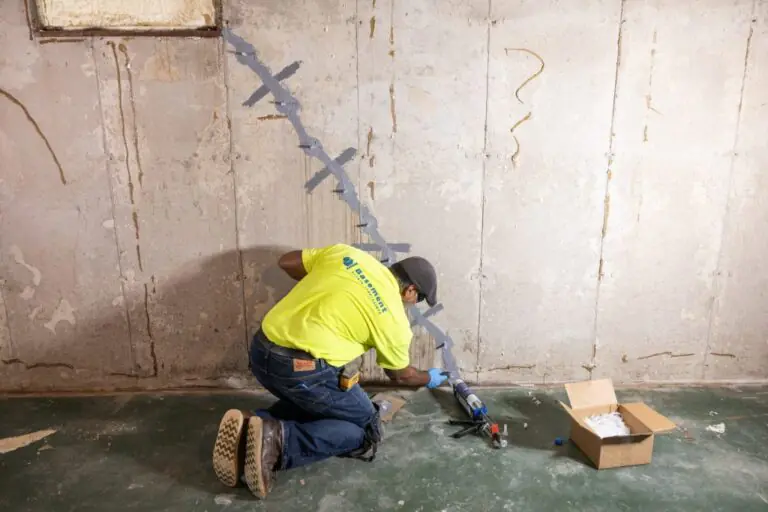
Crack repair may involve epoxy injection, polyurethane injection, sealants, patching, or waterproofing.
Best suited for:
- limited cracks
- leakage control
- non-active cracks
- minor non-structural issues
Not suitable when:
- movement is active
- wall displacement exists
- cracks keep reopening
- soil or drainage cause remains untreated
2. Drainage correction
Drainage correction may include:
- regrading soil away from the house
- extending downspouts
- cleaning gutters
- installing French drains
- correcting surface runoff
- fixing plumbing leaks
- reducing ponding water
Drainage correction is often one of the highest-value foundation protection measures.
3. Slabjacking or mudjacking
Mudjacking lifts a sunken concrete slab by pumping grout beneath it. It is often used for driveways, sidewalks, patios, garage slabs, and some floor slabs.
It can help with local slab settlement or voids but may not be suitable for serious structural foundation movement. For homes built on slab foundations, our concrete slab foundation repair guide explains slab cracks, lifting, void filling, and soil support problems in more detail.
4. Polyjacking
Polyjacking uses expanding polyurethane foam to lift slabs. It is lighter than traditional grout and useful in some slab-lifting applications.
The key question remains whether the soil problem is solved or still active.
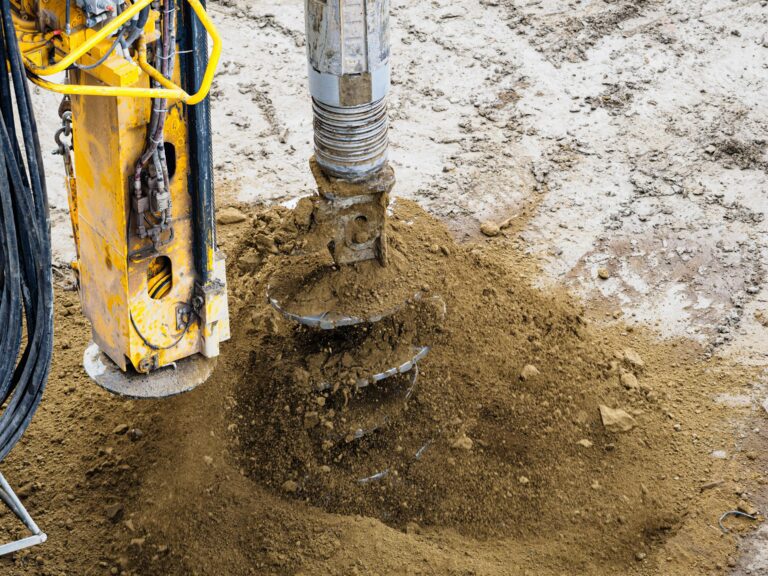
5. Helical piers
Helical piers are steel shafts with helix-shaped plates screwed into the ground until suitable bearing resistance is reached. They can support foundations where deeper load transfer is needed.
6. Push piers
Push piers are steel sections driven into the ground using the structure’s weight as reaction. They transfer load to deeper bearing layers and are commonly used for settlement-related stabilisation.
7. Underpinning
Underpinning strengthens or extends the foundation support. It can involve piers, piles, concrete underpinning, or engineered systems. you can find complete guide here.
It may be needed when:
- the foundation is inadequate
- loads have changed
- deeper support is required
- settlement has affected part of the structure
8. Wall anchors, bracing, and carbon-fibre reinforcement
For bowing basement walls, repair may involve wall anchors, steel beams, braces, carbon-fibre strips, or other lateral support systems.
This is different from settlement repair because the main issue is wall pressure, often from soil and water.
Foundation Repair Cost: What Affects the Price?
Foundation repair cost depends on the problem, not just the size of the house.
The same visible crack may require a minor sealant repair in one house and a major stabilisation plan in another.
Main cost factors include:
- foundation type
- severity of damage
- repair method
- number of piers or anchors
- soil conditions
- access around the house
- drainage correction
- engineering report
- permits
- interior demolition or finishes
- local labour rates
- warranty terms
US foundation repair ranges around $2,225 to $8,134, with average costs around $5,174–$5,175.
| Repair Situation | Cost Level |
|---|---|
| Minor crack sealing | Lower |
| Drainage correction | Low to moderate |
| Local slab lifting | Moderate |
| Several piers or local underpinning | Moderate to high |
| Basement wall stabilisation | Moderate to high |
| Major structural lifting/stabilisation | High |
| Severe foundation replacement | Very high |
A cheaper quote is not always cheaper if it treats only the visible symptom and leaves the cause active.
How to Read a Foundation Repair Quote Like an Engineer
Before signing a repair contract, ask what the quote is actually solving.
A good foundation repair quote should answer these questions:
| Question | Why it matters |
|---|---|
| What is the diagnosed cause of movement? | Repair should match cause |
| Is movement active or historic? | Active movement may need different action |
| What repair method is proposed? | Methods are not interchangeable |
| Why is this method suitable? | Prevents product-first selling |
| Is drainage included? | Water is often part of the problem |
| Is engineering review included? | Important for major repairs |
| Are permits needed? | Varies by location and scope |
| What is excluded? | Interior repairs, plumbing, drainage may be separate |
| What does the warranty cover? | Warranties often have conditions |
| What happens if movement continues? | Important for long-term risk |
Be cautious if a contractor cannot explain the cause, only the product.
Contractor or Structural Engineer: Who Should You Call First?
A foundation contractor can inspect, quote, and perform repairs. Many are reputable and experienced. But a contractor also has a commercial interest in selling a repair system.
A structural engineer is usually paid for an independent opinion. The engineer may not perform the repair, but can help determine whether the problem is cosmetic, serviceability-related, structural, active, soil-related, drainage-related, or construction-related.
| Situation | Best first call |
|---|---|
| One minor stable hairline crack | Monitor or local repair |
| Water pooling near foundation | Drainage contractor or inspection |
| Widening stair-step brick crack | Structural engineer |
| Horizontal basement wall crack | Structural engineer |
| Bowing foundation wall | Structural engineer urgently |
| Expensive pier quote | Independent engineer before signing |
| Buying a house with cracks | Structural engineer or specialist inspector |
| Several contractors disagree | Independent engineer |
| Crack plus sloping floor plus sticking doors | Structural engineer |
For expensive repairs, an independent engineering opinion can protect you from paying for the wrong solution.
What Homeowners Should Do Before Paying for Foundation Repair
1. Photograph and date symptoms
Take photos of cracks, gaps, doors, floors, exterior walls, water ponding, and foundation areas.
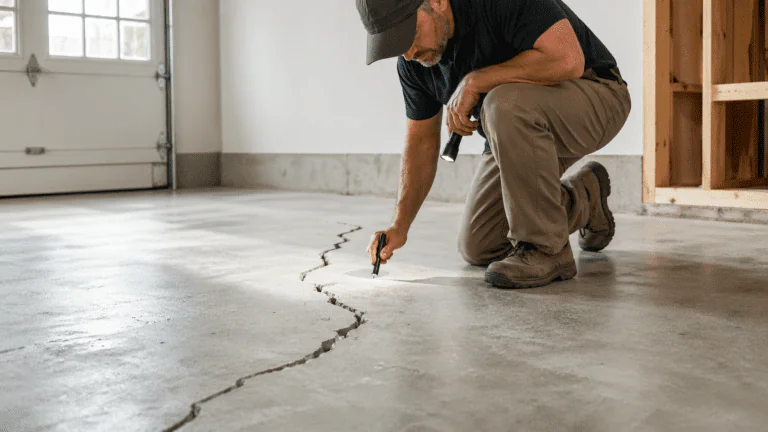
2. Measure cracks where practical
Mark crack ends lightly and record whether the crack changes.
3. Check drainage first
Look at gutters, downspouts, grading, ponding water, irrigation, and plumbing leaks.
4. Look for a pattern
A single crack is different from multiple symptoms in one area.
5. Get more than one opinion
Compare recommendations, not only prices.
6. Ask whether the movement is active
Some problems need repair now. Others may be monitored before major work.
7. Read the warranty
Know what is covered, what is excluded, and what maintenance conditions apply.
Foundation Repair Red Flags
Be careful if you hear:
- “Every crack means foundation failure.”
- “You need to sign today.”
- “Drainage does not matter.”
- “This method fixes every foundation problem.”
- “No engineer is ever needed.”
- “We can quote major repair without checking the full house.”
- “The warranty covers everything.”
- “Soil conditions are not important.”
Foundation repair should be based on diagnosis, not fear.
Can Foundation Problems Be Prevented?
Not all foundation problems can be prevented, but risk can often be reduced.
Useful steps include:
- keep gutters clean
- extend downspouts away from the foundation
- maintain positive grading away from the house
- repair plumbing leaks quickly
- avoid water ponding near the foundation
- monitor cracks over time
- avoid extreme moisture differences around the foundation where practical
- be careful with large trees close to the house
- get suspicious symptoms assessed early
Drainage and moisture control are especially important in expansive clay regions. HUD guidance on unstable clays notes that expansive, highly plastic, or highly compressible clays may require special foundation treatment recommended by a geotechnical engineer.
When Foundation Repair Is Urgent
Get professional help sooner if you notice:
- rapidly widening cracks
- horizontal cracks in basement walls
- bowing or leaning foundation walls
- sudden floor slope changes
- several doors/windows suddenly jamming
- chimney separation
- visible displacement between parts of the structure
- water entering through foundation cracks
- movement after flooding, drought, excavation, or plumbing leaks
If there is any risk of collapse, major wall movement, or unsafe conditions, leave the area and contact a qualified local professional or relevant authority.
Final Engineering Advice
Foundation repair should not begin with panic or sales pressure. It should begin with observation, diagnosis, and understanding the cause of movement.
A crack is a symptom. A sticking door is a symptom. A sloping floor is a symptom. The real question is what those symptoms mean together.
If your home has minor isolated cracks, document and monitor them. If you see a pattern of movement, stair-step cracks, uneven floors, widening gaps, water problems, or wall bowing, get a professional assessment.
The best foundation repair is not always the most expensive one. It is the one that correctly addresses the cause of movement and reduces the chance of further damage.
FAQs
Are foundation cracks always serious?
No. Many hairline cracks are minor. Concern rises when cracks widen, leak, stair-step, run horizontally, or appear with other symptoms.
What is the most common cause of foundation problems?
Soil movement and moisture change are common causes, especially expansive clay and drainage issues.
Can I repair foundation cracks myself?
Minor cosmetic cracks sometimes yes. Active movement, bowing walls, leaks, or settlement symptoms should be professionally assessed.
Do I need a structural engineer for foundation repair?
Not always. But for major movement, conflicting contractor quotes, expensive repairs, or safety concerns, yes