Can You Use Boulders as Retaining Wall?
Yes, you can use boulders as retaining wall, but only when the wall height, soil load, drainage, and site layout are suitable.
In my experience, boulder walls work best for low to moderate landscape walls where the ground behind the wall is fairly level and there are no heavy loads close to the top. They become risky when the wall is taller, the soil is wet or the back slope is steep.
In this article I will try to help you decide if its the right option for your project.
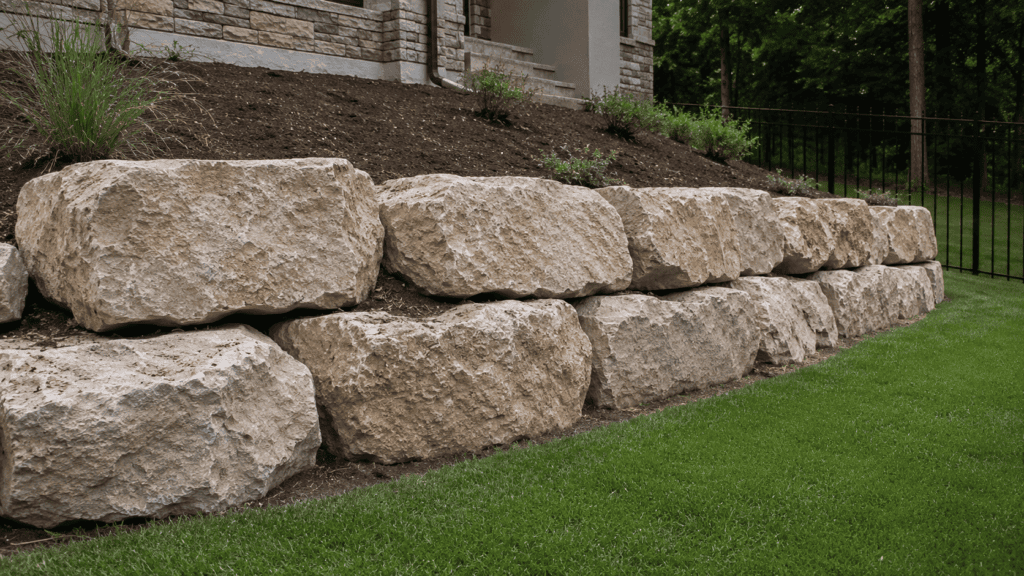
How a Boulder Retaining Wall Holds Back Soil
A boulder retaining wall usually works by gravity.
The soil behind the wall pushes sideways. The boulders resist that pressure through their own weight and through contact with each other. There is usually no mortar, steel, or geogrid doing the main structural work.
A good boulder wall needs:
- Large base stones
- Stable stone-to-stone contact
- Backward batter
- Proper drainage
- A firm base
- Enough buried depth at the bottom
- No heavy load too close behind the wall
This is why two boulder walls can look similar but perform very differently. One may last for decades. Another may move after a few wet seasons.
Why Batter Matters in Boulder Retaining Wall
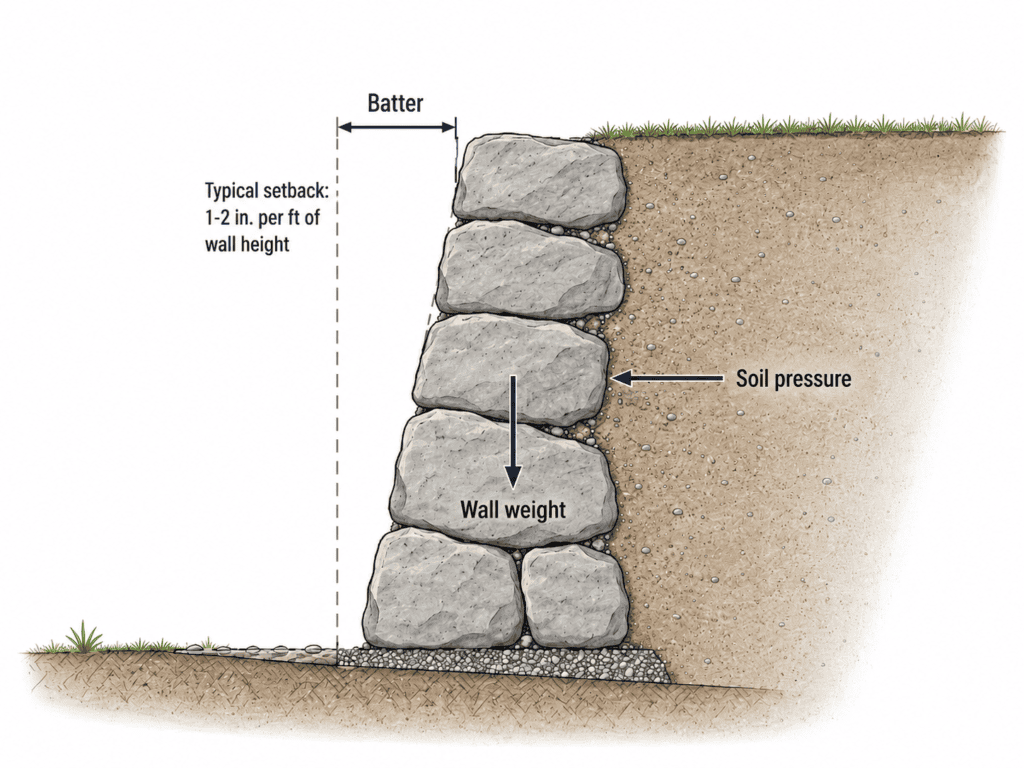
A boulder wall should usually lean back into the retained soil.
This backward lean is called batter. A common practical rule is about 1 to 2 inches of setback for every foot of wall height.
That is not just a visual detail. Batter helps the wall use its own weight against the soil pressure. A vertical stack of boulders is more likely to rotate or bulge forward, especially as the wall gets taller.
Diagram below shows this concept.
Why the Largest Boulders Go at the Base
The largest boulders should go at the bottom of the wall.
The base course carries the highest demand. It supports the stones above it. It also provides the main resistance against sliding and settlement.
The first row should sit on firm, compacted ground. It is usually better when part of the first course is buried. Flat or angular boulders are easier to lock together than smooth round boulders.
Round stones can still be used, but they need careful placement. If they are stacked without interlock, the wall can move.
When Boulders Are Structurally Suitable
Boulders can be suitable for many low retaining walls. They are not suitable for every wall.
In my experience, height of the wall is usually the main deciding factor.
Soil pressure increases fast as the retained height increases. A 4 ft wall is not just a little more demanding than a 2 ft wall. The total lateral force can be several times higher, depending on soil, water, and slope conditions.
Use this as a practical guide:
| Wall condition | Boulder wall suitability |
|---|---|
| Low garden edge | Usually suitable if placed well |
| 2 to 3 ft landscape wall | Often suitable with good base, batter, and drainage |
| 3 to 4 ft retaining wall | Needs more care and better stone sizing |
| Over 4 ft | Usually needs engineering review |
| Driveway, building, slope, or patio above | Needs engineering review even if the wall is shorter |
Many local codes use around 4 ft as a common permit trigger, but rules vary.
A county permit guide from Pierce County, Washington, for example requires permit for retaining walls over 4 ft and shorter walls that support surcharge loads. so its always a good idea to check your local code.
A surcharge is an extra load behind the wall. Common examples include:
- Driveway
- Parking area
- Garage or house foundation
- Patio slab
- Pool
- Fence posts
- Steep slope above the wall
A 3 ft boulder wall holding back flat garden soil is one thing. A 3 ft wall below a driveway is different.
If failure could affect a house, road, neighbour’s property, or public area, get the wall checked.
Drainage Behind a Boulder Wall
Drainage is one of the biggest failure points.
Many people assume boulder walls drain naturally because there are gaps between stones. That is not enough.
Water can still build pressure behind the wall. Fine soil can wash into the gaps. Clay soil can hold water. Once water pressure builds, the wall can lean, bulge, or slide.
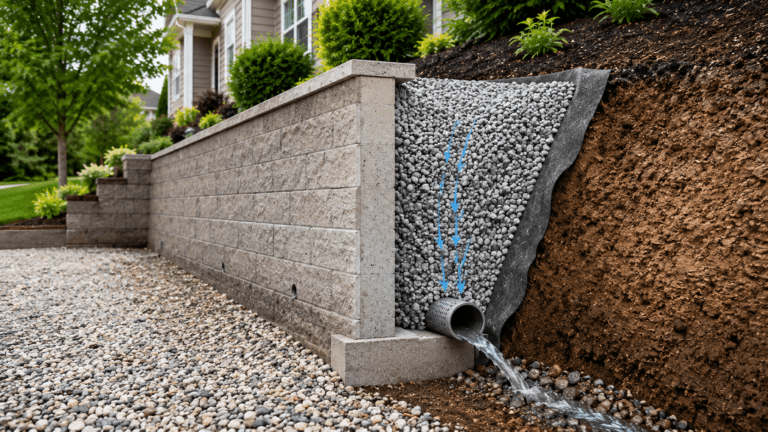
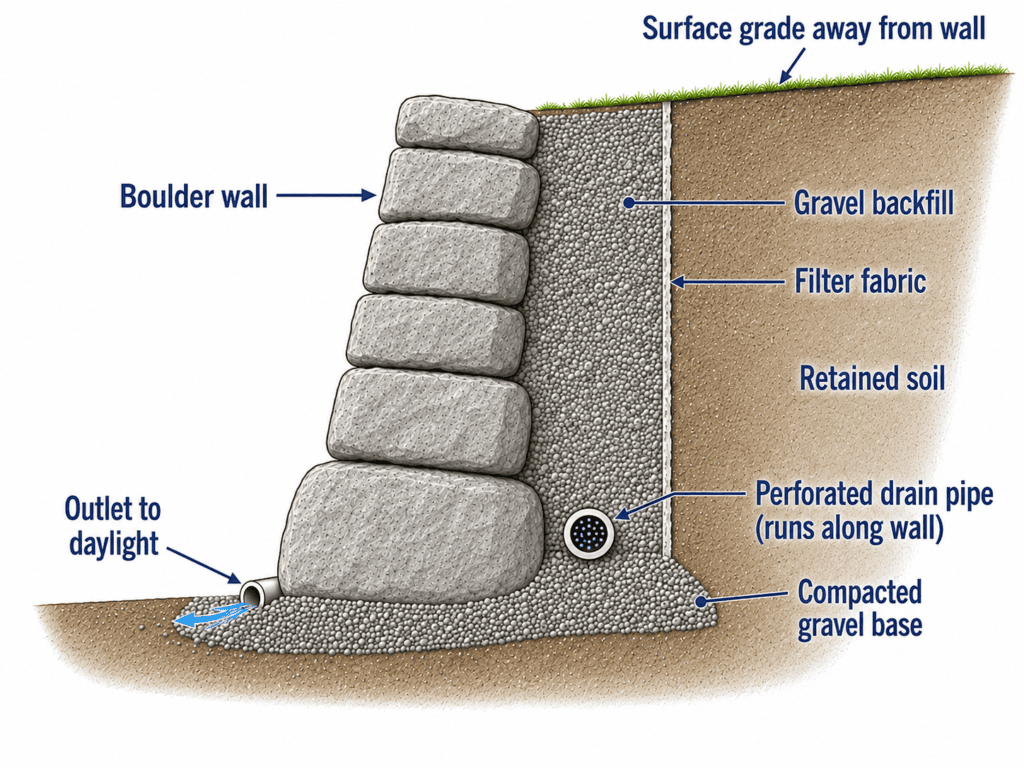
A proper boulder wall should usually include:
- Free-draining gravel behind the wall
- Filter fabric between soil and gravel
- A perforated drain pipe near the base where needed
- A clear outlet for collected water
- Surface grading that sends water away from the wall
The drain pipe should sit near the bottom, where water collects. It also needs somewhere to discharge.
For more detail, see this guide on retaining wall drainage.
Boulders vs Other Retaining Wall Materials
Boulders are best when you want a natural wall and have enough space for a battered gravity wall.
They are not always best for tight spaces, vertical walls, or high structural loads.
| Material | Best use | Main advantage | Main limitation |
|---|---|---|---|
| Boulders | Natural landscape walls | Heavy, durable, natural look | Needs space and machine placement |
| Segmental block | Residential retaining walls | Predictable modular system | Taller walls may need geogrid |
| Poured concrete | Structural walls | Strong and precise | Higher cost and formwork |
| Gabion | Wet or drainage-sensitive sites | Drains well | Industrial appearance |
CMHA’s segmental retaining wall guidance notes that wall height, soil, loads, and geometry affect retaining wall stability. While boulder walls are a different wall type, the same basic factors should be checked when deciding whether a boulder wall is suitable for a site.
If you are comparing boulders with block, you can also use a concrete block calculator to estimate rough block quantities for a basic wall layout.
Common Boulder Retaining Wall Mistakes
Most boulder wall failures come from predictable mistakes.
Using stones that are too small
Small stones do not provide enough mass or interlock for higher retaining loads. They may work for edging, but not for a real retaining wall.
Building the wall too vertical
A vertical wall has less resistance against overturning. A boulder wall should usually lean back into the retained soil.
Skipping drainage
This is the big one. Boulder gaps are not a drainage system. Without gravel, fabric, and a drain path, water pressure can build behind the wall.
Placing the base on weak soil
The bottom course needs firm support. If the first row settles, the wall above it moves too.
Ignoring loads above the wall
A wall below a driveway, patio, slope, or building is not a simple landscape wall. The extra load can change the design completely.
Cost Considerations
Boulder retaining wall cost depends on wall height, access, stone size, trucking distance, equipment, drainage, and labour.
Large boulders need machine placement. Delivery and equipment can become a major part of the price.
Main cost drivers include:
- Wall height and length
- Boulder size
- Excavation
- Site access
- Drainage work
- Soil condition
- Engineering or permits
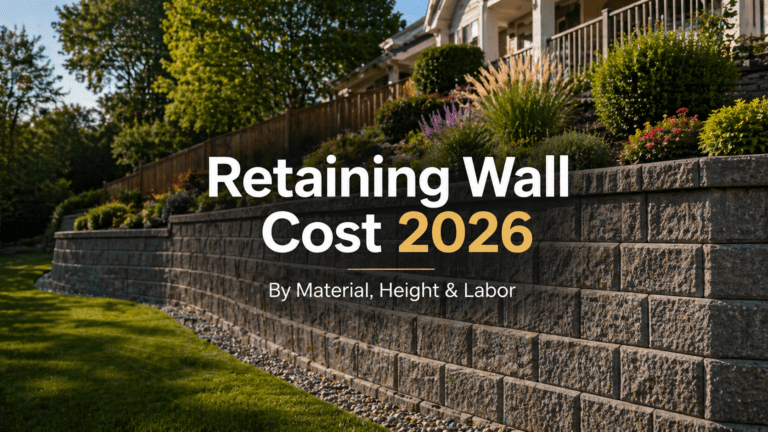
For a full price guide by wall type, see our retaining wall cost article.
When Should You Choose Boulders?
Choose boulders when the wall is low to moderate in height, the site has enough room for a backward batter, and the wall is mainly serving a landscape function rather than supporting a driveway, building, or steep slope.
I would avoid boulders as the first choice when the wall needs to be tall, nearly vertical, close to a structure, or built in a tight property-line condition. In those cases, a more controlled engineered wall system is usually safer and easier to verify.
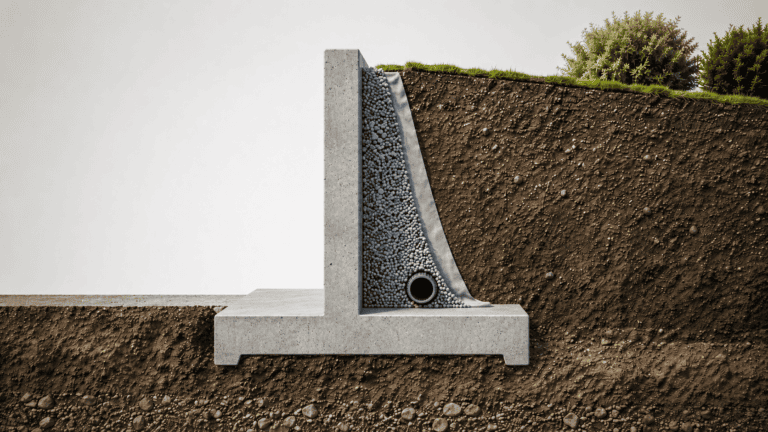
For engineered walls, see our retaining wall design guide for earth pressure, sliding, overturning, bearing, and cantilever wall stability checks.
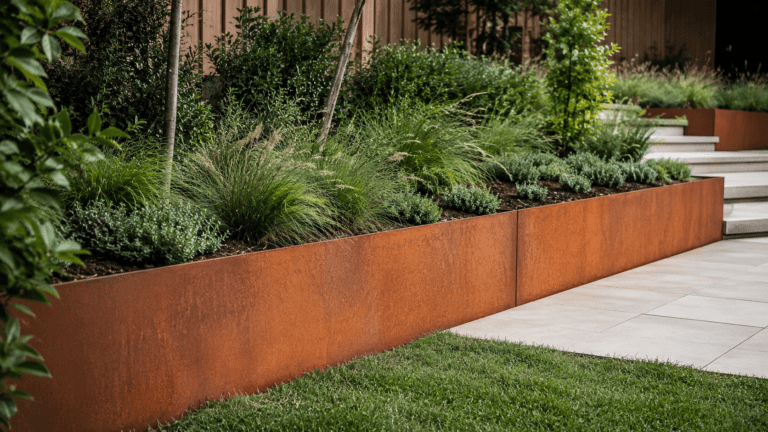
If you want a modern landscape wall instead of a natural stone look, a corten steel retaining wall may also be worth comparing for low garden walls.
FAQs
Do boulder retaining walls need a permit?
They may need a permit depending on height, location, and surcharge loads. Many areas use around 4 ft as a common trigger, but local rules vary. Shorter walls may also need review if they support a driveway, building, slope, or other load.
How tall can a boulder retaining wall be without an engineer?
There is no universal safe height. Low landscape walls are often built without engineering. Walls around 3 to 4 ft need more caution. Walls over 4 ft, or walls with heavy loads above them, should usually be checked by an engineer.
Do boulder walls need drainage pipes?
Often yes. Gaps between boulders do not replace proper drainage. A good wall usually needs drainage gravel, filter fabric, and sometimes a perforated pipe near the base.
How long do boulder retaining walls last?
A well-built boulder retaining wall can last for decades. Lifespan depends on stone quality, base preparation, drainage, wall batter, soil condition, and load above the wall.