Driveway Leveling Cost Calculator: Mudjacking, Foam, Stone Slurry and Grinding
Concrete Driveway leveling usually costs $750 to $6,000+. Small mudjacking jobs often fall near the lower end. Larger foam lifting, stone slurry grout, deep voids, difficult access, or crack repair can push the cost higher.
This calculator helps estimate whether your concrete driveway is a small grinding job, a slab lifting job, or a replacement candidate.
Inputs
Enter driveway repair details
Your driveway leveling estimate
| Result item | What it means |
|---|---|
| Estimated range | The likely low-to-high planning cost for the selected repair conditions. |
| Cost per sq ft | Based on the affected settled area, not always the full driveway area. |
| Method choice | Grinding treats small lips. Mudjacking, stone slurry, and foam lift settled slabs. Replacement is for failed concrete. |
| Quote variation | Cost changes with lift height, void depth, access, local minimum charges, crack repair, drainage correction, and material volume below the slab. |
- Repair method: grinding, mudjacking, stone slurry grout, foam lifting, or replacement
- Whether the void below the slab will be filled
- Hole size, hole spacing, and patching method
- Whether crack repair is included
- Whether drainage correction is included
- How long before you can drive on the slab
- What warranty covers future settlement
Speak with a local driveway professional about uneven or sunken concrete and the repair options available for your property.
How This Calculator Estimates Driveway Leveling Cost
This calculator estimates driveway leveling cost from the settled area, repair method, lift severity, access, crack repair, drainage work, and regional cost level.
It also applies a minimum service charge. Small concrete lifting jobs are rarely priced by square footage alone. A contractor still has to bring equipment, drill injection holes, pump material, patch holes, and clean the site.
We review and update the calculator cost ranges as new pricing data becomes available. This includes contractor pricing patterns, material cost changes, regional cost differences, and updated repair method ranges for mudjacking, foam lifting, stone slurry grout, grinding, and replacement.
Complete concrete driveway costs change a lot by location. For a state-by-state replacement estimate, use our concrete driveway cost by state guide.
Driveway Leveling Cost by Method
The diagram below shows the common driveway leveling methods.
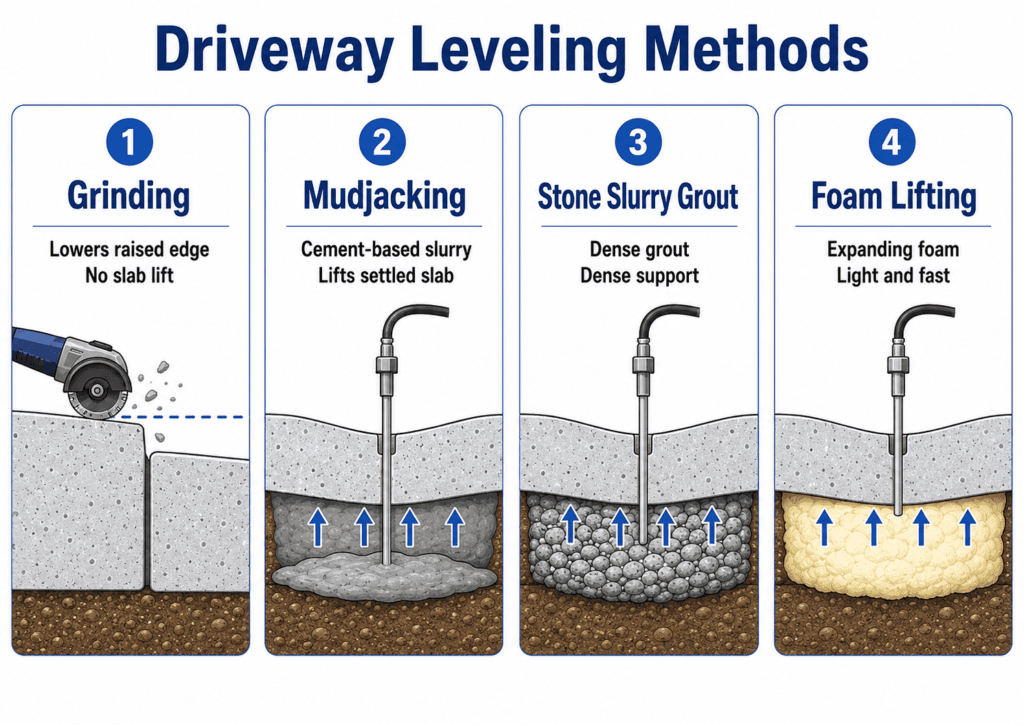
- Mudjacking pumps a cement-based slurry below the slab. It is usually cheaper than foam lifting, but it adds more weight below the concrete.
- Polyurethane foam lifting uses expanding foam. It is lighter and useful when voids are part of the problem. This method is also called polyjacking.
- Stone slurry grout is closer to mudjacking than foam. It uses a dense limestone-based material to lift the slab and support vehicle loads.
- Grinding is different. It cuts down a high edge at a joint. It does not fill a void or raise a sunken panel.
The same lifting logic also appears in broader concrete slab foundation repair work, but a driveway is usually a surface repair unless the settlement points to a deeper foundation or soil problem.
The table below shows the method typical cost, when its recommended and its limits.
| Method | Typical cost | Best for | Main limit |
|---|---|---|---|
| Grinding | $300 to $900 small jobs | Minor raised lips | Does not lift the slab |
| Mudjacking | $750 to $3,000 | Settled concrete panels | Adds weight below the slab |
| Stone slurry grout | $900 to $4,000 | Driveways needing dense support | Needs good access |
| Polyurethane foam lifting | $1,000 to $6,000+ | Fast lifting and void filling | Higher cost |
| Replacement | $4,000 to $10,000+ | Broken or failed driveways | New slab, not leveling |
Research published by ASCE compares cementitious grout and injected polyurethane foam for pavement slab stabilization, which is why this calculator separates grout-based lifting from foam lifting.
Driveway Leveling Cost by Size and Project Type
A 20×20 driveway is 400 square feet. If only one panel is settled, the repair may cost much less than leveling the full area. If most of the driveway has dropped or has voids below it, the cost rises quickly.
Use the table blow for quick reference of driveway leveling cost with respect to project type.
| Project | Typical leveling cost |
|---|---|
| Small trip edge | $300 to $900 |
| One sunken driveway panel | $750 to $2,500 |
| Two to three settled panels | $1,500 to $4,000 |
| 20×20 driveway area | $1,600 to $7,200 |
| Large driveway with voids | $3,000 to $6,000+ |
| Badly cracked driveway | Replacement usually makes more sense |
Why Driveway Leveling Quotes Vary So Much
Two driveways can have the same area and very different repair costs.
The main cost drivers are:
- number of settled slabs
- lift height
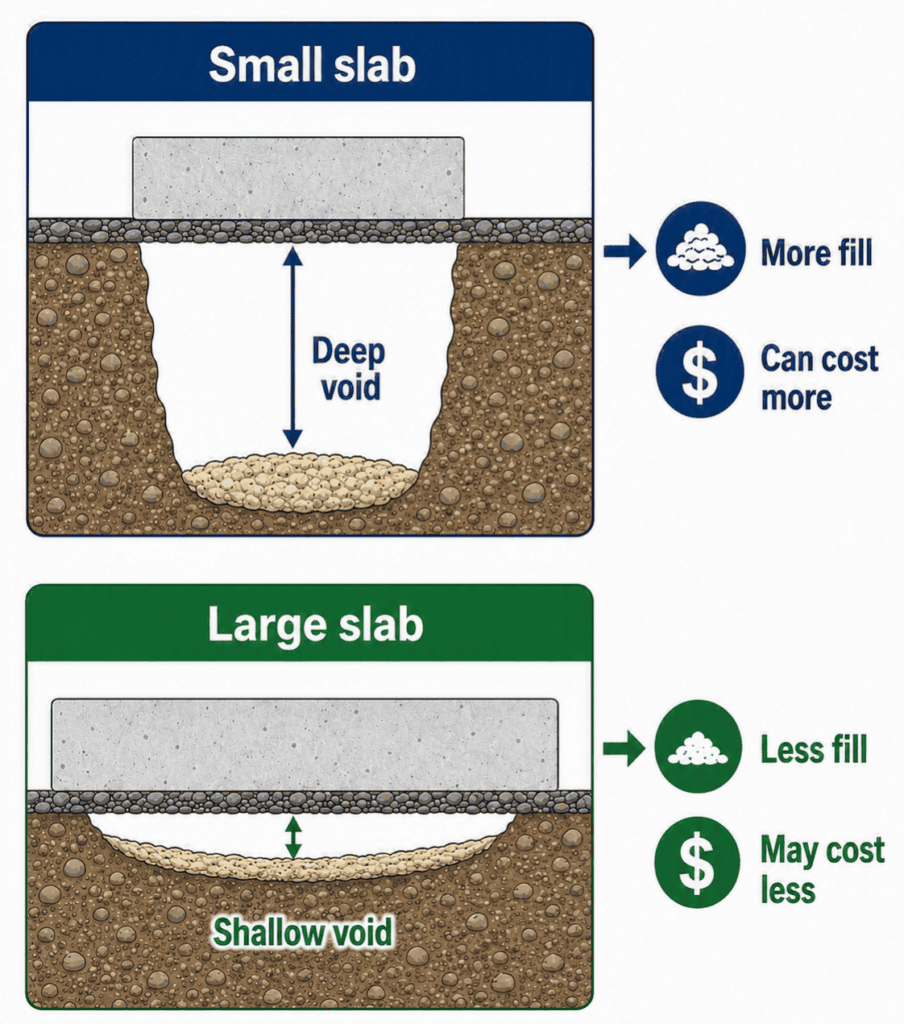
- void depth below the concrete
- crack condition
- drainage problems
- access for pump hoses and equipment
- driveway thickness
- repair method
- local minimum service charge
Void depth matters a lot. A slab that dropped 1 inch over firm soil may need limited material. A slab with a deep empty space below it needs more grout or foam, even if the visible area is small. This is illustrated in the figure below.
Drainage also matters. If roof water, driveway runoff, or poor grading keeps washing soil away, the driveway may settle again after leveling. Our driveway slope calculator can help you measure the existing rise, run, and percent grade.
FHWA pavement guidance treats slab stabilization as a void-filling repair intended to improve support below concrete slabs, not as a cure for every pavement problem.
When Driveway Leveling Works
Driveway leveling works best when the concrete is still usable.
Good candidates include:
- one or more sunken panels
- uneven joints
- settled slabs near the garage
- trip edges caused by settlement
- voids below otherwise solid concrete
- slabs that drain the wrong way because they dropped
Small cracks are not always a deal breaker. Wide cracks, broken corners, and loose sections change the decision.
When Replacement Is Better
Replacement is better when the concrete itself has failed.
Do not level a driveway if most of the slab has:
- wide cracks
- broken panels
- severe scaling
- crumbling edges
- root heave
- frost heave
- repeated settlement from bad drainage
Leveling lifts the concrete you already have. It does not turn bad concrete into good concrete.
If the slab is in replacement territory, compare the leveling quote with a concrete driveway cost calculator. A full replacement estimate should include demolition, base correction, thickness, reinforcement, finishing, and disposal.
Poor joint layout and poor support often show up later as cracks or movement. Your movement joint in concrete planning should happen before the new pour, not after the slab cracks.
Can You Level a Driveway Yourself?
You may grind a small raised lip if the slab is stable and the height difference is minor. Use proper dust control, eye protection, hearing protection, and a grinder rated for concrete.
Do not DIY mudjacking, foam lifting, or stone slurry lifting on a driveway. These repairs need drilling, pumping, pressure control, and experience reading slab movement. Too much lift can crack the slab. Too little material leaves the void in place.
Self-leveling concrete is not the answer for a sunken driveway. It is a surface product. It does not lift the slab or fill the void below it.
How Much Does It Cost to Level a 20×20 Driveway?
A 20×20 driveway is 400 square feet.
If the full area needs lifting, basic mudjacking may fall around $1,600 to $3,600. Foam lifting may fall around $3,200 to $7,200. Stone slurry grout often falls between those ranges.
If only one panel is sunken, the price may be closer to the contractor’s minimum charge. If the driveway has deep voids, cracks, or access problems, the price can be higher.
If the 20×20 driveway is badly cracked, broken, or scaled, replacement may be the smarter repair. Wide driveway cracks often point to shrinkage, movement, poor base support, or drainage problems.
What to Ask Before Hiring a Contractor
Ask these questions before approving the work:
- Which method are you using?
- Is this mudjacking, foam lifting, stone slurry grout, or grinding?
- How many holes will be drilled?
- What size will the holes be?
- Will the void below the slab be filled?
- What happens if the slab cracks during lifting?
- Are crack repair and hole patching included?
- Is drainage correction included?
- How long before I can drive on it?
- What warranty covers future settlement?
A good quote should explain the problem, method, cost, and limits of the repair. A low quote with no site explanation is risky.
FAQ
What is the cheapest way to level a driveway?
Grinding is usually cheapest for a small raised edge. Mudjacking is usually the cheapest true lifting method. Foam lifting costs more but is lighter and works well for void filling.
Is driveway leveling worth it?
Yes, if the concrete is still in good shape. Leveling is usually cheaper than replacement. It is not worth it when the driveway is broken, badly cracked, or severely scaled.
How long does driveway leveling take?
Most driveway leveling jobs take a few hours. Larger jobs with several panels, deep voids, or crack repair can take most of a day.
How long before I can drive on the driveway?
Foam lifting often allows light use sooner. Mudjacking and stone slurry may need more time before vehicle traffic. Follow the contractor’s written instructions.
How long does driveway leveling last?
It depends on soil, drainage, method, and slab condition. A properly leveled slab can last many years if the cause of settlement is fixed. Poor drainage can make it settle again.
Does driveway leveling work in winter?
It depends on the method, temperature, ground condition, and contractor equipment. Frozen ground, snow, and standing water can limit the work.
Is foam lifting better than mudjacking?
Foam lifting is lighter and often faster. Mudjacking usually costs less. Stone slurry grout gives dense support. The best method depends on the slab, soil, voids, and budget.
Can I use self-leveling concrete on a driveway?
Not for a sunken driveway. Self-leveling concrete is a surface layer. It does not lift the slab or fill the void below it.