Asphalt Driveway Cost Calculator
A new asphalt driveway typically costs about $7 to $13 per square foot, while replacing an existing asphalt driveway often costs $8 to $15 per square foot. A simple asphalt overlay over a suitable existing pavement can cost roughly $3 to $7 per square foot.
These averages are useful for a quick budget, but I would not price a real driveway from square footage alone. Use the asphalt driveway price calculator below to estimate both the installed project cost and the amount of hot-mix asphalt your driveway may need.
Driveway & Project
Driveway size and paving project
Site conditions and location
Advanced assumptions
Estimated asphalt driveway cost
| Cost factor | Estimated range |
|---|---|
| Asphalt material | — |
| Paving labor & equipment | — |
| Base preparation | — |
| Grading / excavation allowance | — |
| Removal & disposal | — |
| Drainage allowance | — |
How Much Does an Asphalt Driveway Cost?
For a straightforward residential project, $7 to $13 per square foot is a reasonable starting range for a new asphalt driveway.
Replacement normally costs more because the contractor must remove the old pavement and inspect or repair the base before paving. An overlay costs less when the existing driveway is still structurally suitable.
| Project type | Typical planning range |
|---|---|
| New asphalt driveway | $7–$13 per sq ft |
| Asphalt driveway replacement | $8–$15 per sq ft |
| Asphalt overlay | $3–$7 per sq ft |
These are planning ranges, not fixed prices. A difficult site can fall outside them.
When I compare driveway costs, I first ask what work is included. A $7-per-square-foot quote over an already prepared aggregate base is not directly comparable with an $11-per-square-foot quote that includes excavation, grading, base construction, and drainage.
That distinction matters more than the headline rate.
Asphalt Driveway Cost by Size
The following estimates use the same basic methodology as our calculator for a new 3-inch hot-mix asphalt driveway with relatively straightforward site conditions and U.S.-average pricing.
| Driveway size | Area | Estimated cost |
|---|---|---|
| 10 × 20 ft | 200 sq ft | $2,000–$2,500* |
| 12 × 24 ft | 288 sq ft | $2,000–$3,050* |
| 20 × 20 ft | 400 sq ft | $2,650–$4,250 |
| 24 × 24 ft | 576 sq ft | $3,800–$6,100 |
| 20 × 40 ft | 800 sq ft | $5,300–$8,450 |
| 25 × 40 ft | 1,000 sq ft | $6,600–$10,550 |
*Small paving jobs often have a high effective cost per square foot because the contractor still has to mobilize a crew, trucks, a paver, rollers, and other equipment.
That is why I do not simply multiply every driveway by the same square-foot rate.
What Actually Changes Asphalt Driveway Cost?
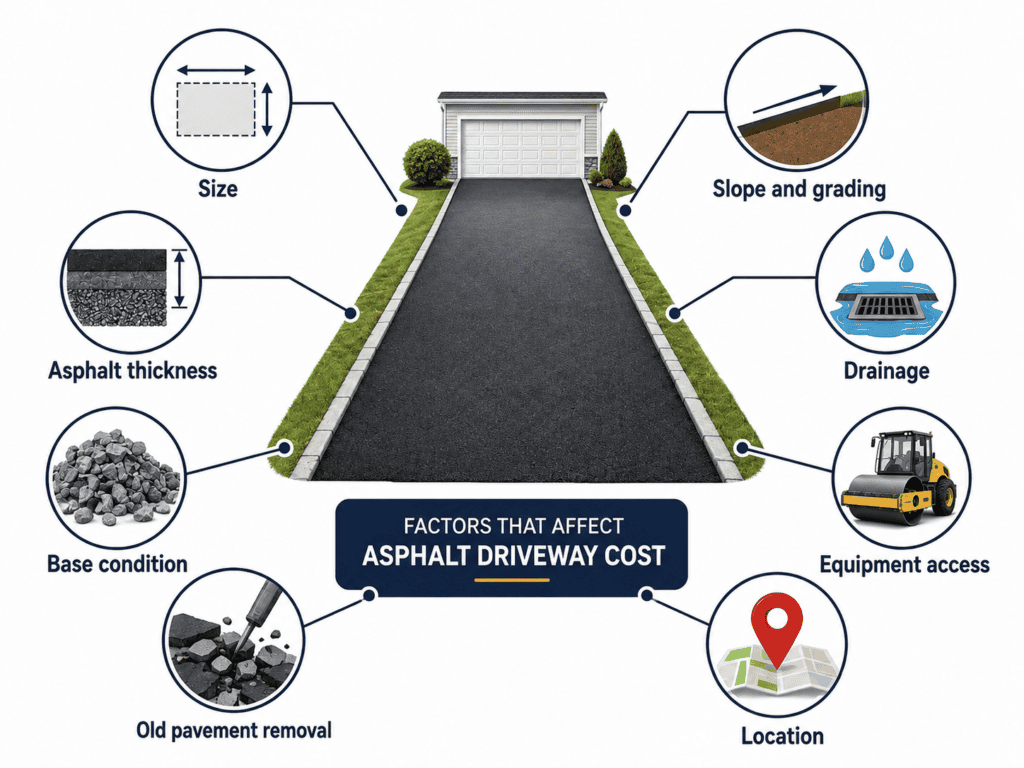
Square footage determines how much pavement you need. It does not tell you how difficult the pavement will be to build.
These are the factors I would check before trusting an estimate.
Driveway Size
A larger driveway needs more asphalt, aggregate base, labor, and equipment time.
Total cost rises with area, although the cost per square foot can fall on larger projects because mobilization expenses are spread over more pavement.
Asphalt Thickness
More thickness means more asphalt tonnage.
For example, an 800-square-foot driveway paved 3 inches thick contains 50% more asphalt volume than the same driveway paved 2 inches thick.
I would not choose pavement thickness based only on price. The required section depends on the supporting soil, aggregate base, drainage, climate, and vehicle loading.
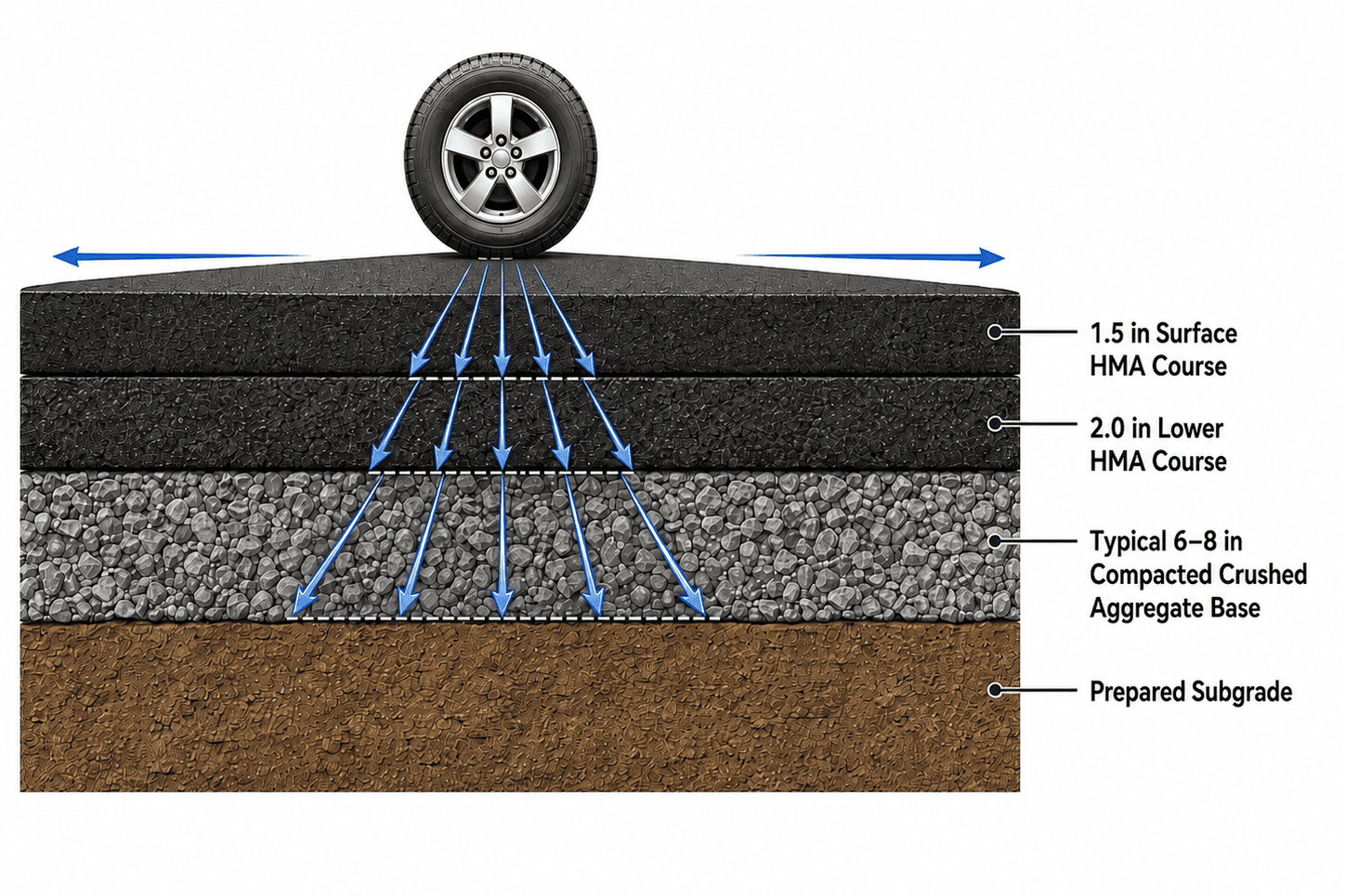
Asphalt Institute driveway guidance shows a residential example with a 2-inch lower HMA course and a 1.5-inch surface course over a compacted aggregate base.
Aggregate Base and Subgrade
This is one of the first things I look at because asphalt does not work by itself.
A driveway is a pavement system.
The asphalt layers distribute load into the aggregate base, which then transfers it into the soil below. If that support is weak or wet, adding a nice new black surface does not fix the underlying problem.
Soft subgrade or poorly compacted base can lead to:
- settlement
- rutting
- depressions
- fatigue cracking
- potholes
- edge failure
Asphalt Institute guidance discusses 6 to 8 inches of crushed aggregate base as a typical residential range in its example, although the actual section should reflect site conditions.
Existing Pavement Removal
Replacement costs more because the existing pavement must be broken up or milled, loaded, hauled away, and disposed of or recycled.
Removing an existing asphalt driveway commonly adds around $1 to $2 per square foot before base repairs and new paving.
Concrete removal can cost more because demolition and hauling are more intensive.
What concerns me more is what becomes visible after the old pavement comes out.
The contractor may find:
- soft soil
- saturated base
- insufficient aggregate depth
- poor compaction
- tree-root damage
- drainage problems
Those conditions can move a replacement project well above a simple square-foot estimate.
Grading and Excavation
A driveway needs the right elevation and profile before asphalt is placed.
Site work may include:
- excavating unsuitable material
- cutting high areas
- filling low areas
- compacting the subgrade
- shaping the driveway crown or cross slope
- creating positive drainage
- matching garage and street elevations
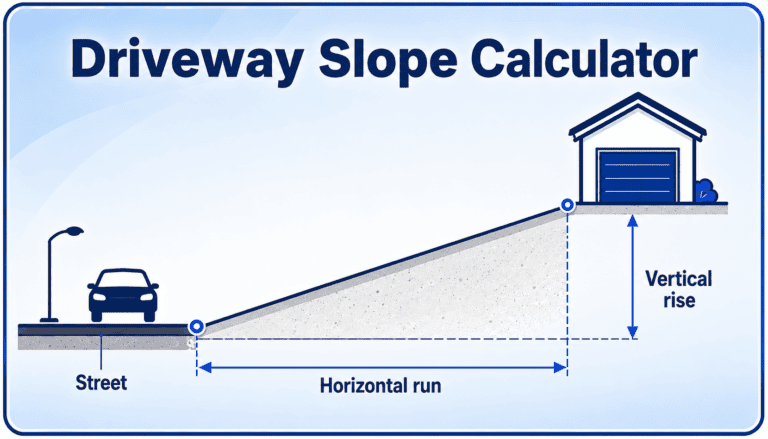
If you are unsure how steep your driveway is, Driveway Slope Calculator calculates percent grade from rise and horizontal distance.
Slope affects more than comfort. It can change drainage, equipment access, pavement transitions, and the amount of grading required.
Driveway Shape
A straight rectangular driveway is usually more efficient to pave than one with tight curves, several parking bays, narrow sections, or irregular boundaries.
Complex geometry requires more handwork and reduces the efficiency of paving and compaction equipment.
Equipment Access
A paving crew needs space.
Dump trucks must reach the paver. Rollers need enough room to compact the asphalt. Restricted access can increase labor even when the driveway itself is not large.
I would expect higher costs where crews have to work around:
- narrow gates
- retaining walls
- landscaping
- buildings
- steep approaches
- limited turning space
Drainage
I would never treat drainage as an optional detail.
Water that sits on the pavement or enters weak areas of the base can shorten driveway life.
NAPA recommends that homeowners make sure the paving contract addresses both site preparation and drainage.
A new surface should send water toward a safe outlet, not toward the garage, foundation, or a low spot in the middle of the driveway.
New Driveway vs Replacement vs Overlay
These are three different paving jobs.
They should not use the same cost model.
New Asphalt Driveway
A new driveway may require excavation, subgrade preparation, grading, aggregate base placement, compaction, and paving.
The site condition often matters as much as the asphalt itself.
A lot that already has a well-compacted gravel driveway is very different from undeveloped soil that needs excavation and drainage work.
Asphalt Driveway Replacement
Replacement adds another construction stage.
The contractor first removes the old pavement, then checks whether the base below can be reused.
For the same basic 800-square-foot driveway used in our asphalt driveway cost calculator example, replacement can move the estimate from approximately:
$5,300–$8,450
to roughly:
$6,250–$10,300
before additional site problems are introduced.
The difference comes from real demolition, hauling, inspection, and repair work.
Asphalt Overlay
An overlay adds a new asphalt layer over an existing pavement.
It makes sense only when the pavement below is suitable.
Asphalt Institute guidance describes roughly 1.5 to 2 inches of surface mix as a typical overlay range in the driveway application it discusses.
Before paving, failed areas and significant defects should be repaired.
I would not recommend treating an overlay as a way to hide a failed base. If the pavement is moving because the underlying support has failed, that movement will eventually show through the new surface.
Our calculator reflects this distinction. It does not allow an overlay over bare soil, and it rejects an overlay when the user selects full base replacement.
How Much Asphalt Does My Driveway Need?
The physical quantity starts with three measurements:
Length
Width
Compacted asphalt thickness
For a rectangular driveway:
Driveway area = Length × Width
Then:
Asphalt volume = Area × Compacted thickness
The calculator converts that volume to weight using a compacted HMA density and adds a small quantity allowance.
Asphalt Tons by Driveway Size
The following table uses the calculator’s default 145 lb/ft³ compacted density and 5% quantity allowance.
| Driveway area | 2 in HMA | 3 in HMA | 4 in HMA |
|---|---|---|---|
| 400 sq ft | 5.1 tons | 7.6 tons | 10.2 tons |
| 600 sq ft | 7.6 tons | 11.4 tons | 15.2 tons |
| 800 sq ft | 10.2 tons | 15.2 tons | 20.3 tons |
| 1,000 sq ft | 12.7 tons | 19.0 tons | 25.4 tons |
| 1,500 sq ft | 19.0 tons | 28.5 tons | 38.1 tons |
This is one reason thickness has such a visible effect on price.
Moving from 2 inches to 4 inches nearly doubles the asphalt quantity.
Do not use this table to select a pavement thickness. Use it to understand the material consequence after the pavement section has been chosen.
Worked Example: 20 × 40 ft Asphalt Driveway
Consider a straightforward new residential driveway with:
- Length: 40 ft
- Width: 20 ft
- Area: 800 sq ft
- Compacted HMA thickness: 3 in
- Some base preparation
- Minimal grading
- Flat site
- Simple shape
- Easy equipment access
- No additional drainage work
The driveway area is:
40 × 20 = 800 sq ft
Using the calculator’s default compacted density and quantity allowance gives approximately:
15.2 tons of HMA
For U.S.-average pricing conditions, the estimated installed cost is approximately:
$5,300 to $8,450
That works out to roughly:
$6.60 to $10.55 per square foot
I would use that number as a budget benchmark, not as the amount a contractor must charge.
If the contractor discovers a weak base, needs to remove old pavement, has poor equipment access, or must correct drainage, the project scope has changed.
The price should change with it.
How Our Asphalt Driveway Cost Calculator Works
Many driveway calculators take the area and multiply it by one national square-foot price.
Ours does not.
The calculator first estimates the physical HMA quantity from:
- driveway area
- compacted asphalt thickness
- compacted density
- quantity allowance
It then estimates separate project components:
- HMA material allowance
- paving labor and equipment
- aggregate base preparation
- grading and excavation
- existing pavement removal
- drainage work
- site complexity
Slope, driveway geometry, and equipment access affect the labor-intensive portions of the estimate.
Small projects also receive a contractor minimum because mobilizing paving equipment and a crew costs money even when the paved area is small.
How the State Adjustment Works
Construction prices vary across the country, so selecting a state changes the result.
The calculator uses U.S. Bureau of Economic Analysis Regional Price Parities (BEA) as a broad geographic price signal.
I did not apply one cost-of-living multiplier to the entire project.
That would be too crude.
Instead, the calculator treats material-sensitive and labor-sensitive costs separately. Asphalt material follows the state goods price signal more closely, while paving labor, grading, and removal use a labor and service-oriented adjustment.
Base work and drainage use blended factors.
This is still a planning model. A state is a large geographic area, and an asphalt plant 10 miles from a project can produce a different quote from one 70 miles away.
Local contractor workload, fuel, trucking, season, and metro labor rates also matter.
How I Check an Asphalt Driveway Quote
When I compare paving quotes, I do not start with the total price.
I start with the pavement section.
A quote that simply says:
“Install 3-inch asphalt driveway”
leaves too many questions unanswered.
1. Is the asphalt thickness compacted?
This should be clear.
Asphalt loses thickness during compaction. I want to know the final compacted pavement thickness, not an ambiguous loose placement depth.
2. What base is included?
The quote should state:
- aggregate type
- base thickness
- whether existing base is reused
- whether weak material will be removed
- how the base will be compacted
A low quote can quickly become expensive if base work is excluded.
3. What happens if soft soil is found?
This is especially important on replacement projects.
The contractor should explain how unsuitable subgrade or failed base areas will be handled and whether that work is included or priced separately.
4. Is old pavement removal included?
Ask about:
- demolition
- loading
- hauling
- disposal or recycling
Do not assume those items are included.
5. Where will the water go?
I want to understand the finished drainage path before paving starts.
The contractor should establish positive drainage without creating a problem at the garage, sidewalk, neighboring property, or foundation.
6. How will the driveway meet the garage and road?
Transitions matter.
A poorly planned transition can create scraping problems for low vehicles or leave an abrupt pavement edge.
7. What exactly does the warranty cover?
Get it in writing.
NAPA recommends written bids and clear contract information covering pavement thickness, site preparation, drainage, and warranty responsibilities.
Asphalt vs Concrete Driveway Cost
Asphalt normally has a lower initial installed cost than concrete, although the better choice depends on more than price.
| Factor | Asphalt | Concrete |
|---|---|---|
| Initial installed cost | Usually lower | Usually higher |
| Pavement behavior | Flexible | Rigid |
| Common rehabilitation | Patching or overlay | Crack, joint, or slab repair |
| Decorative options | More limited | More extensive |
| Time before use | Usually shorter | Requires curing |
| Typical maintenance | Crack repair and surface maintenance | Joint and crack maintenance |
For a project-specific concrete estimate, use our Concrete Driveway Cost Calculator.
If you want to understand why the two pavement systems behave differently under wheel loads, our Asphalt vs Concrete Roads guide explains the difference between flexible asphalt pavement and rigid concrete pavement.
For a residential driveway, I would compare:
- local contractor pricing
- soil conditions
- drainage
- climate
- expected vehicle loads
- maintenance
- appearance
- contractor quality
If you are also considering a lower-cost stone-textured surface, compare the price with our tar and chip driveway cost calculator. It estimates single and double chip seal separately from base preparation and other project costs..
Should You Resurface or Replace Your Asphalt Driveway?
Resurfacing can be a good option when the supporting pavement remains stable.
I would consider an overlay when:
- the base appears sound
- settlement is limited
- damage is mainly at the surface
- isolated failed areas can be repaired
- drainage can be corrected
- there is room for the additional pavement thickness
Replacement becomes more likely when I see:
- widespread alligator cracking
- repeated potholes
- major settlement
- severe rutting
- widespread base failure
- drainage-related movement
- extensive deformation
If the main problem is settlement rather than widespread pavement failure, full replacement may not be the first option to consider.
For sunken or uneven driveway sections, use our Driveway Leveling Cost Calculator to compare leveling methods and typical repair costs.
Bottom Line
For a quick budget, about $7 to $13 per square foot is a useful starting point for a new residential asphalt driveway.
For a real project, I would look deeper.
The driveway area tells you how large the job is. The subgrade, aggregate base, drainage, compacted asphalt thickness, removal requirements, and site access tell you how difficult it is to build correctly.
Use the calculator above to establish a realistic planning range and asphalt quantity.
Then compare contractor quotes based on the work included, not just the final number.
FAQs
How much does an asphalt driveway cost per square foot?
A new residential asphalt driveway commonly costs about $7 to $13 per square foot. Replacement projects often cost more because old pavement removal and base repairs may be required.
How much does a 20 × 40 asphalt driveway cost?
A 20 × 40 driveway contains 800 square feet. Under straightforward conditions, our calculator estimates approximately $5,300 to $8,450 for a new 3-inch HMA driveway using U.S.-average pricing assumptions.
How much asphalt do I need for an 800-square-foot driveway?
At 3 inches compacted thickness, our calculator estimates approximately 15.2 tons of hot-mix asphalt using a 145 lb/ft³ compacted density and 5% quantity allowance.
How many square feet does one ton of asphalt cover?
Using the calculator’s default density and allowance, one ton covers approximately:
79 sq ft at 2 inches
53 sq ft at 3 inches
39 sq ft at 4 inches
Actual mixture density can vary.
Is 2 inches of asphalt enough for a driveway?
There is no universal thickness that works for every driveway.
Subgrade support, aggregate base, drainage, climate, vehicle loading, and mixture design all matter. Asphalt Institute residential guidance includes an example using a 2-inch lower HMA course and 1.5-inch surface course over an aggregate base.
How thick should an asphalt overlay be?
Asphalt Institute driveway guidance discusses roughly 1.5 to 2 inches for a typical surface overlay where the existing pavement is suitable.
Failed areas should be repaired before overlaying.
Is resurfacing cheaper than replacing an asphalt driveway?
Usually.
Resurfacing avoids complete pavement removal and major reconstruction. It only makes sense when the existing pavement and supporting structure remain suitable.
Why is my estimate higher than the average asphalt cost?
Common reasons include:
existing pavement removal
base reconstruction
significant grading
steep slope
difficult equipment access
complex geometry
drainage work
greater pavement thickness
a small project subject to contractor minimums
Is blacktop the same as asphalt?
For residential driveways, homeowners commonly use blacktop and asphalt to describe asphalt pavement.
The actual asphalt mixture, aggregate, binder, layer thickness, and construction method can still vary from one project to another.