Foundation Repair Cost Calculator (2026 Estimate)
Use this foundation repair cost calculator to estimate the cost of foundation cracks, piers, bowing wall repairs, slab lifting, crawl space supports, drainage, and other common foundation work.
You can start with the problem you see or enter the repair method and quantity from a contractor quote.
Updated September 2026 | U.S. pricing | 50-state cost model
Foundation Repair Cost Calculator
Estimate a 2026 U.S. planning range by repair scope, quantity and region. Use symptom mode if you do not yet know the repair method, or scope mode if you already have an inspection or contractor proposal.
What do you know about the repair?
Choose the path that matches the information you have today.
What problem are you seeing?
This selects a broad cost category only. It does not decide which structural repair is appropriate.
Enter the repair method and quantity
The calculator prices the work by the unit commonly used for that repair.
Adjust the project conditions
Keep the defaults if you only want a planning estimate. Open Advanced Options when you know more about the scope.
Advanced quote options
Cost breakdown
| Component | Planning range |
|---|---|
| Base repair | — |
| Estimated total | $0 – $0 |
Compare a contractor quote
Enter the total quoted amount. The calculator compares the price band only; it does not judge whether the contractor’s repair design is appropriate.
Use your estimate as a planning range, then call (888) 664-3492 now to discuss your project with a local foundation repair professional.
Call Now: (888) 664-3492Foundation Repair Cost in 2026
Many foundation repair projects fall around $2,200 to $8,100 in 2026, based on current national consumer cost data. A limited crack repair can cost less than $1,000, while piering, bowing-wall stabilization, major waterproofing, or underpinning can exceed $20,000.
A single cost-per-square-foot number does not work well for most foundation repairs. Repair method and quantity matter more.
| Repair method | 2026 planning cost |
|---|---|
| Polyurethane crack injection | $350 to $900 per crack |
| Epoxy crack injection | $500 to $1,500 per crack |
| Push piers | $1,250 to $3,000 per pier |
| Helical piers | $2,000 to $4,000 per pier |
| Carbon fiber straps | $400 to $900 per strap |
| Wall anchors | $400 to $1,000 per anchor |
| Steel wall braces | $500 to $1,200 per brace |
| Mudjacking | $3 to $8 per sq. ft. |
| Polyurethane foam lifting | $5 to $25 per sq. ft. |
| Crawl space support jacks | $250 to $800 per support |
| Exterior foundation drainage | $30 to $90 per linear ft. |
Pricing basis: CED cross-checked the repair-unit ranges against current U.S. cost data, then calibrated the calculator against our Foundation Repair Cost by State model.
These are planning ranges, not contractor bids. Pier depth, access, engineering, permits, and restoration can change the final price.
How to Use the Foundation Repair Cost Calculator
The calculator has two modes.
1. If You Do Not Know the Repair Method
Choose the problem you can see, such as a crack in foundation, settlement, a bowing wall, a sunken slab, a crawl space problem, or water intrusion.
Then select your foundation type, state, apparent scope, and access conditions.
The result is a preliminary planning range.
A visible symptom helps define the problem being estimated. It does not provide a structural diagnosis or determine whether your house needs piers.
2. If You Already Have a Repair Scope
Use the known-scope option when a contractor or engineer has already specified the work.
For example, enter 6 helical piers, 4 wall anchors, 300 square feet of foam lifting, or 80 linear feet of foundation drainage.
This mode produces a tighter estimate because the calculator knows both the repair method and quantity.
Foundation Repair Cost by Repair Method
This sections lists the common foundation repair solutions and modeled costs.
Foundation Crack Repair
A stable foundation crack can be one of the least expensive repairs.
Polyurethane injection is commonly used where water sealing is important. Epoxy may be used where bonding across a mostly dry crack forms part of the repair.
Injection alone does not correct active settlement or a wall that continues to move.
The calculator uses about $350 to $900 per crack for polyurethane injection and $500 to $1,500 for epoxy injection.
Push Pier Cost
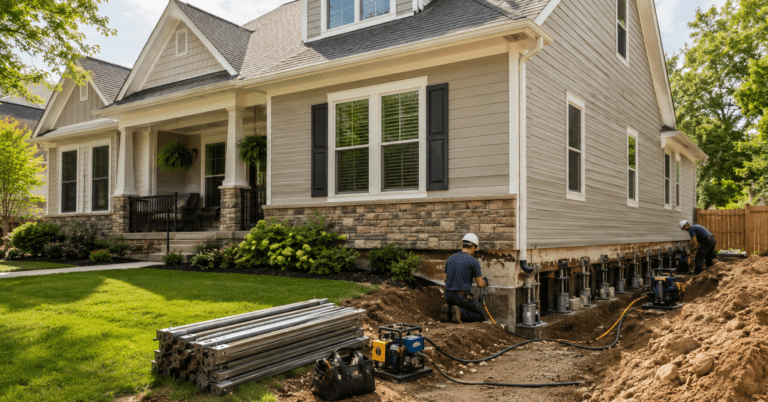
Push piers stabilize parts of a foundation affected by settlement.
Contractors install several piers along the affected section rather than pricing the repair by total house area.
The calculator uses $1,250 to $3,000 per push pier before state and site adjustments. Pier count usually drives the total, while depth, access, lifting, engineering, and restoration can add cost.
Helical Pier Cost
Helical piers are also used for foundation stabilization and underpinning.
The calculator uses $2,000 to $4,000 per pier.
Do not estimate pier count from crack size or house area. Pier location, depth, capacity, ground conditions, and structural loads all matter.
Diagram below shows difference between helical and push piers.
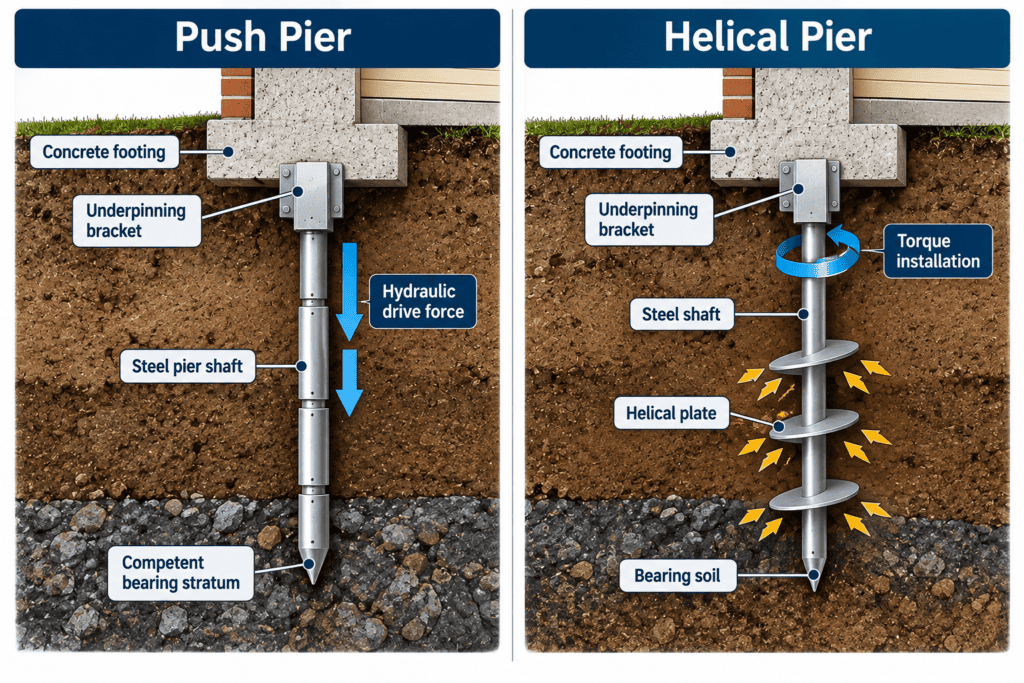
For more detail on deeper support systems, see Foundation Pilings and Deep Foundation Types.
Bowing Basement Wall Repair
Bowing basement walls may be stabilized with carbon fiber straps, wall anchors, or steel braces.
The calculator uses $400 to $900 per carbon fiber strap, $400 to $1,000 per wall anchor, and $500 to $1,200 per steel brace.
The correct system depends on the wall condition and movement. Carbon fiber can stabilize an appropriate wall, but it cannot lift a settled footing or correct foundation settlement.
See Carbon Fiber Foundation Repair for more detail.
Concrete Slab Leveling
Mudjacking and polyurethane foam can lift some settled concrete slabs.
The calculator uses about $3 to $8 per square foot for mudjacking and $5 to $25 per square foot for polyurethane lifting.
Small projects also have minimum service charges, which the calculator accounts for.
If the slab is part of the house foundation, see Concrete Slab Foundation Repair before treating it like a settled sidewalk or patio.
Crawl Space Foundation Repair
Crawl space repairs can involve support posts, beams, joists, piers, moisture control, or several repairs together.
A new support jack does not account for rotten framing or exterior settlement. Known support-jack scopes are priced per support, while broader crawl space problems receive a wider range.
See Pier and Beam Foundation Repair for raised-floor and support-system repairs.
Foundation Drainage and Waterproofing
Water-related work can range from a perimeter drain to full exterior excavation and waterproofing. The calculator separates exterior drainage, interior drain tile, and exterior excavation so the estimate reflects the actual scope.
Foundation Repair Cost by Foundation Type
Foundation type affects access and available repair methods, but it should not replace a repair-specific estimate.
| Foundation type | Common cost drivers |
|---|---|
| Slab-on-grade | Piers, slab lifting, drainage, plumbing access |
| Basement | Wall stabilization, cracks, waterproofing, piers |
| Crawl space | Supports, beams, moisture, limited access |
| Pier and beam | Piers, beams, joists, leveling, moisture |
A 2,000-square-foot slab house that needs two piers should not be priced the same way as a 2,000-square-foot basement with a bowing wall.
What Changes Foundation Repair Cost?
Following variables usually control foundation repair cost:
- Repair quantity usually has the clearest effect. Twelve piers cost more than four.
- Access changes labor and equipment needs. Tight side yards, low crawl spaces, finished basements, patios, and buried utilities can make the same repair harder to complete.
- Pier depth and ground conditions affect underpinning work. An online calculator cannot know the final installation depth.
- Engineering and permits may sit outside the contractor’s base price. The calculator lets you add these separately instead of assuming every quote includes them.
- Drainage can become a separate project when water contributes to soil movement or basement pressure.
- Restoration may also be excluded. Drywall, flooring, concrete replacement, landscaping, and paint can add cost after the structural work ends.
Foundation Repair Cost by State
Foundation repair prices vary across the United States.
CED does not use one blanket multiplier for the South, Midwest, Northeast, or West. Each state has its own low, typical, and high planning benchmark.
The model gives the greatest weight to construction labor and regional price levels, then accounts for construction demand, soil and foundation risk, and climate or access conditions.
For example, the CED dataset uses typical project benchmarks of about $15,000 in California, $13,000 in Massachusetts, $9,500 in Illinois, and $9,000 in Florida.
These are state planning benchmarks, not fixed contractor prices.
For a local example, see our guide to foundation repair in Lebanon, TN, which covers local soil and limestone conditions, warning signs, repair options, and permit considerations.
How the CED Foundation Repair Calculator Works
The calculator uses two calculation methods.
For a known repair scope, it starts with:
Quantity × repair-specific unit cost
It then applies a moderated state price adjustment and the selected access condition. Engineering, soil testing, permits, drainage, and restoration are added only when selected.
We moderate the state adjustment because the full CED state model already includes soil risk and repair complexity. Applying the full factor again could count part of the same risk twice.
For a preliminary problem estimate, the calculator uses the broader CED project ranges because the repair method and quantity remain unknown.
There is no official U.S. database containing installed residential foundation repair prices for every state and repair method. CED therefore presents these values as modeled planning ranges, not guaranteed local quotes.
Foundation Repair Cost Examples
Six Helical Piers
At $2,000 to $4,000 per pier:
6 × $2,000 to $4,000 = $12,000 to $24,000
Engineering, permits, difficult access, lifting, drainage, or restoration may increase the total.
Four Wall Anchors
At $400 to $1,000 per anchor:
4 × $400 to $1,000 = $1,600 to $4,000
The calculator then adjusts the planning range for the selected state and project conditions.
How to Compare a Foundation Repair Quote
Compare the repair scope before comparing the total.
| Check | What should be clear |
|---|---|
| Diagnosis | What is moving, cracking, leaking, or bowing? |
| Repair goal | Is the work stabilizing, lifting, sealing, draining, or rebuilding? |
| Repair method | What exactly will be installed? |
| Quantity | Number of piers, anchors, cracks, supports, or linear feet |
| Engineering | Included or separate? |
| Permits | Included or separate? |
| Drainage | Included where relevant? |
| Restoration | Concrete, flooring, drywall, or landscaping included? |
| Warranty | What is covered and what is excluded? |
A $14,000 quote for six piers is not directly comparable with a $20,000 quote for eight piers plus drainage and engineering.
Stabilization and lifting are not the same promise. A proposal should state whether the contractor intends only to stop further movement or also plans to recover elevation.
Read the warranty exclusions as carefully as the warranty length. Soil movement, drainage problems, plumbing leaks, ownership transfer, or work performed by others may affect coverage.
Use the quote comparison section in the calculator after entering the repair scope.
When to Get an Independent Structural Engineer
Consider an independent structural engineer when movement is substantial, contractors disagree about the cause, a wall has moved significantly, a large underpinning project is proposed, or you receive expensive but conflicting repair scopes.
For major structural movement or an unclear high-cost repair, an independent opinion can help separate diagnosis from sales.
Sources and Methodology
CED cross-checked repair-unit pricing against current 2026 U.S. consumer cost data and contractor-market pricing. The resulting planning ranges include about $2,200 to $8,100 for many foundation repair projects, $2,000 to $4,000 per helical pier, $250 to $800 per non-structural crack, and $400 to $700 per wall anchor. These figures are used as market checks rather than fixed national prices.
State adjustments come from CED’s 50-state model. The model uses BLS Occupational Employment and Wage Statistics for construction labor, BEA Regional Price Parities for differences in state price levels, and the U.S. Census Bureau Building Permits Survey for residential construction activity. Soil and site context are informed by the USDA NRCS Web Soil Survey, while climate conditions use NOAA U.S. Climate Normals. Bureau of Labor Statistics
Technical references include 2024 International Residential Code Chapter 4: Foundations and ACI CODE-562-25: Assessment, Repair, and Rehabilitation of Existing Concrete Structures. These references support the engineering context of foundation assessment, soils, drainage, structural repair, and design.
These values are planning ranges, not contractor quotes. Site inspection findings, local labor and factors such access, exclusions, engineering, permits, drainage etc can change the final project cost.
FAQs
How much does foundation repair cost?
Many foundation repair projects fall around $2,200 to $8,100. Limited crack work can cost less, while piering, wall stabilization, major drainage work, or underpinning can exceed $20,000.
How much does one foundation pier cost?
The calculator uses approximately $1,250 to $3,000 for a push pier and $2,000 to $4,000 for a helical pier before project-specific adjustments.
How many piers does my house need?
This calculator does not determine pier count.
The required number and location depend on the structure, loads, movement pattern, ground conditions, and repair system.
Is foundation repair priced per square foot?
Usually not.
Contractors commonly price structural repairs by pier, anchor, strap, support, crack, or linear foot. Slab lifting is one repair where square-foot pricing is useful.
Does foundation repair cost vary by state in US?
Yes.
Labor, contractor markets, local construction costs, access, foundation types, and site conditions vary. The calculator uses CED’s 50-state cost model rather than one national multiplier.
Does homeowners insurance cover foundation repair?
Coverage depends on the cause and policy language.
Gradual settlement, soil movement, and maintenance-related water problems may be treated differently from damage caused by a sudden covered event. Check the policy and confirm coverage with the insurer before assuming the repair will be paid.
Can I live in my house during foundation repair?
Often yes, but it depends on the repair scope, access, utilities, lifting work, and site safety. See Can You Live in a House During Foundation Repair? for a detailed breakdown.
Is this calculator a structural diagnosis?
No.
It is a budgeting tool. It cannot determine soil capacity, pier depth, structural movement, required reinforcement, or the correct repair design from homeowner inputs.