Sod Installation Cost Calculator (2026 Estimate)
Use this sod installation cost calculator to estimate sod quantity, material cost, delivery, labor, and site preparation. For the default 1,000-square-foot lawn, the estimate is $1,310 to $1,810 when the ground is already cleared and properly graded.
Replacing an existing lawn costs more because removal, disposal, grading, or imported soil may be required before the new sod can be laid.
Lawn & Location
Lawn details
Site preparation
Advanced settings
Estimated sod installation cost
| Cost item | Low | High |
|---|---|---|
| Sod | $660 | $660 |
| Delivery | $150 | $150 |
| Installation | $500 | $1,000 |
| Lawn removal | $0 | $0 |
| Grading | $0 | $0 |
| Topsoil | $0 | $0 |
| Other costs | $0 | $0 |
| Estimated total | $1,310 | $1,810 |
Compare a contractor quote
Discuss your lawn size and site preparation with a local landscaping professional.
Call Now: (888) 985-1657How to Use the Sod Installation Cost Calculator
- Enter the lawn area. Use known square footage, length × width, or the diameter of a circular lawn. Exclude paving, buildings, and planting beds.
- Choose the grass type and waste allowance. Then check the sod price and pallet coverage under Advanced settings.
- Select the work required. Add existing-lawn removal, grading, imported topsoil, and access conditions where applicable.
- Adjust the rates if needed. Replace the starting prices with supplier or contractor quotes for a more useful estimate.
Select your state when using the calculator’s baseline labor rates.
If you already have local installation and removal prices, select Use my quoted rates without adjustments. The calculator will stop applying state, market, and access multipliers to those rates. You can find this in step 2 advance settings.
How Much Does Sod Installation Cost per Square Foot?
The default 1,000-square-foot example costs $1.31 to $1.81 per square foot of finished lawn.
That estimate assumes:
- 1,000 sq ft of measured lawn
- 10% extra sod for cutting and waste
- $0.60 per sq ft for sod
- $150 delivery
- $0.50 to $1.00 per sq ft for basic installation
- no old-lawn removal
- no additional grading
- no imported topsoil
The result is an example based on those inputs, not a fixed national sod price.
For this calculator, basic installation means light preparation on soil that is already cleared and properly graded, followed by laying, trimming, and rolling the sod.
Heavy tilling, excavation, drainage work, substantial grading, soil amendments, and lawn removal are separate.
| Price description | What to check |
|---|---|
| Sod only | Grass variety, purchased quantity, and cutting waste |
| Delivered sod | Delivery charge, unloading, and pallet deposits |
| Basic installation | Required condition of the ground before installation |
| Lawn replacement | Removal, hauling, disposal, and preparation |
| Regrading and sod | Earthwork, final elevations, and drainage |
Keeping these items separate matters. A low installation price may assume the yard is already ready for sod, while another quote may include lawn removal and substantial preparation.
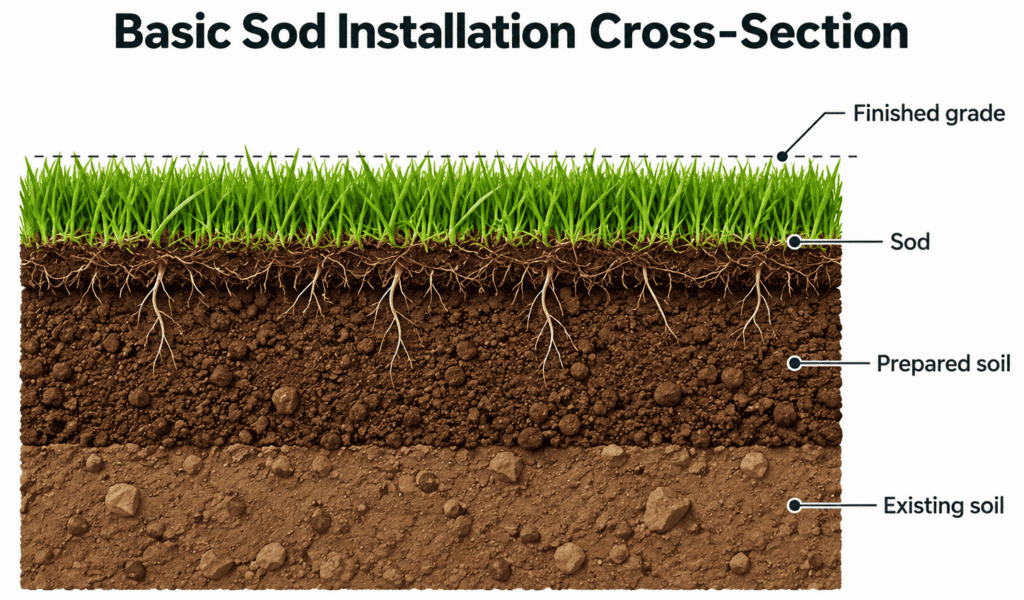
Diagram below show typical cross-section of sod installation.
Sod Installation Labor Cost
The calculator starts with $0.50 to $1.00 per square foot for basic sod installation on cleared, suitably graded soil.
For a 1,000-square-foot lawn, that equals:
1,000 sq ft × $0.50 to $1.00 = $500 to $1,000
Installation labor applies to the measured lawn area, not to unused material left over because of pallet rounding.
Restricted backyard access can increase the labor required. Sod may have to be moved by hand when pallets or equipment cannot reach the installation area.
If you have an actual contractor labor rate, enter it under Advanced settings rather than relying on the calculator’s starting allowance.
Speak with a local landscaping professional about your lawn size, site preparation, and sod installation needs.
Sod Installation Cost by Lawn Size
The examples below use:
- $0.60 per sq ft for sod
- 10% cutting waste
- $150 delivery
- $0.50 to $1.00 per sq ft for basic installation
- no removal, grading, or imported soil
- no state or access adjustment
The calculator defaults to buying the required square footage. The pallet column shows how many 450-square-foot full pallets would be required if a supplier only sells whole pallets.
| Lawn area | Full pallets if required | Sod material | Installed estimate |
|---|---|---|---|
| 200 sq ft | 1 | $132 | $500 minimum |
| 500 sq ft | 2 | $330 | $730 to $980 |
| 1,000 sq ft | 3 | $660 | $1,310 to $1,810 |
| 2,000 sq ft | 5 | $1,320 | $2,470 to $3,470 |
| 5,000 sq ft | 13 | $3,300 | $5,950 to $8,450 |
Small lawns can cost more per square foot because delivery and contractor minimum charges make up a larger part of the project.
If you only need a small repair, ask whether the supplier sells individual rolls, slabs, or pieces before paying for a full pallet.
Measure the Lawn Before Adding Waste
Start with the actual area that will receive sod.
Divide an irregular yard into simple rectangles, triangles, or circles. Calculate each area separately and add the results.
Subtract patios, sidewalks, planting beds, buildings, and other areas that will not receive sod.
For a rectangle:
Area = length × width
For a triangle:
Area = base × perpendicular height ÷ 2
For a circle:
Area = π × radius²
The calculator asks for a circle’s diameter, not its radius.
After measuring the lawn, add an allowance for cutting and fitting.
The calculator provides:
- 5% for simple layouts with few cuts
- 10% for a typical lawn
- 15% for layouts with many curves, narrow strips, or obstacles
Do not use extra sod as a substitute for careful measurement. Check the required quantity with the supplier before ordering a large job.
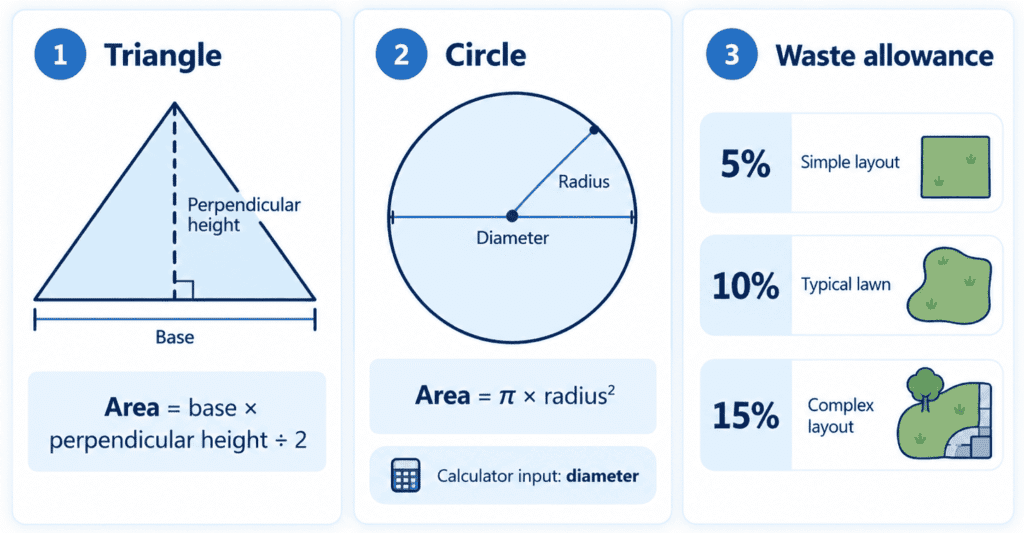
Measure the lawn area first, then add a waste allowance for cuts, curves, and obstacles.Worked Example: 1,000 Square Feet of Sod
Assume a rectangular lawn measuring 40 feet × 25 feet.
The ground is already cleared and graded. Access is easy, and no imported soil is required.
Measured lawn
40 × 25 = 1,000 sq ft
Add 10% waste
1,000 × 1.10 = 1,100 sq ft of sod required
At $0.60 per square foot:
1,100 × $0.60 = $660
Now add delivery and installation.
| Item | Calculation | Cost |
|---|---|---|
| Sod | 1,100 sq ft × $0.60 | $660 |
| Delivery | Entered allowance | $150 |
| Basic installation | 1,000 sq ft × $0.50 to $1.00 | $500 to $1,000 |
| Estimated total | $1,310 to $1,810 |
The $500 professional minimum does not change this estimate because the calculated project cost already exceeds it.
What If the Supplier Requires Full Pallets?
Assume one pallet covers 450 square feet.
The project needs 1,100 square feet:
1,100 ÷ 450 = 2.44 pallets
You cannot buy 2.44 full pallets, so you would need 3 pallets.
Three pallets provide:
3 × 450 = 1,350 sq ft
At $0.60 per square foot, the sod material becomes:
1,350 × $0.60 = $810
The installed estimate increases to approximately $1,460 to $1,960 because you are paying for unused sod on the final pallet.
This is why the calculator separates the sod required from the sod purchase quantity.
Sod Cost per Square Yard and Pallet
Sod may be quoted by the square foot, square yard, pallet, roll, slab, or individual piece.
Convert different quotes to the same unit before comparing suppliers.
One square yard equals:
9 square feet
To convert a square-yard price to a square-foot price:
Price per sq ft = price per sq yd ÷ 9
| Price per sq ft | Equivalent per sq yd |
|---|---|
| $0.40 | $3.60 |
| $0.50 | $4.50 |
| $0.60 | $5.40 |
| $0.75 | $6.75 |
| $1.00 | $9.00 |
A 450-square-foot pallet covers 50 square yards.
At $0.60 per square foot:
450 × $0.60 = $270 of sod per pallet
If a supplier quotes $300 for a pallet covering 500 square feet:
$300 ÷ 500 = $0.60 per sq ft
Some suppliers sell sod by the roll, slab, or individual piece instead of by the pallet. Use the stated coverage to convert the price to a cost per square foot before comparing it with another supplier.
Pallet coverage varies, so never assume that every pallet contains the same square footage.
Cost to Remove Old Lawn and Resod
Replacing an existing lawn costs more than laying sod on prepared bare soil.
The old turf may need to be cut, removed, loaded, hauled away, and disposed of before the new lawn can be prepared.
The calculator starts with an editable lawn-removal allowance of:
$0.50 to $2.00 per square foot
For a 1,000-square-foot lawn:
Removal allowance = $500 to $2,000
Adding that to the default installation example increases the estimate from $1,310 to $1,810 to approximately:
$1,810 to $3,810
That still assumes no additional grading or imported soil.
Before accepting a removal quote, confirm whether it includes:
- cutting or stripping the old turf
- loading
- hauling
- disposal fees
Do not add a separate disposal charge if it is already included in the removal rate.
Grading and Drainage Before Sod
Sod should follow the finished ground surface. It will not correct a low spot, reverse a poor slope, or provide an outlet for trapped water.
Minor finish grading may only require reshaping the upper surface.
Major grading can involve excavation, imported fill, or moving substantial quantities of soil.
I would fix standing water before ordering new sod. Covering a drainage problem with fresh grass does not solve the drainage problem.
For lawn areas beside a driveway, check the direction of runoff before changing the finished ground level. Our driveway slope calculator can convert measured rise and run into a grade percentage.
If the lawn meets a retaining wall, keep drainage outlets clear and review the retaining wall drainage details before changing the surrounding ground level.
The grading inputs in this calculator are planning allowances only. They do not price a drainage system.
Does New Sod Need Topsoil?
Not every sod project needs imported topsoil.
First check the condition of the existing soil and the final elevation you need to maintain beside sidewalks, driveways, patios, and other fixed surfaces.
Where soil improvement is required, University of Minnesota Extension recommends soil testing and following the resulting recommendations.
The calculator converts a selected topsoil depth into cubic yards.
Use:
Cubic yards = lawn area in sq ft × soil depth in inches ÷ 324
For 1 inch over 1,000 square feet:
1,000 × 1 ÷ 324 = 3.09 cubic yards
At $35 per cubic yard:
3.09 × $35 = approximately $108 for the soil material
That does not automatically include trucking or spreading.
Account for the thickness of the sod when setting the final soil elevation as shown in diagram below. Avoid leaving the finished lawn above an adjacent sidewalk or driveway where it can hold runoff on the pavement.
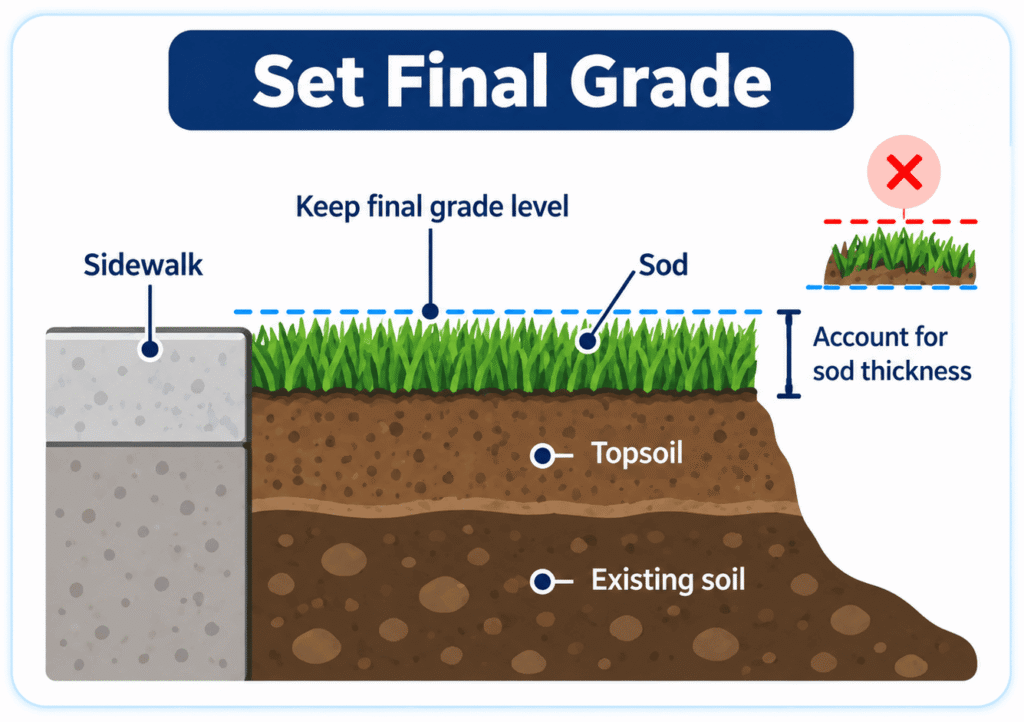
Set the soil low enough to account for sod thickness and keep the finished lawn level with adjacent pavement.Delivery and Site Access
Sod is heavy and bulky, so access affects how easily a crew can move material from the delivery point to the lawn.
Check:
- gate width
- distance from the street or driveway
- stairs
- fences
- narrow side yards
- steep slopes
- obstacles that prevent equipment access
The calculator provides modest 5% and 10% access adjustments for planning.
If a contractor gives you a specific carrying or access charge, enter that amount instead of relying on a percentage.
Keep soil delivery and soil spreading separate unless your topsoil quote explicitly includes them.
Sod Prices by Grass Type
Grass type affects the material price, but the lowest-priced sod is not automatically the best choice for a property.
The calculator uses the following editable starting prices:
| Sod type | Starting price per sq ft |
|---|---|
| Bahia | $0.40 |
| Bermuda | $0.50 |
| Centipede | $0.50 |
| Tall fescue | $0.60 |
| Kentucky bluegrass | $0.60 |
| St. Augustine | $0.65 |
| Zoysia | $0.75 |
These are calculator inputs, not fixed national prices.
Actual supplier pricing can change with cultivar, order size, location, and availability.
Choose a grass that suits the site first. Then replace the calculator’s starting material rate with the actual supplier price.
How Location Changes Sod Installation Cost
Location affects labor prices, but that does not mean every part of a sod project should receive the same geographic multiplier.
This calculator does not multiply the entire estimate by a state cost factor.
When you select a state, the tool adjusts installation and existing-lawn-removal labor using the state’s median landscaping-worker wage relative to the U.S. median.
The state factor uses 2025 wage data for Landscaping and Groundskeeping Workers, published through O*NET using Bureau of Labor Statistics data.
That occupation includes sod-laying work.
The U.S. median used by the calculator is $18.82 per hour.
The state adjustment applies to installation and lawn-removal labor.
It does not adjust:
- sod material
- delivery
- imported topsoil
- grading
A landscaping wage is a labor-cost proxy, not a contractor billing rate.
Local overhead, demand, equipment, insurance, and project conditions can still change a contractor’s price.
If you already have local rates, enter them directly and select Use my quoted rates without adjustments in step 2 advance settings of calculator input.
DIY Sod Installation vs. Professional Installation
In the 1,000-square-foot worked example, sod and delivery total:
$660 + $150 = $810
That is the starting material and delivery cost before equipment, disposal, soil work, or other DIY expenses.
DIY mode removes paid installation, lawn removal, professional grading, and the contractor minimum from the calculator.
It does not automatically price:
- sod cutters
- tillers
- rollers
- wheelbarrows
- disposal
- fertilizer
- soil testing
- irrigation work
- hired equipment
- taxes
- your own time
Add costs that apply to your project under Other project costs.
Finish the preparation before the sod is delivered. Fresh sod should not sit unused because excavation, grading, or another part of the site is still incomplete.
Calculator Methodology
The calculator starts with the measured lawn area and adds the selected waste allowance.
In the default square-foot purchase mode:
Purchased sod = measured area × (1 + waste allowance)
If you select full-pallet purchasing, the calculator divides the required quantity by the entered pallet coverage and rounds up to the next whole pallet.
Installation, lawn removal, and grading use the measured lawn area.
They do not use unused material created by pallet rounding.
The calculator uses editable baseline allowances of:
- $0.50 to $1.00 per sq ft for basic installation
- $0.50 to $2.00 per sq ft for lawn removal and disposal
- separate editable ranges for selected grading
- $150 for delivery
- $500 as the default professional project minimum
These are planning assumptions, not fixed national prices.
The professional minimum acts as a floor. It is not an extra $500 charge added on top of every project.
For example, if a calculated professional project totals $420 and the minimum is $500, the result becomes $500.
If the calculated project totals $1,500, the minimum adds nothing.
The low and high results represent two cost scenarios based on the entered ranges. They are not statistical confidence intervals.
Before You Accept a Sod Installation Quote
Compare contractors using the same project scope.
Ask each contractor to identify:
- measured lawn area
- sod variety
- quantity supplied
- waste allowance
- delivery
- old-lawn removal
- disposal
- grading
- imported soil
- installation
- taxes
- pallet deposits
- initial watering
- exclusions
A price is much easier to compare when you know exactly what work and quantity it covers.
FAQs
How much sod should I order?
Start with the measured lawn area and add a cutting allowance. The calculator uses 5%, 10%, or 15%. A simple rectangular lawn may need less extra material than a yard with curves and obstacles.
Does one pallet of sod cover 500 square feet?
Only if the supplier says it does.
Pallet coverage varies. The calculator starts at 450 square feet per pallet, but you can change that value under Advanced settings.
Is sod sold by the square foot or pallet?
Both are common, depending on the supplier. Sod may also be sold by the roll, slab, or individual piece.
The calculator lets you price the required square footage directly or round the order up to full pallets.
Is seeding cheaper than sod?
Seeding generally has a lower upfront material cost, but it takes longer to establish a lawn.
Both seed and sod still need suitable soil preparation, so compare the complete project rather than the grass material alone.