Basement Waterproofing Cost in 2026: Interior vs Exterior
Basement waterproofing can cost a few hundred dollars for a localized repair to $15,000 or more for a full drainage or exterior waterproofing system.
The price depends mainly on the water problem and the system needed to control it. A leaking wall crack costs far less to fix than excavating an entire foundation and installing exterior drainage.
A realistic estimate depends on foundation perimeter, water source, foundation type, access, and whether the work is done from inside or outside.
Basement Waterproofing Cost at a Glance
Use these as planning ranges, not contractor quotes.
| Method | Typical planning cost | Common use |
|---|---|---|
| Crack injection | $250–$1,500+ per crack | Localized poured-concrete cracks |
| Waterproof coating or sealer | $2–$10 per sq. ft. | Minor dampness or masonry moisture |
| Sump pump installation | $600–$2,500+ | Removing collected groundwater |
| Interior perimeter drain | $4,000–$17,000 | Water at wall-floor joint or below slab |
| Interior drainage | $40–$85 per linear ft. | Partial or full basement perimeter |
| Exterior perimeter drainage | $30–$90 per linear ft. | Groundwater control outside foundation |
| Complete interior system | $6,000–$12,000+ | Drainage, sump and related work |
| Exterior waterproofing | $10,000–$18,000+ | Excavation, membrane and drainage |
These ranges can move substantially. Deep foundations, limited access, finished interiors, structural repairs, landscaping, and regional labor rates all affect the final quote.
How We Estimated These Costs
These are 2026 national planning ranges, compiled from current published pricing for basement waterproofing methods and contractor-installed systems. I use method-specific ranges rather than one national average because crack repair, interior drainage, and exterior excavation are fundamentally different scopes of work.
Actual quotes vary with foundation depth, access, treated perimeter, labor rates, and restoration work.
What Affects Basement Waterproofing Cost?
Waterproofing Method
The method creates the biggest difference in price.
Sealing one crack may take only a few hours. Exterior waterproofing can require excavation to the footing, wall repairs, membrane installation, drainage work, backfilling, and site restoration.
Foundation Perimeter
Many waterproofing systems follow the foundation wall.
A longer or irregular perimeter means more drainage pipe, excavation, membrane, gravel, and labor.
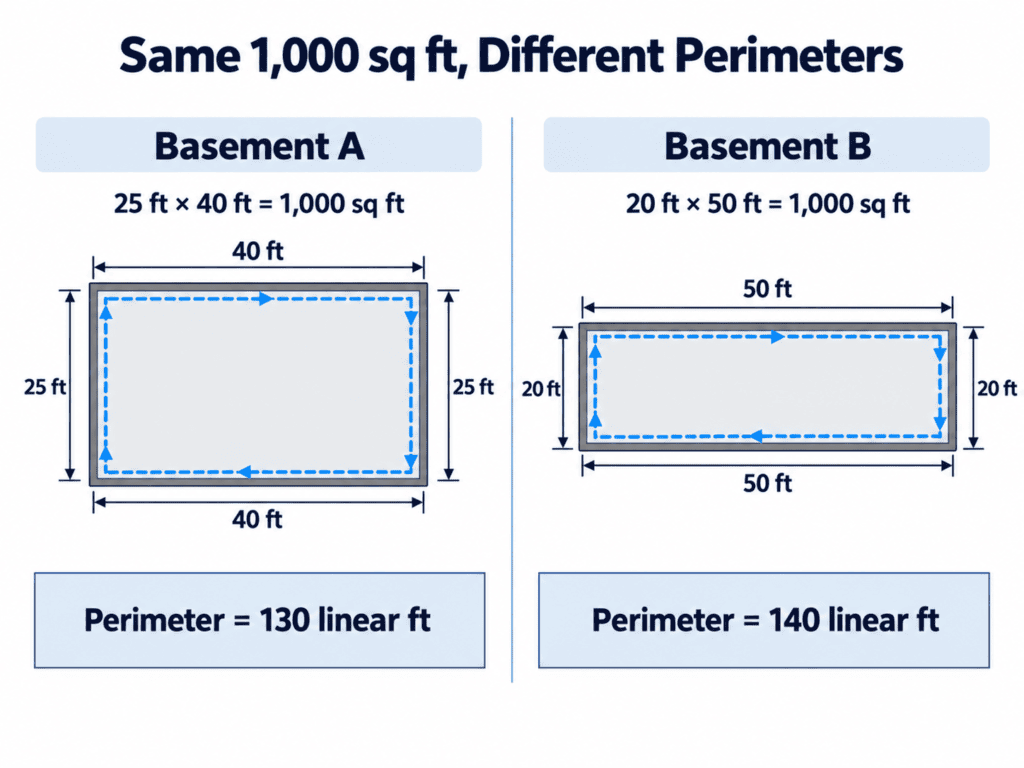
Example: 1,000-Square-Foot Basement
A 25 × 40 ft basement has a perimeter of 130 linear feet.
At roughly $40–$85 per linear foot for interior perimeter drainage, that gives a planning range of about $5,200–$11,050.
That is why square footage alone can be misleading. Another 1,000-sq-ft basement may have a different perimeter and therefore a different drainage cost. The concept is shown in diagram below.
Interior or Exterior Access
Interior work is usually easier to access.
Exterior work becomes more expensive when crews have to work around:
- patios
- decks
- driveways
- utilities
- landscaping
- narrow side yards
Excavation depth also matters.
Foundation Type
Water does not move through every foundation in the same way.
A poured concrete wall may leak through an isolated crack.
A concrete block foundation has mortar joints and hollow cells that can create additional water paths.
Older brick and stone foundations often require more preparation because the wall surface and joints are less uniform.
If your house has a CMU wall, see our concrete block foundation guide.
Foundation Depth
A deeper basement increases excavation work.
The crew has more soil to remove, more wall surface to expose, and a deeper work area to manage safely.
Finished Basement
Interior drainage can become more expensive in a finished basement.
Contractors may need to remove drywall, flooring, baseboards, framing, or built-ins before installing the drainage system.
Those finishes then have to be restored resulting in an expensive job.
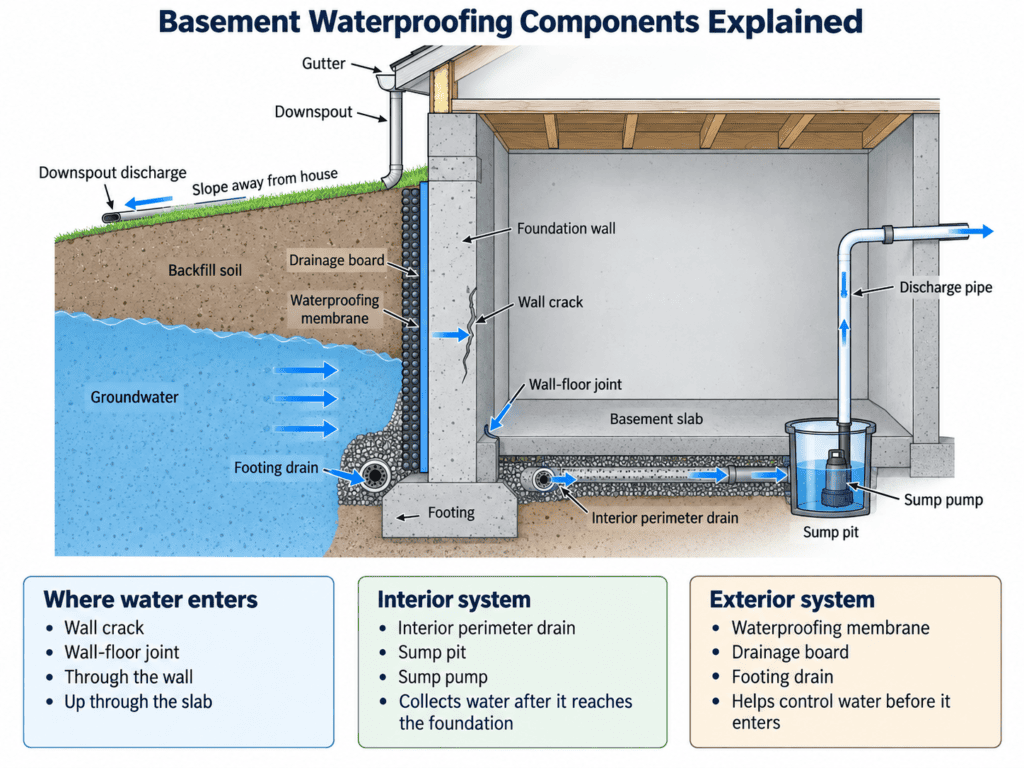
The image below can be useful for homeowners to understand the components of basement that can contribute in overall basement waterproofing cost.
Interior Basement Waterproofing Cost
Interior waterproofing usually costs less than exterior work because it avoids major excavation.
A common interior system includes:
- perimeter drainage
- sump basin
- sump pump
- discharge piping
- wall drainage membrane where needed
The contractor typically removes a strip of slab near the foundation wall, installs drainage below the floor, and routes the collected water to a sump.
Interior drainage does not necessarily stop water from reaching the outside of the foundation.
It collects and removes water after it reaches the foundation area. Interior waterproofing drainage concept is shown in the video below.
Other Interior Basement Waterproofing Methods
Not every basement needs a full perimeter drainage system. Localized leaks or minor dampness may be treated with more targeted methods.
Crack Injection
A localized crack in poured concrete can sometimes be sealed with polyurethane or epoxy injection.
This works when the crack itself is the water path and the wall is otherwise stable.
Do not treat a horizontal crack, bowing wall, or displaced foundation as a simple waterproofing issue.
If the wall itself is cracked or moving, our basement wall crack repair cost guide compares injection, carbon fiber, anchors, braces, and larger structural repairs.
Waterproof Coatings
Waterproof coatings and masonry sealers cost much less than drainage systems.
They can help with minor dampness or moisture moving through masonry.
They are not a reliable fix when groundwater is building pressure behind the wall.
A coating can resist moisture. It cannot remove groundwater.
Exterior Basement Waterproofing Cost
Exterior waterproofing treats the wall from the soil side.
A typical project may include:
- Excavating beside the foundation.
- Cleaning and inspecting the wall.
- Repairing cracks or damaged masonry.
- Applying a waterproofing membrane.
- Installing drainage or protection board.
- Repairing or replacing the footing drain.
- Backfilling.
- Restoring landscaping or hardscape.
Exterior systems usually cost more because excavation and restoration require substantial labor.
Interior vs. Exterior Basement Waterproofing
| Factor | Interior | Exterior |
|---|---|---|
| Excavation | Usually limited | Usually extensive |
| Cost | Usually lower | Usually higher |
| Main function | Collect and remove water | Reduce water reaching wall |
| Site disruption | Low | Can be significant |
| Sump pump | Common | Sometimes required |
| Retrofit difficulty | Usually easier | Depends on exterior access |
| Best fit | Existing basement drainage | Exterior water control |
Exterior waterproofing is not automatically the right choice for every house.
Interior drainage can be much more practical when exterior access is blocked by additions, patios, driveways, or neighboring structures.
Waterproofing, Dampproofing and Drainage Are Different
These terms are often used interchangeably, but they do different jobs.
Dampproofing
Dampproofing limits moisture movement through a below-grade wall under normal soil-moisture conditions.
Waterproofing
Waterproofing provides stronger resistance to liquid water.
The 2024 IRC section R406.2 requires waterproofing where a high water table or other severe soil-water conditions are known to exist.
Drainage
Drainage removes water before it can remain against the foundation or build pressure below the slab.
This is critical.
Building Science Corporation identifies groundwater drainage as one of the main controls for basement moisture. Free-draining backfill, drainage boards, footing drains, and under-slab drainage all help prevent water from accumulating against the foundation.
What Basement Problem Do You Have?
Start with the symptom before choosing a system.
| Symptom | What to investigate | Possible response |
|---|---|---|
| One leaking wall crack | Local crack path | Crack injection or repair |
| Damp wall or efflorescence | Exterior moisture or poor drainage | Improve drainage; wall treatment if appropriate |
| Water at wall-floor joint | Groundwater near footing | Interior perimeter drain and sump |
| Water coming through floor | Water below slab | Sub-slab drainage and sump |
| Water after heavy rain | Runoff, gutters or grading | Improve surface drainage first |
| Several leaking walls | Broader groundwater problem | Interior or exterior drainage |
| Bowing wall or horizontal crack | Structural movement | Structural evaluation first |
Water pressure matters because accumulated groundwater can force water through joints, cracks, and other weak points in a foundation.
When a Cheaper Fix May Work
Check surface drainage before paying for a major waterproofing system.
Look for:
- clogged gutters
- short downspouts
- soil sloping toward the house
- low spots beside the foundation
- patios draining toward the wall
- leaking window wells
- blocked exterior drains
EPA specifically recommends correcting basement moisture problems before finishing or remodeling the space, and notes that some cases can be improved simply by redirecting downspouts or regrading soil away from the foundation.
A drainage correction that costs hundreds of dollars may solve a problem that would otherwise be mistaken for a five-figure waterproofing job.
When Waterproofing Is Not Enough
Waterproofing does not repair structural movement.
Have the wall evaluated before simply sealing it if you see:
- significant horizontal cracking
- inward bowing
- displaced blocks
- widening cracks
- foundation settlement
- visible wall movement
If the wall is already moving, deal with the structural problem first.
Additional Costs That Can Raise the Quote
The waterproofing system may not be the only cost.
Additional work can include:
- foundation crack repair
- structural wall repair
- mold remediation
- drywall removal
- flooring replacement
- sump pump backup
- electrical work
- excavation
- landscaping restoration
- patio or driveway repair
- permits
- discharge piping
Ask contractors to separate these items in the estimate.
That makes competing quotes much easier to compare.
How to Compare Basement Waterproofing Quotes
Do not compare two quotes by price alone.
Ask each contractor to identify:
- where the water is entering
- what is causing it
- how many linear feet are being treated
- whether the system is interior or exterior
- drain location
- discharge location
- sump pump included
- membrane or coating used
- crack repairs included
- excavation included
- restoration included
- electrical work included
- permits included
- warranty terms
- exclusions
A $6,000 quote and a $12,000 quote may describe completely different work.
One contractor may be installing drainage along one wall.
Another may be excavating the entire foundation.
Compare the scope before comparing the price.
Is Basement Waterproofing Worth It?
If water is entering the basement, fix the source before spending money on finishes.
Repeated moisture can damage drywall, flooring, framing, insulation, and stored belongings. Damp basements can also support mold growth. EPA recommends correcting basement moisture before converting or remodeling the space.
The goal is not to buy the most expensive waterproofing system.
The goal is to identify the water path and use the system that controls it.
A coating is poor solution if groundwater pressure makes it fail.
A full perimeter drain is also poor solution if the real problem is a downspout emptying beside the house.
FAQs
How much does it cost to waterproof a 1,000-square-foot basement?
A 1,000-square-foot basement can cost from a few thousand dollars to more than $10,000 to waterproof.
Perimeter length, water source, and waterproofing method usually matter more than floor area alone.
Is interior or exterior basement waterproofing cheaper?
Interior waterproofing is usually cheaper because it avoids deep exterior excavation.
Exterior systems generally cost more because crews must expose the foundation and restore the site afterward.
How much does an interior basement drain cost?
A professional interior perimeter drain is commonly priced by linear foot.
The total also depends on the sump basin, sump pump, discharge piping, slab replacement, and finished-basement restoration.
How much does exterior basement waterproofing cost?
A full exterior waterproofing project can easily reach five figures.
Excavation depth, perimeter length, access, drainage work, and restoration have the largest effect on cost.
Can waterproof paint stop basement leaks?
Waterproof paint can help with minor dampness.
It is not a reliable solution for active groundwater pressure or significant leakage through cracks, joints, or below the slab.
Should I waterproof my basement from inside or outside?
Exterior systems reduce water reaching the foundation wall.
Interior systems collect and remove water from inside and are often easier to retrofit.
The right choice depends on the water source, exterior access, foundation condition, and drainage around the house.