How 2026 Tariffs Are Affecting Concrete, Lumber, and Steel Costs
Updated September 8, 2026
Tariffs are adding significant pressure to U.S. construction costs in 2026, but the effect varies sharply by material.
Steel and lumber have recorded sizable price increases. Ready-mix concrete on the other hand has increased less. New tariffs on Canadian Portland cement and engineered wood products could add further pressure, but the tariff rate itself does not tell us how much a foundation, deck, driveway, or home addition will cost.
For homeowners, the better question is: Which materials in the project are exposed, and how much of the total job do they represent?

Which Building Materials Are Facing Tariffs?
Several trade measures now overlap.
Steel, aluminum, and copper are still covered by Section 232 tariffs, but the rate is not the same for every product. It can vary by material, country of origin, and product type. Some imports face tariffs of up to 50%.
The U.S.-Canada trade dispute added more pressure in August. New 50% tariffs now apply to some Canadian plywood, laminated veneer lumber, fiberboard, and Portland cement. Softwood lumber is not part of this new tariff because it is already covered by separate trade measures.
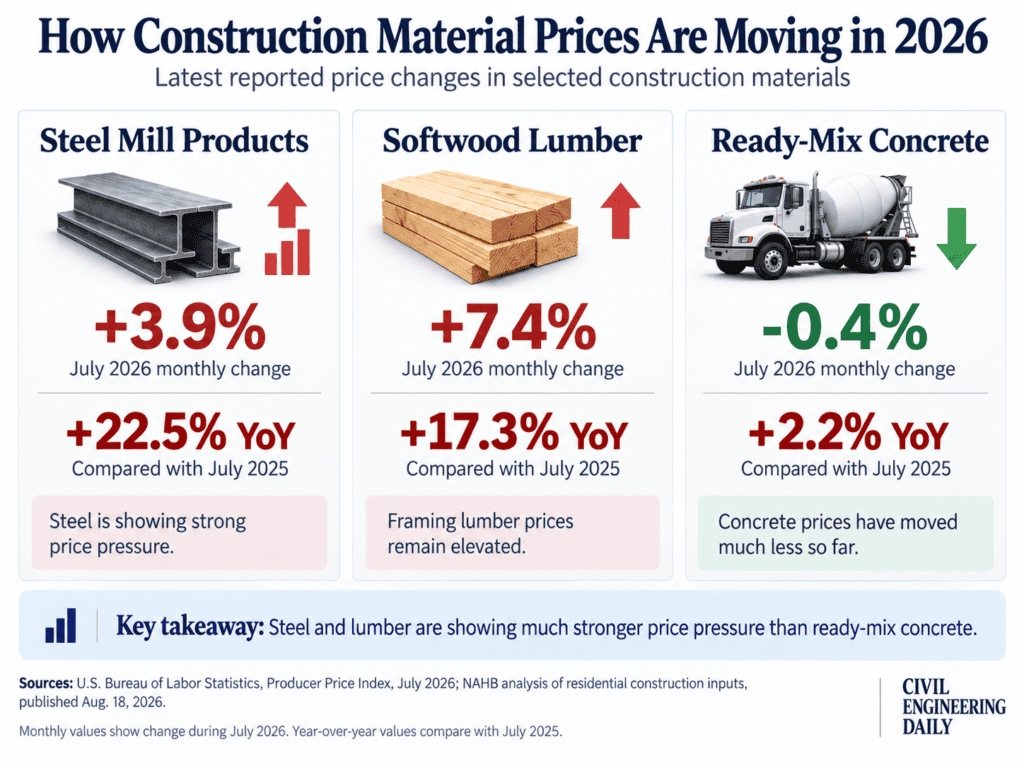
Here is where prices stood in the latest available data:
| Material | Current tariff/trade exposure | Latest verified price movement | Common residential uses |
|---|---|---|---|
| Steel mill products | Section 232 tariffs; rates vary by product/origin | +3.9% in July; +22.5% YoY in July | Rebar, beams, connectors, anchors |
| Softwood lumber | Separate tariff and trade-duty treatment | +7.4% in July; +17.3% YoY | Wall, floor and roof framing, decks |
| Ready-mix concrete | Indirect exposure through cement and reinforcement | −0.4% in July; +2.2% YoY | Foundations, slabs, driveways, walls |
| Portland cement | Certain Canadian imports now face 50% tariffs | Full effect still developing | Concrete, mortar, masonry |
| Plywood / engineered wood | Certain Canadian products face new 50% tariffs | Full effect still developing | Sheathing, LVL beams, headers, subfloors |
BLS reported the 3.9% July increase in steel mill products, while NAHB’s analysis of residential construction inputs found the 7.4% monthly rise in softwood lumber and the much smaller movement in ready-mix concrete.
As you can see metals and lumber prices are the ones most severely hit recently.
Why a 50% Tariff Does Not Mean a 50% Higher Project Cost
A tariff applies to an imported product. A construction estimate includes much more than that product.
Suppose a project costs $30,000, and $3,000 of that price represents a tariff-sensitive material.
If the contractor’s cost for that material rises 20%:
$3,000 × 20% = $600
The project would rise from $30,000 to about $30,600, or roughly 2%, before considering secondary effects.
What the Tariffs Mean for Concrete, Steel, and Lumber
Concrete: Watch Cement and Rebar Separately
For concrete projects, I watch cement and reinforcing steel separately.
NAHB estimates that imported cement accounts for roughly 15% to 20% of the U.S. cement market, and those imports come from several countries. The new 50% tariff applies only to certain Portland cement imported from Canada, not to all cement used in the U.S.
That helps explain why ready-mix concrete prices have moved much less than steel and lumber so far. In July 2026, the national Producer Price Index for ready-mix concrete was only 2.2% higher than a year earlier.
Cement is also only one part of ready-mix concrete. Aggregates, water, admixtures, batching, and delivery all contribute to the final price.
There is also a timing lag. The latest Canadian cement tariffs came after the July price data were collected, so their full effect is not yet visible in the ready-mix index. Any added pressure from cement and steel costs may take time to work through supplier prices and contractor bids.
That is why I would not judge the cost of a reinforced-concrete project from the ready-mix price alone. A footing and stem wall, for example, also requires reinforcing steel, excavation, formwork, drainage, anchors, and labor. See CED’s footing and stem wall foundation guide for how those components fit together.
Steel: The Price Pressure Is Already Visible
Steel has a more direct link to the current cost pressure.
Residential construction uses steel in rebar, beams, lintels, anchors, fasteners, joist hangers, connectors, and manufactured components.
The U.S. Bureau of Labor Statistics reported that steel mill product prices were 22.5% higher in July than a year earlier and rose another 3.9% during the month.
Earlier AGC data showed aluminum mill shapes up 52.4% year over year in June, while copper and brass mill shapes were up 26.0%. AGC identified steep tariffs as one factor pushing metal costs higher.
Steel has moved enough that reinforcement and structural steel deserve attention when comparing new contractor quotes.
For example, a reinforced concrete retaining wall combines concrete and rebar with excavation, drainage, formwork, and backfill. The reinforcement matters, but it is still only one part of the complete system. CED’s retaining wall design guide shows how those components work together structurally.
Lumber: Framing Lumber and Engineered Wood Are Different Markets
“Lumber” is too broad a term for this market.
Dimensional framing lumber, plywood, OSB, LVL, and fiberboard serve different purposes and do not all face the same trade treatment.
A wood-framed house may use dimensional lumber for studs and joists, structural panels for sheathing, and LVL for heavily loaded headers and beams.
The August Canadian action affects plywood and several engineered wood products. Softwood lumber remains under a separate tariff and duty structure.
Softwood lumber prices were already 17.3% higher year over year in July, so contractors are dealing with an elevated market before the full effect of the latest engineered-wood tariffs becomes clear.
Which Home Projects Have the Most Exposure?
Material exposure changes from one project to another.
| Home project | Main tariff-sensitive materials | Relative exposure |
|---|---|---|
| Concrete driveway | Cement through ready-mix | Moderate |
| Reinforced foundation | Concrete + reinforcing steel | High |
| Concrete retaining wall | Concrete + reinforcing steel | High |
| Wood deck | Lumber + metal connectors | High |
| Home addition | Lumber + engineered wood + steel + concrete | Very high |
| Roof framing | Lumber + engineered wood + connectors | Moderate to high |
These are qualitative CED assessments, not predictions of how much each project will increase in price.
A driveway is a good example. It uses a large volume of concrete but usually much less steel than a reinforced foundation. The two projects can therefore react differently even though both involve concrete.
Homeowners pricing new flatwork can use the CED concrete driveway cost calculator to separate concrete, reinforcement, base preparation, demolition, drainage, and labor instead of treating the project as one material cost.
If you are estimating the cost to reconstruct an entire house rather than one material or trade, use our home replacement cost calculator.
What Should Homeowners Do Right Now?
I would not postpone a necessary repair solely because tariffs are in the news.
For a large project, get more than one current quote and check how long each price remains valid.
Ask whether the contract contains a material-escalation clause. If steel, lumber, or another major input rises before construction begins, that clause determines who carries the additional cost.
It is also worth asking whether major materials have already been purchased or will be ordered closer to the start date.
Do not expect a national commodity increase to appear immediately in every local quote. Contractors may have inventory on hand, suppliers may be working under existing agreements, and larger builders may have purchasing arrangements that smaller contractors do not.
The data show some of that lag already.
AGC reported construction input prices 7.1% higher year over year in June, while bid prices for new nonresidential buildings were up only 3.5%. The indexes are not residential project quotes, but the gap shows that contractors do not always pass material inflation through immediately.
What I Am Watching Next
The next few months will tell us more than the headline tariff rates.
I am watching steel mill prices, softwood lumber, engineered wood products, Portland cement imports, and ready-mix concrete.
The newest Canadian tariffs only took effect recently, so their full impact will take time to work through inventories, supplier contracts, and contractor bids.
For homeowners, what really matters is the price the contractor pays for the materials, not the tariff percentage in the headlines.
Data in this article are based primarily on the U.S. Bureau of Labor Statistics Producer Price Index, National Association of Home Builders material-cost and trade analysis, Associated General Contractors of America construction-price analysis, and current federal tariff actions. Price indexes measure market trends and should not be treated as local contractor quotes.