How to Dry Pour Concrete: Does It Really Work?
Dry pour concrete looks simple. You empty bagged concrete into a form, level the dry material, and add water from the surface instead of mixing it first.
The method can produce hardened concrete, but that does not make it equivalent to properly mixed concrete.
For dry pour concrete slabs, the biggest problem is control. You cannot verify water distribution, mixture consistency, or consolidation as reliably as you can with conventional concrete.
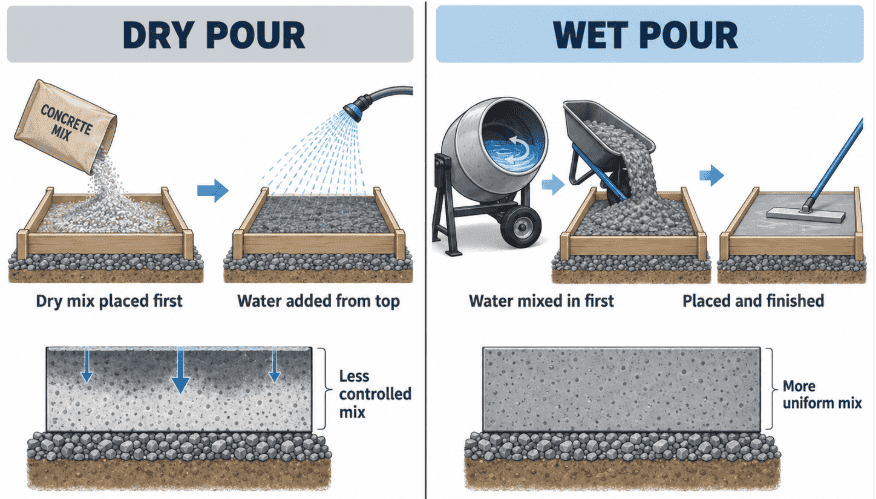
I will explain the method and where you can use it effectively. Diagram below shows difference between dry pour method and conventional wet pour method.
What Is Dry Pour Concrete?
Dry pouring means placing dry bagged concrete mix into its final location before adding water.
The viral slab method usually follows this sequence:
- Keep the slab moist while the concrete hardens.
- Prepare the base and forms.
- Place the dry concrete mix inside the forms.
- Level the dry mix with a screed.
- Wet the surface gradually.
With conventional bagged concrete, you measure the water and mix it throughout the cement and aggregate first. You then place the fresh concrete, consolidate it, finish the surface, and cure it.
The video below shows a real-world dry-pour experiment on a small concrete pad for an outdoor kitchen beside a patio.
Does Dry Pour Concrete Work?
Yes, in the limited sense that dry concrete mix can become hard when it receives water.
Cement reacts with water through hydration. The reaction forms products that bind the aggregate together and allow concrete to develop strength.
But the important engineering question is not:
Did the slab harden?
It is:
Did the full slab develop sufficiently uniform concrete with the strength and durability required for the job?
Those are not the same thing.
The American Cement Association (ACA) explains that strong, durable concrete depends on careful proportioning and mixing. It also identifies the water-cement ratio as a major factor controlling the quality of the cement paste.
When you mix concrete conventionally, you can measure the water and distribute it throughout the batch.
With a surface-wetted dry pour, you lose much of that control. Water has to move into material that is already sitting in the form. A wet-looking surface does not tell you exactly what happened through the full slab thickness.
Consolidation is another concern
Fresh concrete also needs adequate consolidation.
ACI explains that freshly placed concrete normally contains entrapped air voids. If those voids remain, the hardened concrete can become nonuniform, weaker, more porous, and poorly bonded to reinforcement.
Proper consolidation reduces those voids.
Tamping or leveling loose dry concrete before adding water is not the same process as consolidating a workable mass of fresh concrete.
That does not prove that every dry-poured slab will fail. It does mean you should not assume the finished material has the same uniformity as concrete that was properly mixed, placed, and consolidated.
If you want to see how consolidation normally works in fresh concrete, see our guide to internal vibration of concrete.
How to Dry Pour Concrete
If you still want to try dry pouring, I would limit it to a small, nonstructural project where poor performance would have minor consequences.
There is no standardized surface-wetting schedule that I can recommend for a dry-poured slab. The steps below describe the common DIY method.
Step 1: Prepare and Compact the Base
Remove vegetation, topsoil, and loose material.
Grade the area and compact the subgrade or granular base so the slab has reasonably uniform support.
Poor support can cause settlement and cracking regardless of how the concrete is mixed.
Install the forms securely and check the finished elevation and drainage slope before adding concrete.
Step 2: Place the Dry Concrete Mix
Empty the dry bagged mix evenly inside the forms.
Avoid creating large isolated piles and then trying to drag all of the material across the form. Distribute the bags across the area as evenly as practical.
Do not use concrete bags that have already absorbed moisture and contain hard lumps.
Dry concrete mix also creates cement and silica-containing dust. Wear suitable gloves, eye protection, and respiratory protection while handling it. QUIKRETE’s current safety guidance warns that the material can cause severe skin and eye damage and that repeated inhalation of dust can damage the lungs.
Step 3: Level the Dry Mix
Spread the material to the required depth.
Use a straight screed board across the forms to establish the finished elevation.
Check for obvious low spots before adding water. Once the surface begins to hydrate, correcting the level becomes much more difficult.
Step 4: Wet the Surface Gradually
DIY dry-pour methods normally use a gentle spray rather than a high-pressure stream.
The aim is to introduce water without washing cement paste or fine particles away from one part of the slab.
This step is also the main weakness of the method.
With normal bagged concrete, the manufacturer can specify a water quantity per bag because that water is mixed throughout the material. With a dry-poured slab, you cannot control the local water-cement ratio with the same confidence.
Flooding the surface will also not solve the problem. Excess water can also reduce concrete quality.
Step 5: Keep the Concrete Moist While It Hardens
Initial wetting and curing are different operations.
Curing means maintaining suitable moisture and temperature conditions after hydration has started.
The American Cement Association notes that curing keeps cement hydration going so concrete can continue to gain strength.
Protect the slab from rapid drying, freezing temperatures, and damaging weather while it hardens.
Good curing helps concrete develop its properties. It cannot, however, give you precise control over a mixture that was never uniformly mixed before placement.
Dry Pour vs. Wet Pour Concrete
The real difference is not simply whether you own a concrete mixer.
It is how much control you have over the material before it hardens.
| Factor | Dry-pour slab | Properly wet-mixed concrete |
|---|---|---|
| Water added | After dry placement | Before placement |
| Water quantity | Difficult to control locally | Measured |
| Water distribution | Difficult to verify through full depth | Mixed throughout batch |
| Workability | No conventional fresh mix before wetting | Can be controlled |
| Consolidation | Limited compared with fresh concrete | Conventional consolidation possible |
| Finishing | More limited | Normal floating/troweling possible |
| Specified strength | Should not be assumed | Can be produced and tested to specification |
| Structural use | Not recommended as an improvised method | Standard construction practice |
One point is especially important when using bagged concrete.
A strength printed on the bag does not automatically apply to a dry-poured slab.
For example, QUIKRETE Fast-Setting Concrete Mix lists a typical 28-day compressive strength of 4,000 psi. But its technical data states that these properties apply when the material is mixed to a 2- to 3-inch slump and tested under the referenced ASTM methods.
You therefore cannot take the 4,000-psi value from the bag and assume that a slab installed dry and watered from above also achieved 4,000 psi.
Without testing, you simply do not know.
This is also why I would avoid claims that dry-poured concrete is always “60%,” “70%,” or “80%” as strong as wet-mixed concrete. I could not find a credible technical basis for a universal percentage like that.
When Does Dry Pour Concrete Make Sense?
There is an important exception to the warnings above.
Fence Posts With a Manufacturer-Approved No-Mix Method
Some fast-setting concrete products are specifically designed to be used without premixing when setting posts.
QUIKRETE Fast-Setting Concrete Mix is a good example. For post setting, QUIKRETE instructs the user to place the dry mix directly into the hole and then add water until the material is saturated.
The video below shows this manufacturer-approved no-mix method in practice.
The important point is that this does not mean QUIKRETE recommends the same procedure for slabs.
For slab construction, the same product instructions first require the concrete to be mixed with water. The fresh concrete is then placed, compacted to eliminate air pockets, screeded, floated, finished, and cured.
Sakrete makes a similar distinction. Its Fast Setting Concrete Mix allows a no-mix procedure for setting posts, while its flatwork instructions call for the material to be mixed to a uniform consistency before placement and consolidation.
So there is a clear difference between a manufacturer-approved no-mix post-setting method and the viral dry-pour slab technique.
If the concrete has to carry significant loads or meet a specified strength, use a conventional concrete mixing and placement method.
Where Should You Not Dry Pour Concrete?
I would not use an improvised dry-pour slab method for the following applications:
| Application | Why I would avoid dry pouring |
|---|---|
| Foundations and footings | Structural concrete needs predictable properties |
| Structural slabs | Strength and serviceability matter |
| Driveways | Repeated vehicle loading and exterior exposure |
| Garage floors | Vehicle loads and long-term durability |
| Reinforced structural concrete | Bond and consolidation around reinforcement matter |
| Column or wall foundations | Localized structural loads can be high |
| Equipment foundations | Loads, vibration, and anchorage may be important |
| Specified-strength concrete | You cannot assume the specified strength was achieved |
A driveway is a particularly poor place to experiment.
It carries repeated wheel loads and faces rain, temperature changes, and—in many U.S. climates—freezing conditions and deicing chemicals.
For driveway planning, our concrete driveway cost calculator also covers base preparation, reinforcement, joints, drainage, and other items that affect the finished slab.
Foundations deserve even less experimentation. If a footing design specifies a concrete strength, the construction method needs to provide confidence that the installed concrete can meet it.
How Long Does Dry Pour Concrete Take to Cure?
There is no universal dry-pour curing time that guarantees a surface-wetted slab has developed a particular strength.
Concrete begins hardening after cement and water react, but strength develops over time.
You will often see 28 days mentioned with concrete because 28 days is a common reference age for compressive-strength testing. It does not mean concrete waits 28 days and suddenly becomes fully cured.
The American Cement Association, for example, defines 3,000-psi concrete by its compressive strength at the 28-day test age.
For a product used according to its approved instructions, follow that manufacturer’s curing and loading guidance.
For an improvised dry-poured slab, elapsed time alone cannot tell you whether the complete slab hydrated uniformly or reached the strength shown on the bag.
Also keep three terms separate:
Setting is the transition from a plastic or workable state toward a rigid material.
Hardening is the continuing development of mechanical properties.
Curing means maintaining the conditions needed for hydration and strength development.
A slab can feel hard at the surface long before you have evidence of what happened through its full depth.
So, Is Dry Pour Concrete Worth It?
For a conventional concrete slab, I would mix the concrete before placing it.
Dry pouring saves the physical step of mixing, but that convenience comes at the expense of material control.
Proper mixing distributes a measured amount of water throughout the cement and aggregate. It produces fresh concrete that can then be placed, consolidated, finished, and cured using established methods.
With a surface-wetted dry pour, you cannot verify those conditions nearly as well.
FAQs
Is dry pour concrete as strong as wet-poured concrete?
Do not assume that it is. A dry-poured slab does not provide the same control over water distribution, mixture consistency, and consolidation. There is also no reliable universal percentage that tells you how much strength a dry pour will achieve compared with properly mixed concrete.
Can you dry pour a concrete driveway?
I would not. Driveways carry repeated vehicle loads and face outdoor exposure for many years. Use properly mixed concrete designed for the expected loading and environmental conditions.
Can you dry pour concrete for fence posts?
Yes, when the specific product allows it. QUIKRETE Fast-Setting Concrete Mix and Sakrete Fast Setting Concrete Mix both provide no-mix post-setting procedures. Do not assume the same method applies to every bagged concrete product or to slabs.
Can you dry pour QUIKRETE?
It depends on the product and the application. QUIKRETE Fast-Setting Concrete Mix permits dry placement followed by water for its post-setting method. QUIKRETE’s slab instructions call for mixed concrete that is placed, compacted, screeded, finished, and cured.
Can you dry pour concrete over dirt?
Concrete still needs adequate support beneath it. Loose topsoil, organic material, or poorly compacted fill can settle and crack a slab regardless of the concrete-placement method. Prepare and compact the base appropriate for the intended project.
How thick can you dry pour concrete?
There is no credible universal maximum thickness for the viral surface-wetted dry-pour slab method. Online claims such as a 3- or 4-inch maximum should not be treated as engineering rules. As slab thickness increases, verifying uniform water distribution through the full section becomes even more uncertain.
Sources and Technical References
- American Concrete Institute (ACI) — guidance on consolidation of concrete and the effects of entrapped air. ACI: Why is consolidation needed?
- American Cement Association — concrete proportioning, water-cement ratio, mixing, placement, and curing. American Cement Association: Applications of Cement
- QUIKRETE — Fast-Setting Concrete Mix technical data and separate post/slab installation methods. QUIKRETE Fast-Setting Concrete Mix technical data
- QUIKRETE — standard Concrete Mix mixing, slab placement, and curing instructions. QUIKRETE Concrete Mix technical data
- Sakrete — Fast Setting Concrete Mix post-setting, mixing, flatwork, and curing instructions. Sakrete Fast Setting Concrete Mix technical data