What Is Concrete Cloth? Uses, Cost and How It Works
Concrete cloth is a flexible cementitious fabric that hardens after water is applied. The technical term is geosynthetic cementitious composite mat, or GCCM. It is usually supplied as a concrete cloth roll and used for ditch lining, erosion control, slope protection, culvert lining and fast construction where traditional poured concrete is slow, costly or difficult to place.
Think of it as concrete that arrives in fabric form. You unroll it, fix it, hydrate it, and it hardens. It sounds like a construction magic trick, but it is a real engineering material with real limits.
What Is Concrete Cloth?
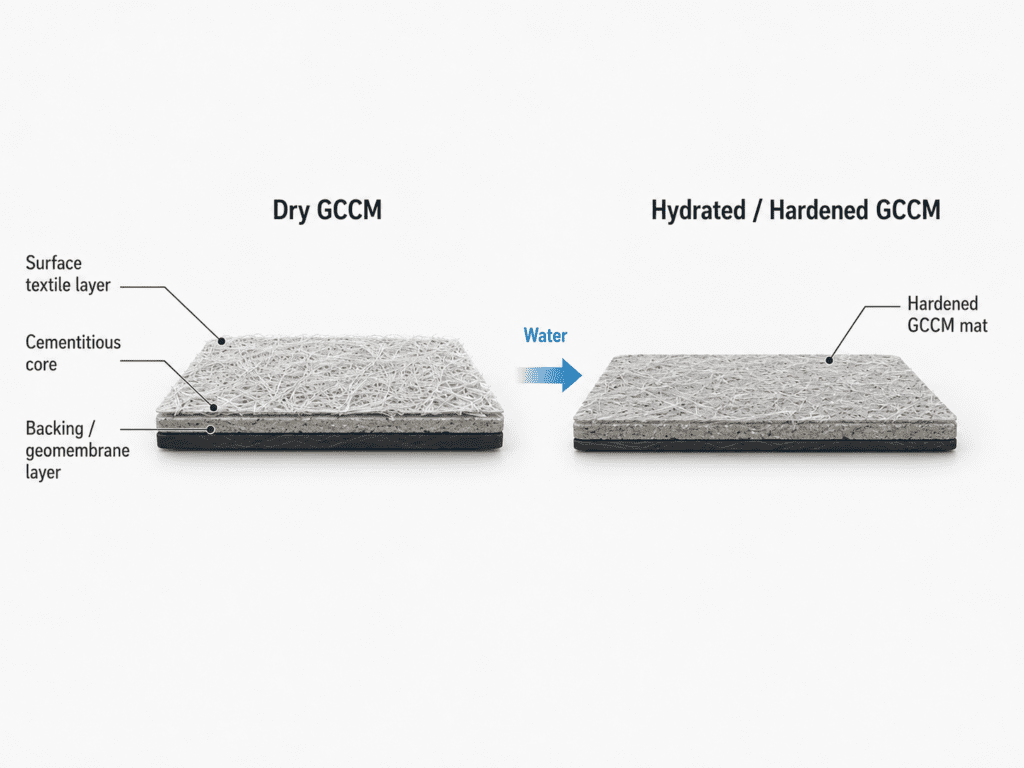
Concrete cloth is a type of cement impregnated fabric. It contains a dry cementitious mix held inside a geotextile or fibre structure. Once water is applied, the cementitious layer hydrates and hardens.
The engineering term is GCCM, which stands for geosynthetic cementitious composite mat. ASTM D8364/D8364M covers requirements and properties for GCCM materials used in different applications, which helps designers compare and specify products more consistently.
“Concrete cloth”, “cement cloth” and “concrete cloth fabric” are common generic phrases, while GCCM is the technical term. You may also see it described as concrete on a roll, water-activated concrete cloth, geosynthetic concrete mat or a concrete erosion control mat.
Best Uses and Where to Avoid It
Concrete cloth works best as a fast protective lining, not as a thick load-bearing concrete member.
| Best use for concrete cloth | Avoid when the project needs |
|---|---|
| Ditch lining | Structural slabs |
| Erosion control | Driveways |
| Slope protection | Foundations |
| Culvert lining | Retaining wall strength |
| Outfall protection | Heavy vehicle loading |
| Weed suppression | Poorly prepared subgrade support |
| Remote-site lining | High-impact zones without design checks |
The simple rule is this: use concrete canvas roll where speed, access and surface protection matter. Use conventional concrete where thickness, reinforcement and load capacity control the design.
For projects where you still need ordinary concrete volume, use our concrete calculator before ordering material.
How Does Concrete Cloth Work?
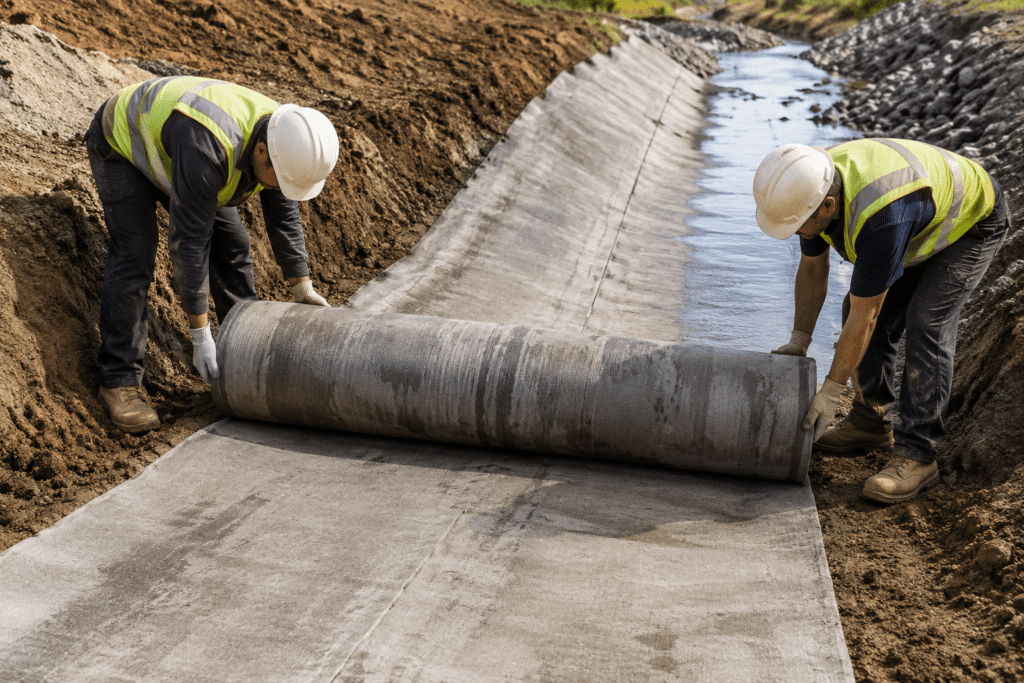
Concrete canvas roll works in three basic steps. Unroll it, fix it in place, and hydrate it with water. After hydration, the cementitious material hardens and forms a protective concrete-like layer.
Concrete Canvas describes GCCMs as flexible, concrete-filled geosynthetics that harden on hydration to form a thin, durable and waterproof concrete layer.
The final performance still depends on subgrade preparation, fixing, overlaps, anchorage and hydration. This is where a good product can still fail if it is installed like a picnic blanket.
For project-specific installation, always follow the manufacturer’s method statement or installation guide, especially for overlap direction, anchorage, hydration rate, edge fixing and curing conditions.
Common Uses of Cement Cloth
It is mainly used where a cementitious lining is needed quickly. It can reduce mixing, formwork, plant access and installation time.
Common uses include:
- drainage ditch lining
- channel lining
- slope protection
- erosion control
- culvert lining
- outfall protection
- bund lining
- pipe protection
- weed suppression
- remote-site works
Concrete Canvas lists typical GCCM applications such as channel lining, slope protection, bund lining, culvert lining, outfall protection, gabion covering and pipe protection.
Some smaller products are also sold for pond liner protection and water-feature work, but these may differ from infrastructure-grade GCCMs.
Cost and Roll Size
Concrete cloth price is difficult to give as a single number because products vary by thickness, roll size, supplier, quantity, delivery distance, anchorage details and project specification. A concrete canvas roll or concrete cloth roll for a small drainage job will not be priced the same way as material supplied for a large civil-engineering project.
As a current retail example, a common pond/water-feature concrete cloth roll is often sold in the range of about $790–$880 for a roll around 3.3 ft wide by 30–32.8 ft long. That works out roughly around $7.40–$8.20 per square foot before shipping, taxes, waste, anchorage and labor.
| Example product type | Typical listed material cost | Approx. area | Rough material cost |
|---|---|---|---|
| Small pond/water-feature roll | $790–$880 per roll | about 100–110 sq ft | about $7.40–$8.20/sq ft |
| Civil/infrastructure GCCM | Usually quote-based | project-specific | varies by thickness, quantity and specification |
| Installed cost | Material + labour + overlaps + anchorage + freight | project-specific | usually more useful than roll price alone |
Those numbers are useful for scale, not for final budgeting. Infrastructure-grade GCCMs, thicker mats, remote delivery, overlap waste, anchorage, subgrade preparation and contractor labor can change the installed cost significantly.
Can You Use Concrete Cloth for DIY?
DIY use is possible in small, non-critical applications, but it still needs proper subgrade preparation, overlap details, anchorage, hydration and curing conditions.
For home use, it may be considered for small drainage features, garden erosion control, pond liner protection or low-risk slope protection. Do not use it for driveways, foundations, retaining walls or load-bearing work unless a qualified designer has specified it.
Advantages of Concrete Cloth
Concrete cloth is attractive because it can make some site work faster and cleaner.
| Advantage | Why it matters |
|---|---|
| Fast installation | Less forming, mixing and finishing |
| Roll format | Easier transport to remote sites |
| Reduced plant needs | Less reliance on mixers and heavy equipment |
| Factory-controlled material | More consistent than improvised site mixes |
| Good erosion-control use | Helpful in channels, slopes and drainage areas |
The biggest benefit is speed. On awkward, remote or access-limited sites, a concrete cloth roll can be much easier to place than conventional poured concrete.
Limitations of Concrete Cloth
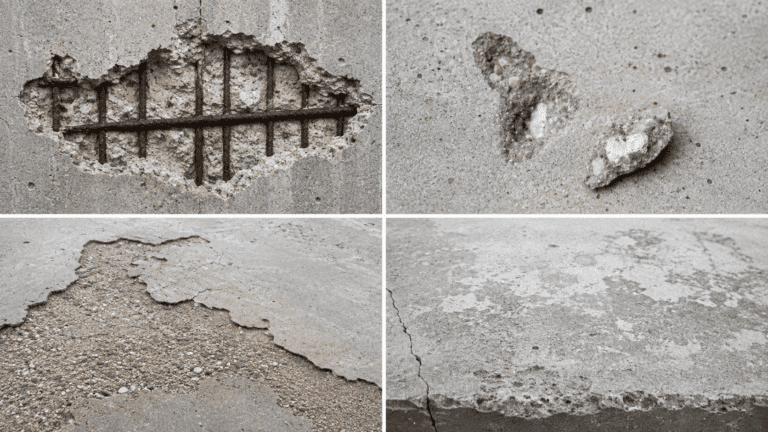
GCCM should not automatically replace poured concrete where the design needs structural capacity, reinforcement, thickness or high impact resistance. For ordinary concrete behavior and cracking risk, see our guide on what causes concrete to crack.
Designers still need to check:
- flow velocity
- abrasion exposure
- anchorage
- overlaps
- subgrade condition
- freeze-thaw exposure
- UV exposure
- chemical exposure
- product classification
- long-term durability
This is where standards matter. ASTM D8364 classifies GCCM materials because different applications require different physical properties.
Concrete Cloth vs Poured Concrete
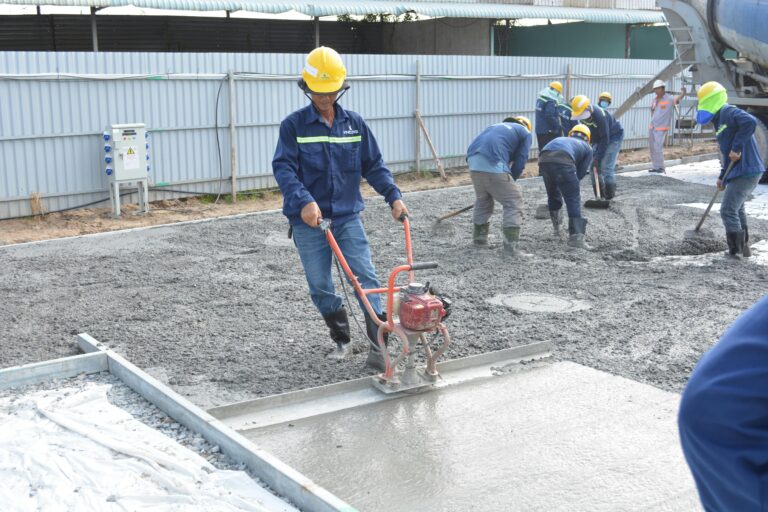
Concrete cloth and poured concrete solve different problems.
| Feature | Concrete cloth | Poured concrete |
|---|---|---|
| Best use | Lining, erosion control, protection | Slabs, foundations, structural work |
| Installation | Roll out, fix, hydrate | Form, place, compact, finish, cure |
| Equipment | Usually less plant needed | Often needs more equipment and labour |
| Thickness | Thin cementitious layer | Can be much thicker |
| Structural role | Limited | Can be structural |
| Main advantage | Speed and access | Strength, depth and reinforcement |
Concrete cement cloth wins when speed, access and lining are the main issues. Poured concrete wins when load capacity, thickness and reinforcement control the design.
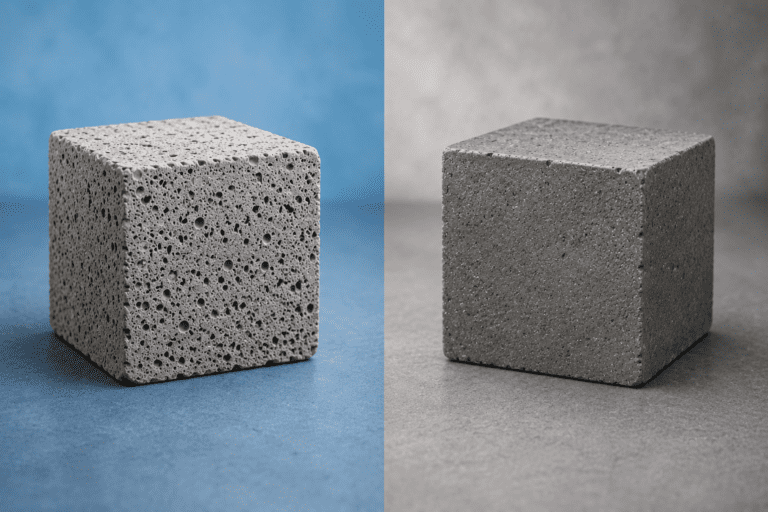
If you are comparing lightweight or non-traditional concrete materials, our foam concrete vs normal concrete guide explains where lower-density concrete helps and where standard concrete still performs better.
Glass fiber reinforced concrete is another specialized cementitious composite, but manufacturers usually spray or cast it into architectural panels and molded products rather than supply it as a roll.
Conclusion
Concrete cloth is useful when a fast cementitious lining is needed for erosion control, ditch lining, slope protection, culvert lining or difficult-access sites. Technically, it belongs to the GCCM family: geosynthetic cementitious composite mats.
It is not a universal replacement for poured concrete, but it can save time and simplify installation when used in the right application, with the right product specification and realistic expectations.
FAQs
Is concrete cloth real concrete?
Concrete cloth is a cementitious composite fabric that hardens after hydration. It forms a concrete-like protective layer, but it is not the same as a thick reinforced concrete slab.
What is concrete cloth used for?
Concrete cloth is mainly used for ditch lining, erosion control, slope protection, culvert lining, drainage channels, bund lining and outfall protection.
Is Concrete Canvas the same as concrete cloth?
Concrete Canvas is a well-known GCCM brand. Concrete cloth is the common generic phrase people use for water-activated cementitious fabric.
Can I use concrete cloth for a driveway?
Usually, no. A driveway needs proper structural thickness, subgrade design and load capacity. GCCM is better suited to lining, protection and erosion-control applications.
How much does concrete cloth cost?
Cost depends on product type, thickness, roll size, supplier, quantity, shipping and project requirements. For real projects, compare installed cost, not only price per roll.