Precast Concrete Culvert Guide: 7 Key Uses, Costs & Types
This guide compares concrete pipe culverts, precast box culverts, multi-cell box culverts, and corrugated steel culverts so you can choose the right option before the trench is open and everyone is staring at the excavator.
Main Types of Precast Concrete Culverts
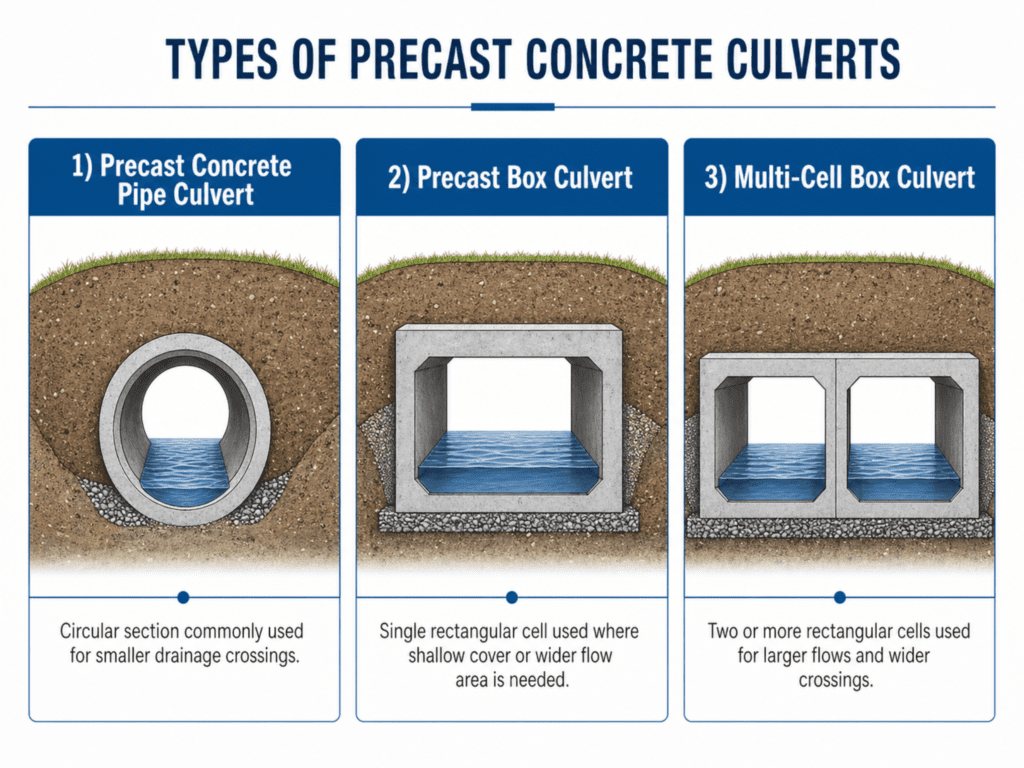
Three main types of precast concrete culverts are shown in the figure below.
1. Precast Concrete Pipe Culvert
A precast concrete pipe culvert is circular in shape and is commonly used for stormwater drainage, driveway crossings, and smaller flow channels.
It is often suitable when the required waterway opening is moderate and enough soil cover is available above the pipe.
2. Precast Box Culvert
A precast box culvert is rectangular or square. It is widely used for road crossings, stream crossings, shallow-depth installations, large stormwater flows, and situations where the opening must be wider than a circular pipe can practically provide.
Precast box culverts are especially useful where:
- Water flow is large
- Cover depth is limited
- Road closure time must be reduced
- A wide opening is needed
- The culvert must carry heavy traffic loads
- A rectangular channel shape is preferred
3. Multi-Cell Precast Box Culvert
A multi-cell precast box culvert uses two or more box openings side by side. This can be useful where a single large opening is not practical or where flow needs to be divided across multiple cells.
Precast Concrete Culvert vs Corrugated Steel Culvert
A corrugated steel culvert is another common culvert option. It is usually lighter than concrete and may be easier to transport and install in some locations. However, material choice should not be based on price alone. The figure and table below will give a clear perspective on both culverts strong and weak points.
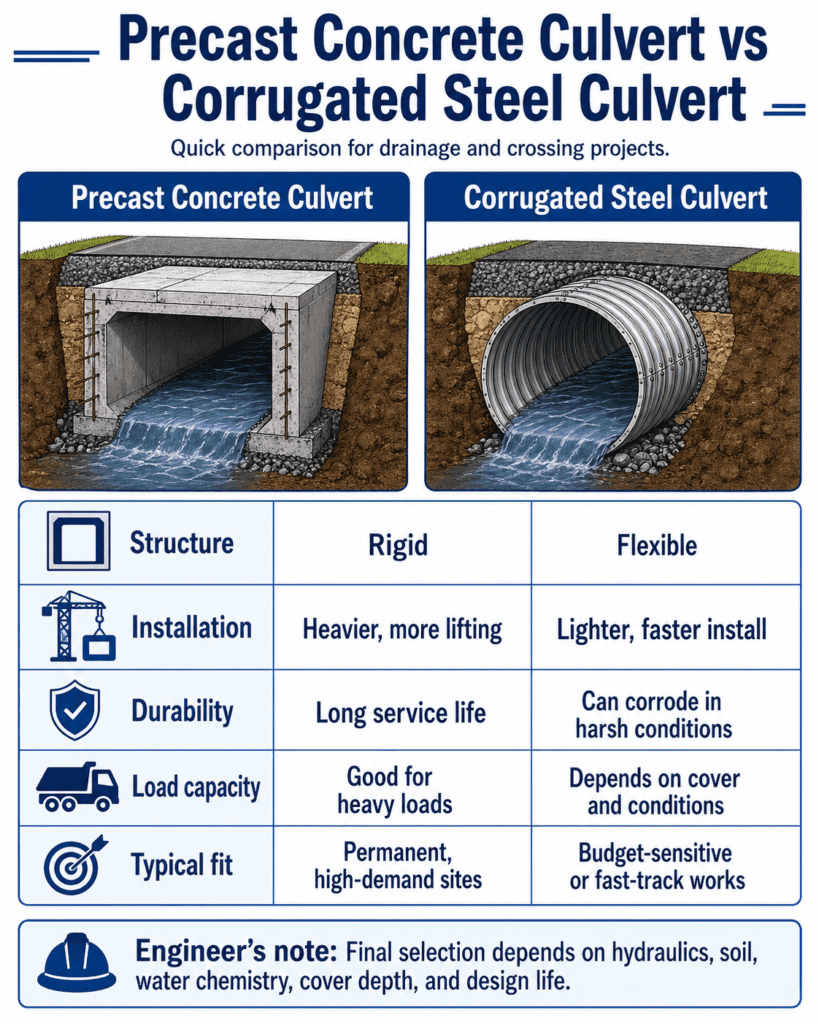
A corrugated steel culvert may be a good solution where fast installation, lighter handling, or lower initial material cost is important.
A precast concrete culvert is often preferred where long-term durability, high load resistance, fire resistance, and lower corrosion sensitivity are important.
When is a Precast Concrete Culvert the Better Choice?
A precast concrete culvert is often a strong option when the project requires:
- Fast installation with less on-site concrete work
- Reliable factory-controlled quality
- High load-carrying capacity
- Long service life
- Resistance to heavy traffic loads
- Reduced road closure time
- A large drainage opening
- A shallow cover solution
- Lower long-term maintenance
- Consistent dimensions and finish
For road and infrastructure projects, reducing site time can be a major advantage. Cast-in-place culverts may require formwork, reinforcement placement, concrete pouring, curing time, and weather-dependent scheduling.
A precast culvert can shorten this process because much of the work is completed before the units arrive on site.
When a Precast Culvert May Not Be the Best Option
A precast culvert is not automatically the best choice for every project.
It may be less suitable when:
- The site has poor access for cranes or heavy delivery trucks
- The culvert shape is highly irregular
- Transport distance is very long
- The project is very small and a pipe culvert is enough
- The soil requires major improvement before installation
- The design needs many unusual angles or transitions
- The budget only considers initial cost and ignores long-term maintenance
For small driveway drainage, a simple concrete pipe, plastic pipe, or corrugated steel culvert may sometimes be more economical, depending on the loading and local requirements.
What Affects the Cost of a Precast Concrete Culvert?
The cost of a precast concrete culvert depends on several factors. There is no single fixed price because every project has different structural, hydraulic, and installation requirements.
Main cost factors include:
1. Culvert size
Larger openings require more concrete, more reinforcement, heavier lifting equipment, and larger transport arrangements.
2. Culvert type
A small pipe culvert is usually cheaper than a large precast box culvert. Multi-cell box culverts cost more because they require more material and more complex installation.
3. Design load
Culverts under highways, industrial yards, railways, or heavy vehicle routes need higher structural capacity than culverts under light driveways.
4. Soil and cover depth
The depth of soil above the culvert affects the load on the structure. Very shallow cover and very deep cover both require careful design.
5. Bedding and backfill requirements
Poor bedding or weak backfill can damage even a well-made culvert. Proper granular bedding, compaction, and side support are essential.
6. Joint sealing
Water-tight or soil-tight joints may be required depending on the project. Joint type affects both cost and performance.
7. Site access
Restricted access can increase lifting, handling, labour, and equipment costs.
8. Headwalls and wing walls
Many culverts need headwalls, wing walls, aprons, erosion protection, or end treatments. These items can significantly affect total project cost.
9. Drainage and erosion protection
Riprap, outlet protection, energy dissipation, and slope stabilization may be needed where water velocity is high.
If your drainage project also includes earth retention, see our guide on retaining wall cost in 2026.
Typical Installation Steps for a Precast Concrete Culvert
The exact installation method depends on the design, local standards, and manufacturer instructions. However, a typical process includes:
1. Site survey and design
The engineer checks flow requirements, soil conditions, road levels, cover depth, loading, and outlet conditions.
2. Excavation
The trench or channel is excavated to the required depth, width, and alignment.
3. Foundation preparation
Weak soil may need removal, replacement, compaction, or stabilisation. The bedding must provide uniform support.
4. Bedding layer
A suitable bedding layer is placed and levelled. This helps support the culvert evenly.
5. Placement of precast units
The precast culvert sections are lifted into position using suitable equipment.
6. Jointing and sealing
The joints are connected and sealed according to the project requirements.
7. Backfilling
Backfill is placed carefully and compacted in layers on both sides to avoid unbalanced pressure.
8. End treatment
Headwalls, wing walls, aprons, erosion protection, or outlet protection are installed where needed.
9. Final surface restoration
The road, driveway, embankment, or landscape is restored above and around the culvert.
Many culvert failures are not caused by the culvert unit itself. They are caused by poor bedding, poor compaction, bad drainage at the outlet, erosion, or incorrect backfill placement.
Common Problems With Concrete Culverts
A concrete culvert can fail or perform poorly if it is incorrectly designed, installed, or maintained.
Common problems include:
- Cracking from poor bedding support
- Settlement due to weak soil below the culvert
- Joint leakage
- Soil loss through open joints
- Erosion at the inlet or outlet
- Blockage from debris
- Undersized hydraulic opening
- Excessive water velocity at the outlet
- Headwall or wing wall movement
- Road settlement above the culvert
If settlement or cracking appears near a building foundation, read our foundation repair guide before starting repairs.
Small cracks do not always mean immediate structural failure, but active movement, widening cracks, joint separation, settlement above the culvert, or erosion around the outlet should be investigated.
How to Choose the Right Precast Culvert
Before choosing a precast concrete culvert, ask these questions:
- How much water must pass through the culvert?
- Is the culvert carrying road traffic, heavy vehicles, or railway loading?
- How much soil cover is available above the culvert?
- What are the soil conditions below the culvert?
- Is the water aggressive, acidic, abrasive, or fast-flowing?
- Is the culvert temporary or permanent?
- Is access available for crane lifting and transport?
- Will the culvert need headwalls, wing walls, or erosion protection?
- Is future maintenance easy or difficult?
- Is lowest initial cost more important than long-term performance?
For small drainage crossings, a simple culvert pipe may be enough. For road and highway drainage projects, culvert sizing should be checked using recognised hydraulic guidance such as the FHWA Hydraulic Design of Highway Culverts
Precast Box Culvert: Best Uses
A precast box culvert is especially useful for:
- Road crossings
- Highway drainage
- Railway drainage
- Stream crossings
- Large stormwater systems
- Shallow-depth drainage
- Industrial access roads
- Agricultural crossings
- Utility tunnels
- Pedestrian underpasses
- Animal or livestock crossings
For standard precast box culvert specifications, many projects refer to the ASTM C1433 standard for precast reinforced concrete box sections.
Because the shape is rectangular, a box culvert can provide a large waterway opening without needing the same height as a large circular pipe. This can be important where the road level is fixed and there is limited space between the channel bed and pavement surface.
Is a Precast Box Culvert Better Than Cast-in-Place Concrete?
A precast box culvert is often better when speed, quality control, and reduced road closure time are important. A cast-in-place culvert may be better when the geometry is unusual, transport access is difficult, or the project requires a fully customized shape. The table below will help you decide between the two.
The National Precast Concrete Association box and 3-sided culverts guide gives a useful overview of common precast culvert applications and product types.
| Factor | Precast Box Culvert | Cast-in-Place Box Culvert |
|---|---|---|
| Speed | Faster installation | Slower due to formwork, pouring, and curing |
| Quality control | Factory controlled | Site dependent |
| Weather impact | Lower | Higher |
| Custom shape | Limited by available moulds and transport | More flexible |
| Site labour | Lower | Higher |
| Road closure time | Usually shorter | Usually longer |
| Transport needs | Requires delivery of heavy units | Less heavy precast transport |
For standard drainage crossings, precast box culverts are often preferred. For complex geometry, cast-in-place concrete may still be necessary.
Precast Concrete Culvert Maintenance
Even a durable concrete culvert needs inspection and maintenance. Regular checks can prevent small issues from becoming expensive failures.
Check for:
- Debris blockage
- Sediment build-up
- Cracks
- Joint separation
- Erosion at inlet or outlet
- Settlement above the culvert
- Exposed reinforcement
- Water bypassing the culvert
- Scour around headwalls
- Vegetation blocking flow
A culvert should be inspected before and after major storms, especially if it carries significant runoff.
Final Engineering Advice
A precast concrete culvert is a strong, durable, and practical solution for many drainage and crossing projects. A precast box culvert is especially useful where a large opening, shallow cover, high load resistance, and fast installation are required.
However, the culvert unit is only one part of the system. The real performance depends on hydraulic sizing, soil support, bedding, jointing, backfilling, inlet and outlet protection, and long-term maintenance.
For a small, low-risk drainage crossing, a simple pipe culvert may be enough. For roads, larger flows, heavy loads, or permanent infrastructure, a properly designed precast concrete culvert can provide better long-term value than a cheaper short-term solution.
The safest approach is to choose the culvert based on the site conditions, not only the material price.
FAQs
What is a precast concrete culvert?
A precast concrete culvert is a factory-made reinforced concrete drainage structure used to carry water, storm runoff, streams, or services under roads, driveways, railways, embankments, or industrial areas.
What is a precast box culvert?
A precast box culvert is a rectangular or square concrete culvert made in a factory and installed on site. It is commonly used for road crossings, stormwater drainage, stream crossings, and shallow-cover drainage systems.
Is a precast box culvert better than a pipe culvert?
A precast box culvert is usually better for larger openings, shallow cover, heavy traffic loads, or road crossings. A pipe culvert may be more economical for smaller drainage needs.
How long does a precast concrete culvert last?
A properly designed and installed precast concrete culvert can last for many decades. Service life depends on concrete quality, exposure conditions, bedding, joints, water chemistry, loading, and maintenance.
Is a corrugated steel culvert cheaper than a concrete culvert?
A corrugated steel culvert may have a lower initial cost and is lighter to handle, but long-term performance depends on corrosion risk, abrasion, coating condition, soil support, and water chemistry. Concrete culverts often provide better durability in many permanent infrastructure applications.
What causes concrete culvert failure?
Common causes include poor bedding, weak soil, erosion, undersized hydraulic capacity, joint leakage, poor backfill compaction, heavy loads, outlet scour, and lack of maintenance.
Do precast culverts need headwalls?
Many culverts need headwalls or wing walls to support the embankment, control erosion, and improve inlet and outlet performance. The need depends on the site, slope, flow, soil, and culvert size.