Concrete Calculator: Yards, Bags & Volume
Use this concrete calculator to estimate cubic yards, cubic feet, cubic meters and bag quantities for slabs, walls, footings, circular slabs, piers, post holes and concrete steps. Enter the project dimensions and choose a waste allowance to see both the calculated volume and the amount to order.
Concrete Calculator
Calculate concrete volume, cubic yards, cubic feet, cubic meters, bag counts, weight and optional material cost for slabs, walls, footings, circular slabs, round piers, post holes and solid concrete steps.
Project dimensions
Optional cost settings
Your concrete estimate
Do not use normal concrete weight values for lightweight materials such as foam concrete, because their density can be much lower than standard concrete
How Much Concrete Do I Need?
Start with the actual volume of the concrete you plan to place.
For a rectangular slab, multiply the length by the width by the concrete thickness. Convert the result to cubic yards if you are ordering ready-mix concrete.
One cubic yard contains 27 cubic feet.
The calculator above separates the calculated concrete volume from the recommended order quantity. The second value includes your selected waste allowance, so you can see exactly how much extra material has been added.
For example, a 10 ft × 10 ft slab at 4 inches thick contains about 1.23 cubic yards of concrete before waste. With a 10% allowance, the calculator increases the order quantity to about 1.36 cubic yards.
For irregular areas, divide the pour into simple rectangles or circles, calculate each part separately, then add the volumes together.
Concrete Volume Formulas
The formula changes with the shape of the pour, but the calculation always starts with volume.
| Project | Concrete volume formula |
|---|---|
| Rectangular slab | Length × Width × Thickness |
| Wall | Length × Height × Thickness |
| Strip footing or trench | Length × Width × Depth |
| Circular slab | π × Radius² × Thickness |
| Round pier or column | π × Radius² × Height |
| Post holes | π × Radius² × Depth × Quantity |
| Solid concrete steps | Width × Rise × Run × [n(n+1) ÷ 2] |
For imperial measurements:
Cubic feet = Length (ft) × Width (ft) × Thickness (in) ÷ 12
Then:
Cubic yards = Cubic feet ÷ 27
For metric measurements, keep the main dimensions in meters and convert millimeter thickness to meters before multiplying.
The solid-step calculation assumes conventional solid cast-in-place steps built up from grade. It is not intended for suspended reinforced-concrete stairs with a waist slab.
Engineer Note
This calculator estimates material quantity, not structural capacity.
Concrete thickness, reinforcement, subgrade support, joints and concrete strength still need to suit the actual loading and site conditions. ACI treats slab thickness and soil support as design considerations for slabs-on-ground rather than values that should be selected from a calculator alone.
Common Concrete Slab Sizes
The table below shows the exact geometric concrete volume before waste.
Use it for quick planning, then add a waste allowance before placing an actual order.
| Slab size | 4 in thick | 5 in thick | 6 in thick |
|---|---|---|---|
| 10 × 10 ft | 1.23 yd³ | 1.54 yd³ | 1.85 yd³ |
| 12 × 12 ft | 1.78 yd³ | 2.22 yd³ | 2.67 yd³ |
| 20 × 20 ft | 4.94 yd³ | 6.17 yd³ | 7.41 yd³ |
| 24 × 24 ft | 7.11 yd³ | 8.89 yd³ | 10.67 yd³ |
| 30 × 40 ft | 14.81 yd³ | 18.52 yd³ | 22.22 yd³ |
A 20 × 20 ft slab, for example, takes about 4.94 cubic yards at 4 inches thick before waste. Increasing the thickness to 6 inches raises that volume to about 7.41 cubic yards.
That difference is why I would measure the required thickness before pricing concrete. A small change in thickness over a large area changes the order quickly.
If you are trying to estimate the complete installed slab price, including labor, reinforcement, base preparation and finishing, use the Concrete Slab Price Calculator instead.
How Much Does 1 Yard of Concrete Cover?
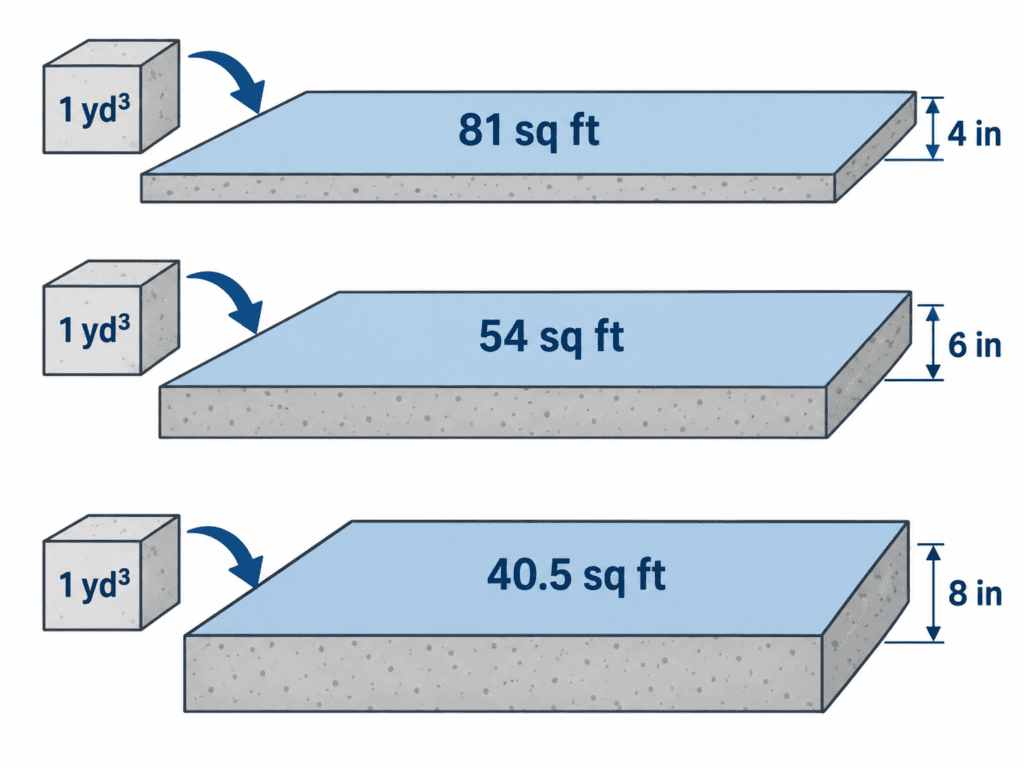
One cubic yard of concrete always contains 27 cubic feet, but the surface area it covers changes with thickness.
| Concrete thickness | Approx. area covered by 1 yd³ |
|---|---|
| 3 in | 108 sq ft |
| 4 in | 81 sq ft |
| 5 in | 64.8 sq ft |
| 6 in | 54 sq ft |
| 8 in | 40.5 sq ft |
So one cubic yard will cover about 81 square feet at 4 inches thick.
At 6 inches thick, the same cubic yard covers only about 54 square feet.
These numbers are theoretical coverage before waste, uneven subgrade or variations in the forms.
How Many Bags of Concrete Do I Need?
Bagged concrete is usually sold by weight, but each bag produces a certain volume of mixed concrete.
That yield is what matters when estimating how many bags to buy.
The calculator uses the following typical yields:
| Bag size | Approx. yield | Approx. bags per cubic yard |
|---|---|---|
| 40 lb | 0.30 ft³ | 90 |
| 50 lb | 0.375 ft³ | 72 |
| 60 lb | 0.45 ft³ | 60 |
| 80 lb | 0.60 ft³ | 45 |
| 90 lb | 0.675 ft³ | 40 |
These values match the published yields for QUIKRETE Concrete Mix No. 1101. The manufacturer lists approximately 0.30 ft³ for a 40-lb bag, 0.375 ft³ for 50 lb, 0.45 ft³ for 60 lb, 0.60 ft³ for 80 lb and 0.675 ft³ for 90 lb.
Actual yield can vary between products, especially with specialty or fast-setting mixes. Check the yield printed on the bag before purchasing.
Example: 80-lb Bags for a 10 × 10 Slab
A 10 × 10 ft slab at 4 inches thick contains about 33.3 cubic feet.
At 0.60 cubic feet per 80-lb bag:
33.3 ÷ 0.60 ≈ 56 bags
That is before adding extra material.
With a 10% waste allowance, the calculator gives about 62 bags.
Common Concrete Thicknesses
Thickness has a large effect on concrete quantity, so do not choose it only to make the material estimate cheaper.
These values are useful planning starting points, not structural design requirements.
| Project | Common planning thickness | Practical note |
|---|---|---|
| Walkway | 4 in | Common for normal foot traffic |
| Patio | 4 in | Base preparation and drainage still matter |
| Small shed slab | 4–5 in | Load and soil conditions can change the requirement |
| Residential driveway | 5–6 in | Vehicle loading and base support matter |
| Garage or heavier slab | 6 in or more | Reinforcement and joint layout may also need design |
For structural slabs, heavy equipment, poor soil, unusual loads or foundations, use project-specific design information rather than this table.
ACI’s floor and slab guidance specifically identifies slab thickness, base/subbase preparation, concrete strength, reinforcement and joints as items that should be addressed in the design documents.
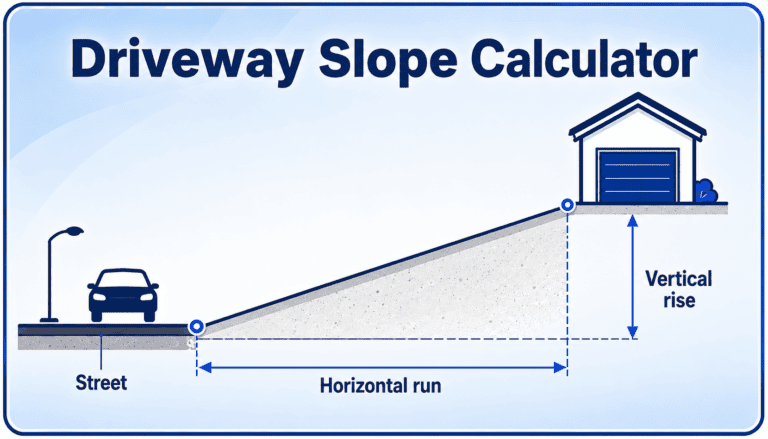
If you are estimating a driveway rather than just concrete quantity, the Concrete Driveway Cost Calculator gives a more complete project estimate.
Bagged Concrete or Ready-Mix?
Bagged concrete makes sense for small pours.
I would normally consider it for post holes, isolated repairs, small pads and short sections where setting up a ready-mix delivery would be unnecessary.
The calculation changes once the bag count becomes large.
One cubic yard requires roughly 45 80-lb bags or 60 60-lb bags before waste. Mixing several cubic yards by hand means handling thousands of pounds of dry material while also trying to place and finish the concrete before it starts setting.
For a slab, driveway or larger footing, ready-mix is usually the more practical option.
Ready-mix also lets the crew place a larger volume continuously, which is important when the pour should be completed without unnecessary interruptions.
If you plan to order from a ready-mix producer, NRMCA’s Concrete in Practice series includes CIP 31 specifically for ordering ready-mixed concrete.
For a small DIY slab, also read our Dry Pour Concrete guide before deciding to place dry bagged mix and add water afterward. Dry placement is not a general substitute for properly mixing concrete.
How Much Extra Concrete Should You Order?
The calculated dimensions give you the theoretical volume.
Real jobs rarely match that number perfectly.
The bottom of an excavation may be uneven. Forms can move slightly. Post holes can widen during digging. Some concrete also remains in the mixer, wheelbarrow, chute or pump line.
That is why I prefer to show the waste allowance separately from the actual geometric volume.
| Site condition | Planning allowance |
|---|---|
| Accurate forms and flat base | 5% |
| Normal slab, footing or post-hole work | 10% |
| Rough subgrade or uneven excavation | 15% |
For many ordinary residential pours, 10% is a reasonable starting allowance.
Sakrete likewise recommends adding about 10% when estimating bagged concrete so the job does not run short because of uneven ground, form variation or normal losses.
Do not treat 10% as an automatic rule for every project. A large commercial pour with carefully surveyed forms is different from a hand-dug footing or a row of oversized post holes.
How Much Does Concrete Weigh?
For planning purposes, the calculator uses 150 lb per cubic foot, or roughly 2,400 kg/m³, for normal-weight concrete.
That means one cubic yard is approximately:
27 × 150 = 4,050 lb
or just over 2 US tons.
The American Concrete Institute defines normal weight concrete at approximately 150 lb/ft³ (2,400 kg/m³).
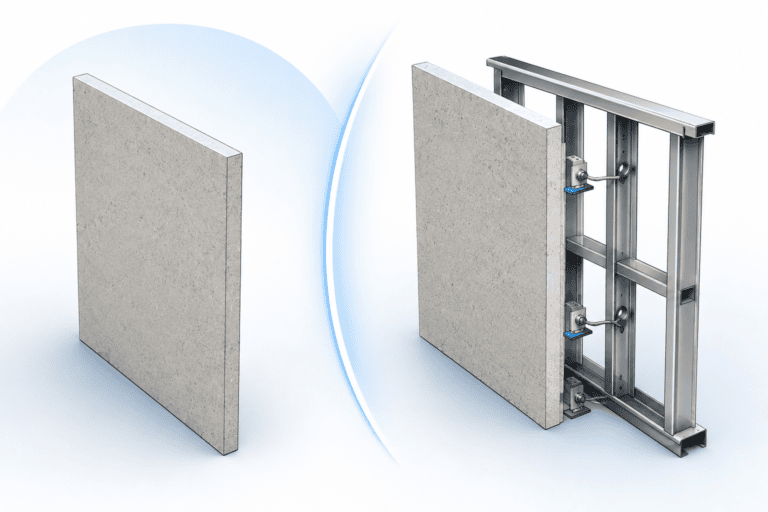
Do not apply the same number to lightweight materials. If you are working with glass-fiber reinforced concrete panels, use the GFRC Weight Calculator instead.
Before You Order Concrete
Run the quantity calculation again after the forms or excavation are actually in place.
I would check the final dimensions from the inside faces of the forms rather than relying only on the original plan dimensions.
Also check the base before ordering. A low area in the subgrade becomes extra concrete if it is not corrected first.
Have reinforcement, embedded items and formwork ready before the truck arrives. Concrete quantity is only one part of the pour. Placement access and finishing time can become the bigger problem once fresh concrete is on site.
For large or structural pours, confirm the final quantity and specifications with the ready-mix supplier or project engineer before placing the order.
Concrete Calculator FAQs
How much concrete do I need for a 10 × 10 slab?
A 10 × 10 ft slab at 4 inches thick needs about 1.23 cubic yards of concrete before waste.
With a 10% allowance, the order quantity becomes about 1.36 cubic yards.
At 6 inches thick, the same 10 × 10 slab requires about 1.85 cubic yards before waste.
How much does one cubic yard of concrete cover?
One cubic yard covers about 81 square feet at 4 inches thick.
At 5 inches thick, it covers about 64.8 square feet. At 6 inches thick, it covers about 54 square feet.
These are theoretical values before waste.
How many 80-lb bags of concrete make one cubic yard?
An 80-lb bag that yields about 0.60 cubic feet requires approximately 45 bags to produce one cubic yard.
Add your waste allowance after calculating the project volume.
How many 60-lb bags of concrete make one cubic yard?
A typical 60-lb concrete mix bag yields about 0.45 cubic feet.
One cubic yard therefore requires approximately 60 bags before waste.
Should I use concrete bags or ready-mix?
Use bags for small projects where the total quantity is manageable.
For larger slabs, driveways and footings, ready-mix is usually easier because a large volume can be placed continuously without hand-mixing dozens or hundreds of bags.
How much extra concrete should I order?
A 10% allowance is a practical starting point for many residential projects.
Use less when the forms and excavation are very accurate. Consider more when the excavation is irregular or the actual pour dimensions are difficult to control.