Footing and Stem Wall Foundation: Detail, Cost & Construction
A footing and stem wall foundation also knows as T-foundation commonly uses a concrete footing below grade with a concrete or masonry stem wall above it. The footing spreads the house load into the soil, while the stem wall raises and supports the structure.
A footing and stem wall foundation is not complicated, but it is easy to get wrong. The concrete can look perfect on day one and still cause problems later if the builder misses the drainage, rebar, soil, or moisture-control details.
The article tries to explain the basic detail of the foundation, what are the construction steps followed and usual cost of this foundation setup.
Footing and Stem Wall Detail: What Should Be Included?
A conventional footing and stem wall foundation usually includes:
- Continuous concrete footing
- Concrete or masonry stem wall
- Vertical dowels between the footing and wall
- Horizontal reinforcement in the stem wall
- Anchor bolts or approved connectors for the sill plate
- Damp-proofing or waterproofing on below-grade wall surfaces
- Gravel backfill
- Perimeter drain pipe where site conditions require it
- Finished grade sloping away from the house
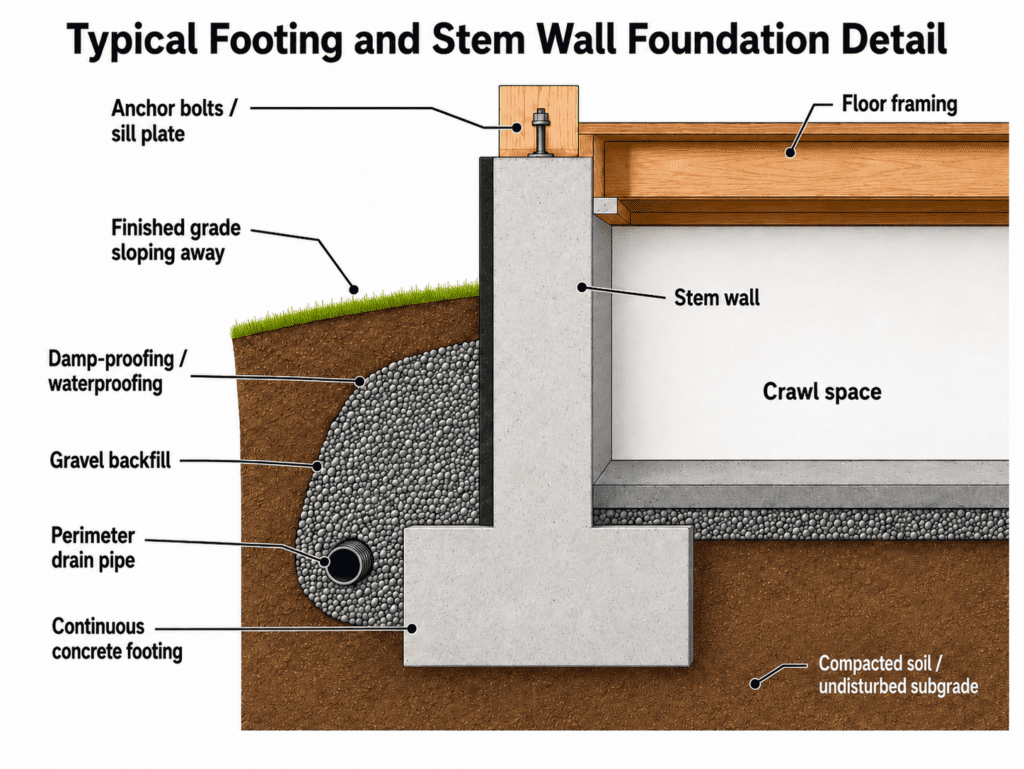
Also check if your foundation has continuous footing and not pier and beam setup in order to identify correct foundation.
Anchor bolts are not just small hardware details. They connect the wood sill plate to the foundation and help transfer lateral and uplift forces into the foundation system.
The IRC covers residential foundation requirements for footings, foundation walls, drainage, basement waterproofing, and frost protection depending on site conditions and local adoption.
Stem wall problems usually have less to do with concrete strength and more to do with what happens around the wall. Poor drainage, loose soil, missing dowels, or bad backfill can create cracks and moisture problems even when the concrete itself is strong enough.
How Footing and Stem Wall Construction Works
1. Excavate and prepare the soil
The contractor excavates to the required depth and removes soft, loose, or organic soil. In cold regions, the footing usually needs to sit below local frost depth unless an approved frost-protected shallow foundation design is used.
Frost-protected shallow foundation guidance allows shallower foundation depths in some projects when the design uses approved insulation details.
2. Set forms and place rebar
The crew sets the footing forms, checks elevation, places rebar, and installs vertical dowels. The footing spreads the building load into the soil, while the dowels help tie the footing and stem wall together.
Do not treat rebar placement casually. A bar that sits in the wrong place may look fine before the pour, but it does not do the same job inside the concrete.
3. Pour the footing
In a two-pour system, the footing is placed first. After it gains enough strength, the crew forms or builds the stem wall above it.
Concrete should be placed, consolidated properly with an internal vibrator where appropriate, and cured correctly. Poor consolidation or early drying can cause honeycombing, weak surfaces, and avoidable cracking.
ACI residential concrete guidance covers subgrade preparation, forms, reinforcement, placement, consolidation, finishing, and curing for residential concrete work.
4. Build or pour the stem wall
The stem wall may be cast-in-place concrete, concrete masonry block, or another approved foundation wall system. It supports the floor framing, slab edge, or crawl space perimeter and keeps wood framing away from direct ground moisture.
If the stem wall is built with CMU, our concrete block foundation guide explains how the block wall, footing, reinforcement, grout, waterproofing, and drainage work together.
Some stem wall systems may bear directly on soil without a separate spread footing, but this article focuses on the common residential footing and stem wall foundation because that is what most homeowners mean when they use this term.
Here is a useful video showing how stem wall is poured on site.
5. Add moisture control and drainage
This is the step where a cheap foundation job turns into an expensive repair later.
In my experience, most stem wall failures trace back to water, not concrete strength. The mix can be sound and the rebar placed correctly, and the wall will still crack or leak if drainage was an afterthought.
Surface grading does the first line of work. The ground around the house needs to slope away from the foundation, not toward it. Below grade, free-draining gravel and a perimeter drain pipe relieve water pressure before it reaches the wall.
Damp-proofing handles ordinary ground moisture on the wall surface. Waterproofing is the heavier treatment, and I specify it whenever there is hydrostatic pressure or a high water table on site.
A vapor barrier handles a different problem entirely. In slab construction it goes directly under the slab. In a crawl space, it’s laid over the ground itself, not attached to the framing above it. Either way, its job is to stop ground moisture from migrating up into the living space.
A complete drainage and moisture setup typically includes:
- Gravel backfill
- Perforated drain pipe
- Filter fabric
- Damp-proofing or waterproofing on the wall
- Vapor barrier under the slab or floor system
- Downspout extensions
- Finished grade sloping away from the home
6. Backfill carefully
Backfill should not go in too early, and it should not push hard against a fresh wall. Heavy clay placed directly against the stem wall can hold water and increase pressure. Use suitable backfill and compact it in lifts.
One-Pour vs Two-Pour Stem Wall Construction
Some builders pour the footing and stem wall together. People call this a one-pour footing and stem wall, mono pour footing and stem wall, or monolithic footing and stem wall.
| Method | Best For | Main Advantage | Main Risk |
|---|---|---|---|
| One-pour footing and stem wall | Simple layouts and experienced crews | Faster schedule | Harder formwork, rebar control, and consolidation |
| Two-pour footing and stem wall | Most residential work | Better control of alignment and wall placement | Takes more time |
One-pour construction can work well, but it is not automatically better. If the forms shift, rebar moves, or concrete does not consolidate properly it will not be effective.
On the other had the major disadvantage of two-pour setup is that there will be a cold joint between stem wall and footing so that has to be designed and kept in mind.
Typical Stem Wall Foundation Dimensions
Typical residential ranges for footing and stem wall foundation dimensions are given in the table below. Do not copy them blindly. The final design should depend on local code, frost depth, soil bearing capacity, seismic category, wall height and the actual structural loads.
| Element | Common Residential Range |
|---|---|
| Footing width | 16–24 inches |
| Footing thickness | 8–12 inches |
| Stem wall thickness | 6–10 inches |
| Stem wall height | 1–4 feet |
| Rebar | #4 or #5 bars are common |
A footing detail that worked on one house may be wrong on another site. Soil, frost depth, wall height, and drainage conditions change the foundation design.
If the wall is built with concrete blocks or CMU, our concrete cinder block calculator can help estimate block quantity, mortar, waste and rough material cost before construction.
When a Stem Wall Foundation Works Best
A stem wall foundation often makes sense when:
- The home has a crawl space
- The lot has slope or grade changes
- The finished floor needs to sit above grade
- Frost depth affects footing design
- Drainage control matters
- Soil movement is a concern
- Plumbing or mechanical access below the floor is useful
It may not be the cheapest choice on a flat, stable lot where a slab-on-grade foundation is code-compliant and easier to build.
When it works / when it does not
| Works Well When | Reconsider When |
|---|---|
| The lot slopes or needs grade adjustment | Soil is weak and needs a deeper foundation system |
| The house needs a crawl space | Drainage cannot be managed properly |
| The floor needs elevation above grade | A simple slab is code-compliant and cheaper |
| Frost depth affects design | Budget cannot support excavation, drainage, and wall forming |
Stem Wall Foundation Cost
A footing and stem wall foundation usually costs more than a basic slab because it needs more excavation, formwork, concrete, reinforcement, drainage, and moisture protection.
| Cost Factor | Why It Matters |
|---|---|
| Excavation depth | Deeper trenches increase labor and hauling |
| Wall height | Taller stem walls need more concrete and steel |
| Soil condition | Weak or expansive soil may need special design |
| Drainage | Gravel, pipe, fabric, and outlets add cost |
| Waterproofing | Below-grade walls need moisture protection |
| Labor | Stem wall forming takes time and skill |
As a rough homeowner planning range, many residential stem wall foundations can fall around $8–$18 per square foot, but difficult sites can go higher.
Concrete and reinforcing steel are separate cost inputs, and both can change as material markets move. See our latest analysis of 2026 tariffs on concrete, steel, and lumber costs for current market context.
Common Stem Wall Foundation Problems
The image below lists and demonstrates common stem wall foundation problems
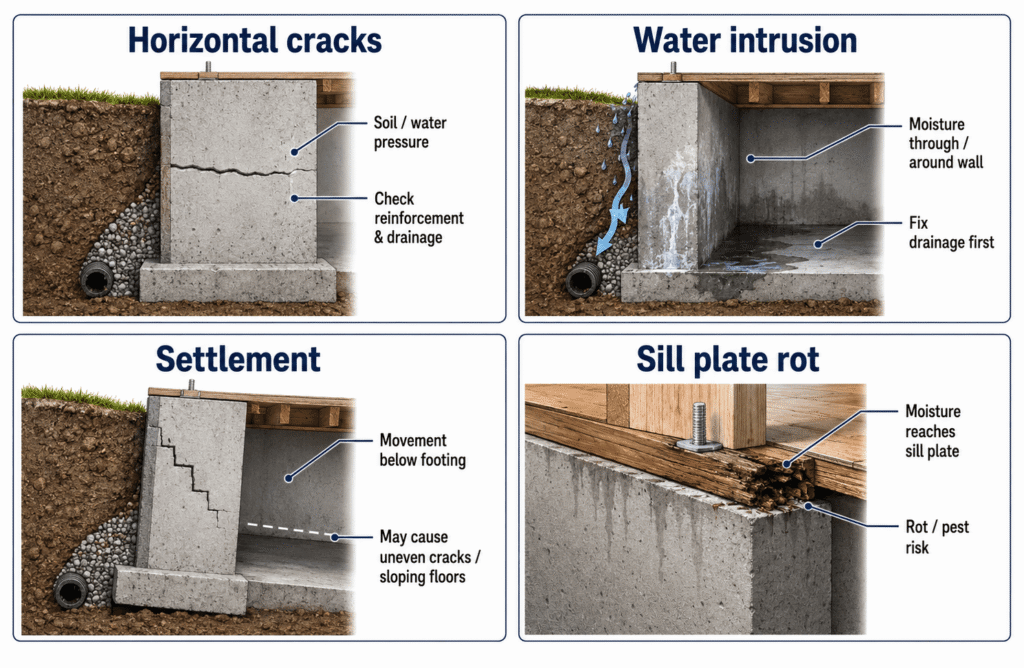
Horizontal cracks
Horizontal cracks can point to soil pressure, water pressure, or poor reinforcement. They deserve more attention than small hairline shrinkage cracks.
Water intrusion
Water stains, damp crawl spaces, musty smells, and efflorescence usually mean moisture is moving through or around the wall. Fix drainage first. Paint alone will not stop outside water pressure.
Settlement
Uneven cracks, sloping floors, or gaps near doors and windows may indicate settlement below the foundation.
Sill plate rot
If moisture reaches the wood sill plate, rot and pest damage can follow. Clearance from grade, flashing, anchor bolts, and capillary breaks all matter.
If your stem wall is cracking, shifting, or showing signs of foundation settlement, call (888) 664-3492 to discuss the problem with a local foundation repair professional.
Call Now: (888) 664-3492Final Thoughts
A footing and stem wall foundation is a normal residential foundation system, not a complicated specialty detail. But it needs the right basics: firm soil, continuous load path, correct reinforcement, moisture control, drainage, and careful backfill.
Get those details right, and the foundation is far more likely to stay dry, stable, and trouble-free for years.
FAQs
What is the difference between a footing and a stem wall?
The footing sits lower and spreads the house load into the soil. The stem wall sits above the footing or bearing base and supports the structure above grade.
Can footing and stem wall be poured together?
Yes. Builders call this a one-pour or monolithic footing and stem wall. It can save time, but it needs careful formwork, reinforcement placement, and concrete consolidation.
Does a stem wall foundation need drainage?
Yes, especially when the wall retains soil. Drainage reduces water pressure and helps prevent cracks, leaks, and damp crawl spaces.
Is a stem wall foundation better than a slab?
It depends on the site. A stem wall often works better for crawl spaces, sloped lots, frost-depth conditions, and drainage-sensitive sites. A slab may be cheaper on flat, stable ground.
Can a stem wall crack?
Yes. Stem walls can crack from shrinkage, settlement, soil pressure, poor drainage, or weak reinforcement detailing.