What Is Used in Prestressed Concrete? Materials, Tendons and Uses
In prestressed concrete, high-strength concrete and high-tensile steel tendons are used to place the member into compression before service loads act on it. This reduces tensile cracking, improves deflection control, and allows longer, slimmer structural members than ordinary reinforced concrete.
A prestressed concrete bridge girder can often span much farther than a normal reinforced concrete beam of similar depth. The reason is simple: the concrete is already compressed internally before traffic loads, floor loads, or other service loads act on it.
Instead of allowing concrete to crack first and then relying on reinforcement to control those cracks, prestressing reduces tensile stress from the beginning. That is why prestressed concrete is widely used in bridges, parking structures, floor systems, tanks, piles, railway sleepers, and long-span infrastructure.
Unlike ordinary residential concrete systems where cracking is often linked to shrinkage or settlement, prestressed members are specifically designed to minimize service cracking.
What Materials Are Used in Prestressed Concrete?
Prestressed concrete mainly uses:
- high-strength concrete
- high-tensile steel tendons
- anchorage systems
- ducts and grout in post-tensioned systems
| Component | Function | Why It Matters |
|---|---|---|
| High-strength concrete | Resists compression | Handles large prestressing forces |
| Steel tendons | Introduce prestress force | Compress the concrete internally |
| Anchorage systems | Hold tendon force | Maintain prestressing force |
| Ducts and grout | Protect tendons | Common in post-tensioning systems |
High-strength concrete is necessary because ordinary concrete may not safely resist the large compressive forces introduced during prestressing.
This is also why prestressed members are typically manufactured under tighter quality control than ordinary site-cast concrete. For a related discussion on structural concrete behaviour and reduced self-weight, see our guide on foam concrete vs normal concrete.
Why Steel Tendons Are Used in Prestressed Concrete
Steel tendons are used because they can carry extremely high tensile force without permanent deformation under normal service conditions.
These tendons are stretched using hydraulic jacks, and when they attempt to shorten, they compress the surrounding concrete.
Common tendon forms include:
- seven-wire strands
- prestressing bars
- high-strength steel wires
This internal compression is what allows prestressed concrete beams and girders to remain slimmer while carrying heavy loads over long spans.
The Precast/Prestressed Concrete Institute (PCI) provides detailed technical guidance on prestressed concrete design and construction practices used throughout the industry.
Prestressed concrete does not make concrete strong in tension. Instead, it reduces or delays tensile stress so the member remains mostly compressed during service loading.
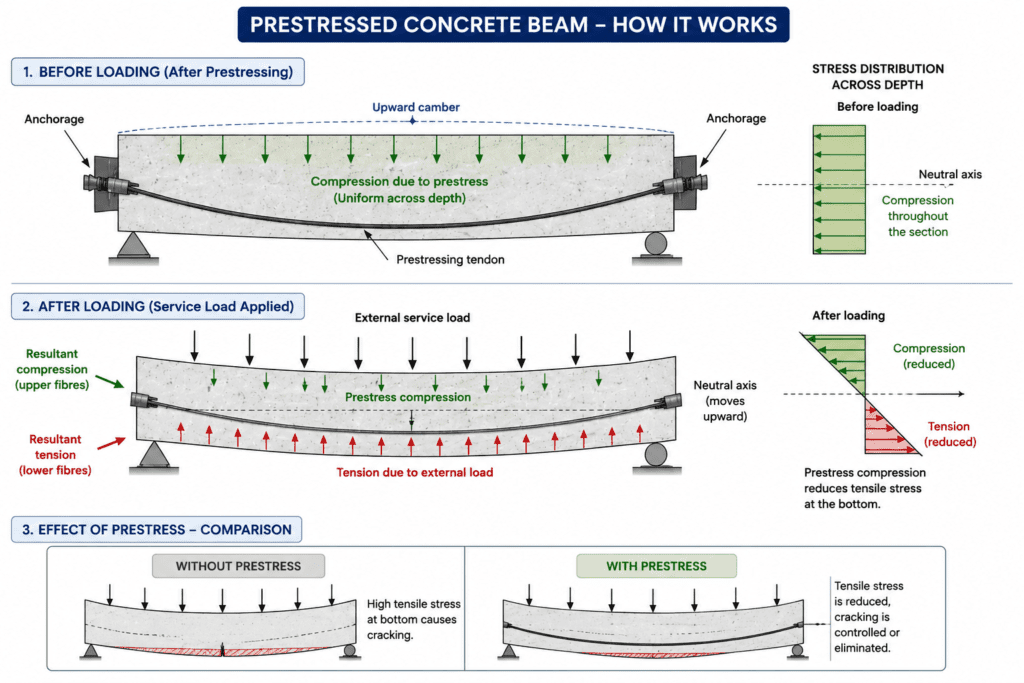
What Happens Inside a Prestressed Concrete Beam?
In an ordinary reinforced concrete beam:
- the lower part of the beam goes into tension under bending
- cracks form once tensile strength is exceeded
- reinforcement controls crack width afterward
In a prestressed concrete beam:
- internal compression already exists before loading
- service loads must first overcome that compression
- cracking is delayed or significantly reduced
That is why prestressed concrete is commonly used in bridge girders, long-span floor systems, parking decks, and transportation infrastructure.
The Federal Highway Administration (FHWA) also provides prestressed concrete bridge design examples showing how prestressing improves structural efficiency in highway structures.
Pre-Tensioning vs Post-Tensioning
Prestressed concrete construction mainly uses two methods: pre-tensioning and post-tensioning.
Pre-Tensioning
In pre-tensioning:
- Steel tendons are stretched first
- Concrete is cast around them
- Tendons are released after the concrete hardens
The prestressing force transfers into the concrete through bond.
Pre-tensioning is commonly used in:
- prestressed concrete sleepers
- prestressed concrete planks
- prestressed concrete piles
- prestressed concrete poles
Post-Tensioning
In post-tensioning:
- Ducts are cast into the concrete member
- Tendons are stressed after concrete hardens
- Tendons are anchored mechanically at the ends
Post-tensioning is widely used in:
- bridges
- parking structures
- long-span slabs
- tanks
- commercial floor systems
Most residential structures use ordinary reinforced concrete instead of prestressed systems because prestressing becomes more economical on larger spans and heavier structural systems.
That is why residential cracking problems are usually related to drainage, settlement, or shrinkage rather than prestress force. For example, our guide on foundation crack repair explains how cracks commonly develop in conventional reinforced concrete foundations.
Prestressed Concrete Losses
Prestressed concrete losses are reductions in prestressing force over time.
These losses matter because the force applied during stressing is not fully retained throughout the structure’s service life.
| Type of Loss | Examples |
|---|---|
| Immediate losses | elastic shortening, anchorage slip, friction |
| Long-term losses | creep, shrinkage, steel relaxation |
Engineers account for these prestressed concrete losses during design to ensure adequate long-term crack control and deflection performance.
Prestressed concrete is most economical where longer spans, lower cracking, and improved deflection control justify the additional design and construction complexity.
Common Uses of Prestressed Concrete
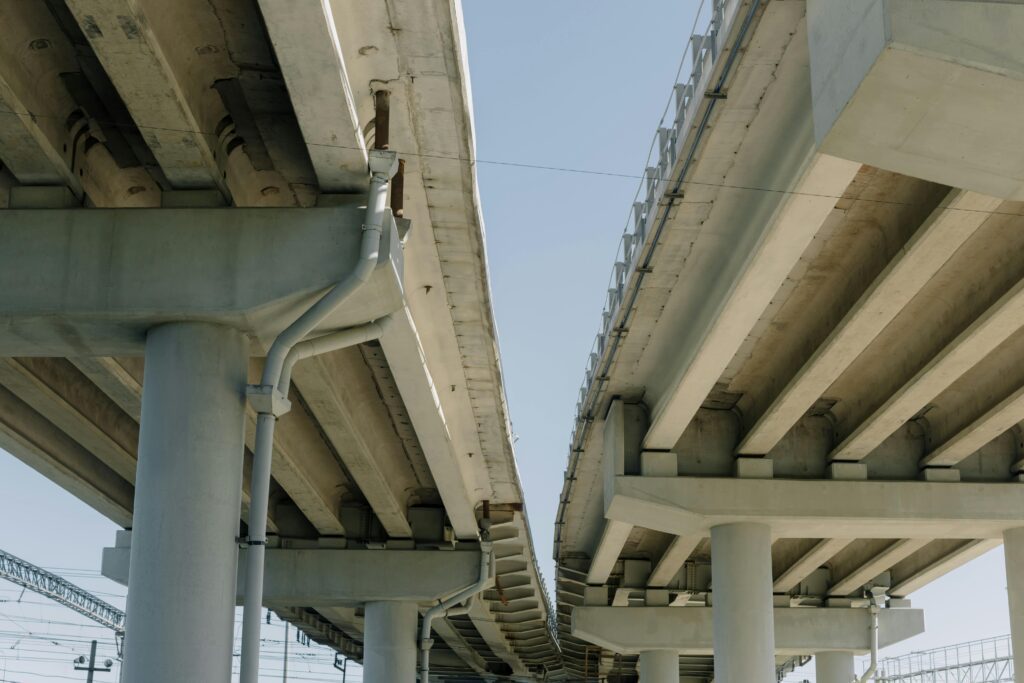
Prestressed concrete is widely used where long spans, durability, and reduced cracking are important.
| Prestressed Concrete Member | Typical Use |
|---|---|
| Prestressed concrete girder | Highway bridges |
| Prestressed concrete I beam | Buildings and bridges |
| Prestressed concrete floor systems | Parking structures and commercial floors |
| Prestressed concrete cylinder pipe | Water infrastructure |
| Prestressed concrete piles | Deep foundations |
| Prestressed concrete poles | Utility infrastructure |
| Prestressed concrete tanks | Water and industrial storage |
For buried transportation and drainage infrastructure, see our guide on precast concrete culverts.
Prestressed Concrete vs Reinforced Concrete
| Prestressed Concrete | Reinforced Concrete |
|---|---|
| Compression introduced before loading | Steel mainly acts after cracking begins |
| Better crack control | More visible service cracking |
| Longer economical spans | Shorter economical spans |
| More complex construction | Simpler construction |
| Common in bridges and long-span systems | Common in foundations, slabs, and walls |
This difference becomes important when diagnosing cracking. A crack in an ordinary reinforced concrete wall may relate to settlement or shrinkage, while cracking in prestressed concrete may involve tendon force, prestress losses, anchorage issues, or tendon corrosion. For broader structural repair context, see our guide on foundation repair basics.
Advantages and Disadvantages of Prestressed Concrete
Advantages
- longer spans
- reduced cracking
- improved durability
- better deflection control
- thinner structural sections
- higher load capacity
Disadvantages
- higher initial cost
- specialised equipment required
- more complex design
- difficult tendon inspection and repair
Prestressed Concrete Failure
Prestressed concrete failure can occur because of:
- tendon corrosion
- poor grouting
- anchorage failure
- overload
- fire damage
- excessive prestress losses
- construction defects
Because tendons carry very high stress, corrosion protection and proper grouting are critical for long-term safety and durability.
Final Thoughts
Prestressed concrete combines high-strength concrete with high-tensile steel tendons to create a pre-compressed structural member. This improves crack resistance, span capacity, durability, and long-term service performance compared to ordinary reinforced concrete.
That combination of efficiency, strength, and durability is why prestressed concrete remains one of the most important structural systems used in modern infrastructure and long-span construction.
Frequently Asked Questions
What materials are used in prestressed concrete?
Prestressed concrete mainly uses high-strength concrete and high-tensile steel tendons. Anchorage systems, ducts, grout, and stressing equipment may also be used depending on the construction method.
Why are tendons used in prestressed concrete?
Tendons introduce compressive force into the concrete, reducing tensile cracking and improving structural performance.
What is the difference between pre-tensioning and post-tensioning?
In pre-tensioning, tendons are stressed before concrete is cast. In post-tensioning, tendons are stressed after the concrete hardens.
What are prestressed concrete losses?
Prestressed concrete losses are reductions in prestressing force caused by effects such as elastic shortening, anchorage slip, friction, creep, shrinkage, and steel relaxation.
Where is prestressed concrete commonly used?
Prestressed concrete is widely used in bridges, girders, piles, tanks, floor systems, pipes, sleepers, and long-span structural members.