Movement Joint in Concrete: Expansion, Control and Isolation Joints
A movement joint in concrete gives slabs a planned place to shrink, expand, settle, or separate without cracking randomly. The main types are control joints, expansion joints, isolation joints, and construction joints. Correct spacing, timing, filler, and sealant help reduce cracking, spalling, water entry, and long-term slab damage.
Why Concrete Needs Movement Joints
Concrete is strong in compression but weak in tension. That is why slabs crack when movement is restrained.
Concrete shrinks and also experiences thermal movement. If a nearby element such as wall, column etc. stops that movement, tensile stress builds in the concrete.
When the stress exceeds the concrete’s tensile strength, cracking occurs.
The main sources of movement are:
- Drying shrinkage as the concrete cures and loses moisture.
- Thermal expansion and contraction during daily and seasonal temperature changes.
- Plastic shrinkage before hardening, especially in hot, dry, or windy weather.
- Settlement or weak support below the slab.
- Restraint from fixed objects such as walls, columns, drains, steps, and adjacent slabs.
A movement joint in concrete basically gives concrete breathing room to expand or contract.
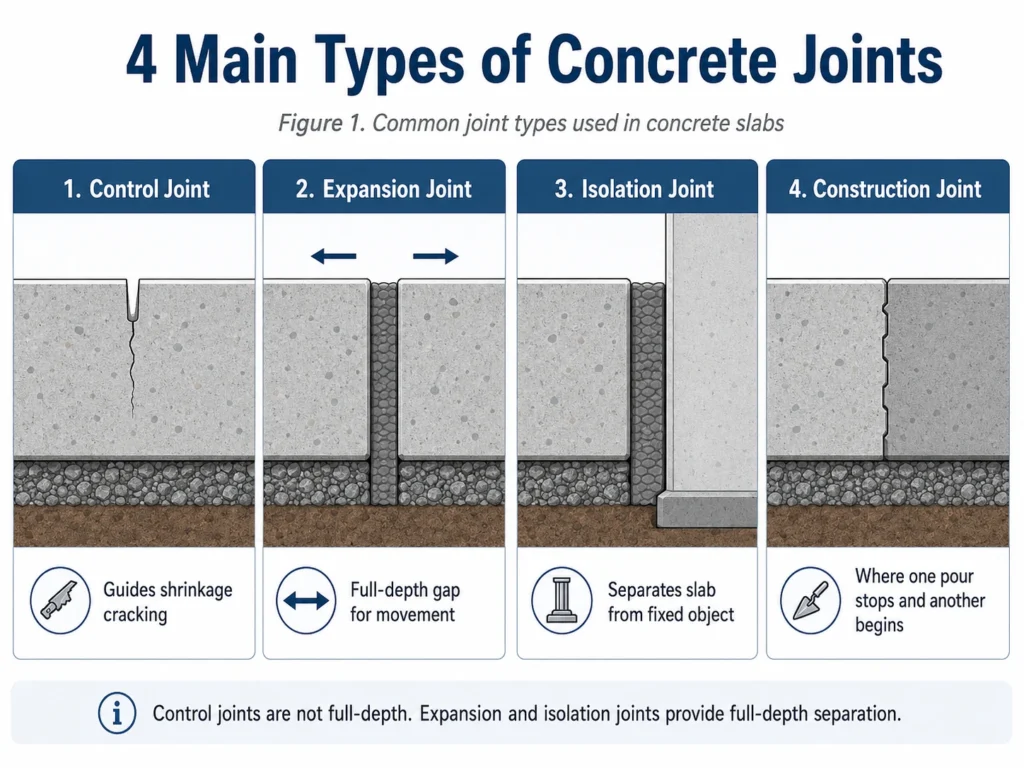
Figure 1 shows four main types of joint types which are the explained further in coming sections.
Types of Movement Joint in Concrete Explained
1. Control Joint, or Contraction Joint
A control joint is a weakened line in the slab. You cut or groove it so shrinkage cracks form there instead of running randomly across the surface.
The joint does not stop the crack. It controls where the crack forms.
Common ways to form a control joint include:
- Saw cut: Cut with a diamond blade after the concrete has hardened enough.
- Grooving tool: Pressed into the surface while the concrete is still plastic.
- Formed groove: Made with a timber, metal, or plastic strip during placement.
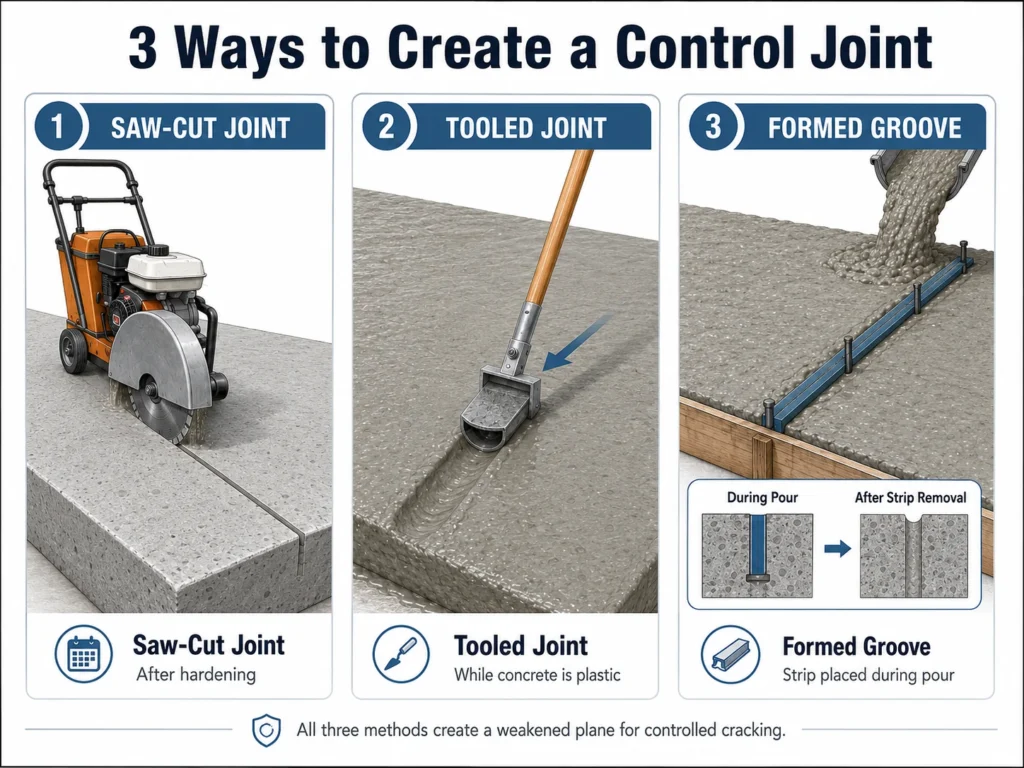
Saw-cut timing matters. If cut too early the blade can ravel the joints. Cut too late and random cracks may already have started. Saw cutting often happens within a few hours after finishing, commonly around 4 to 12 hours.
2. Expansion Joint
Unlike the control joint, an expansion joint is a full-depth gap between two concrete sections. It gives the sections complete freedom to move against each other.
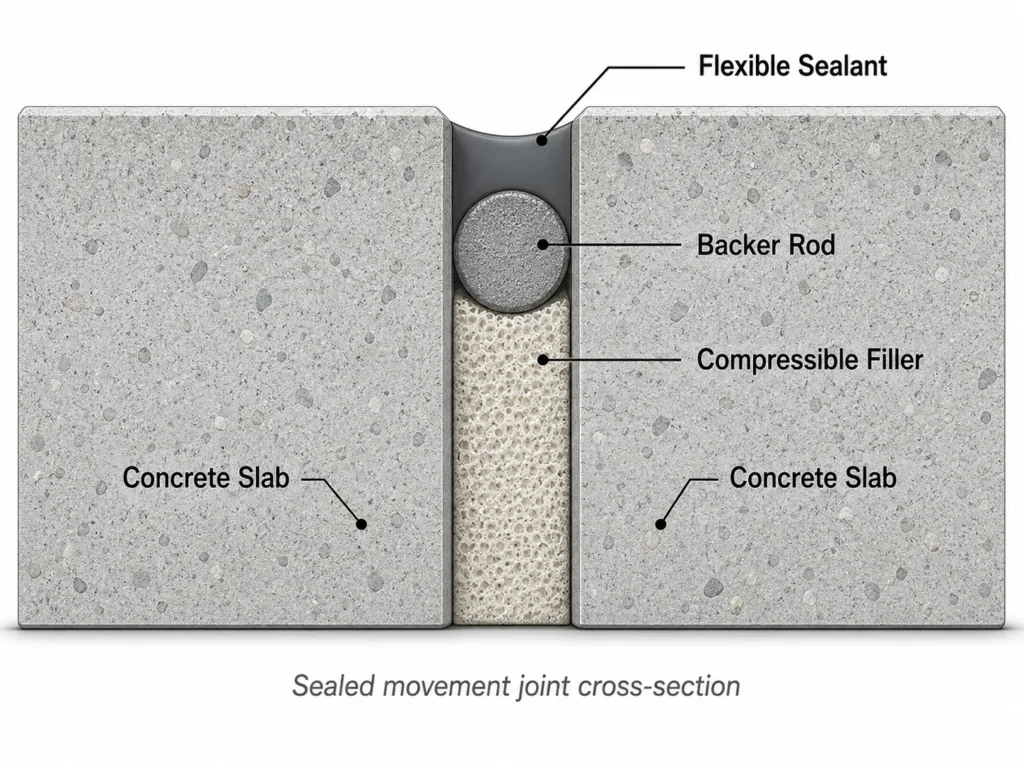
The joint usually contains compressible material such as fiberboard or closed-cell foam. The top is often sealed with a flexible sealant to reduce water and debris entry, while a sealed concrete surface can help limit staining and moisture absorption around exposed slab joints.
If you need to choose a sealant, see our guide to expansion joint sealant for concrete, including self-leveling, non-sag, and higher-movement options.
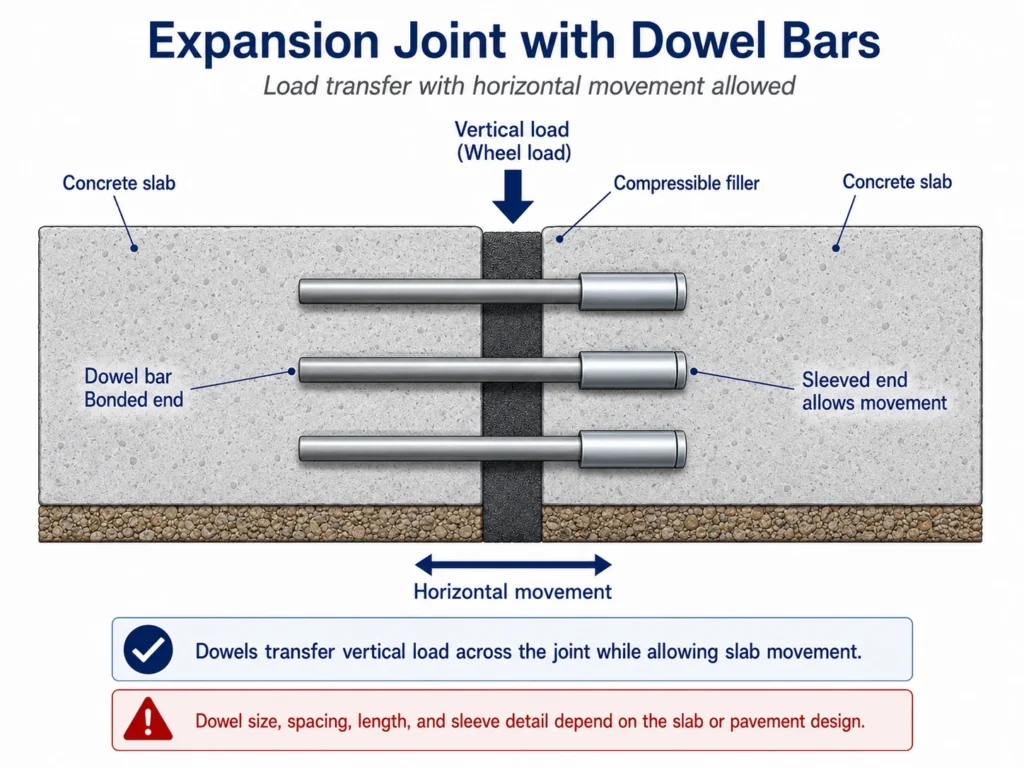
Some pavement expansion joints use dowel bars for load transfer. One end of each dowel is sleeved so it can slide. This transfers vertical load while still allowing horizontal movement. The mechanism is shown in Figure 3.
Dowel size, sleeve detail, length, and spacing must come from the slab or pavement design. In heavier pavement work, 25 mm bars at 300 mm centers may be used, but this is not a universal residential slab detail.
Expansion joints matter most where concrete meets a fixed structure or where long slab runs face significant temperature movement.
3. Isolation Joint
An isolation joint separates a slab from a fixed element.
Use isolation joints around columns, wall footings, drain frames, manhole covers, steps, post bases, and foundation edges.
The slab and the fixed object do not move the same way. Without separation, stress builds at the corner or edge. A diagonal crack can then radiate outward, often at about 45 degrees. The short video below shows why isolation joints are needed
4. Construction Joint
A construction joint forms where one concrete pour stops and another begins.
It may occur at the end of the day, at a planned pour break, or where a later slab section is added.
A construction joint is not automatically a movement joint in concrete. It still needs proper detailing. Depending on the job, it may need dowels for load transfer, tie bars for continuity, a roughened face, a keyway, or other surface preparation before the next pour.
Joint Spacing
Control joint spacing depends on slab thickness, mix design, curing, drying rate, subgrade restraint, reinforcement, and slab shape.
For plain unreinforced slabs on grade, a common rule of thumb is given in the Table 1 below.
| Slab Thickness | Control Joint Spacing | Max Panel Ratio |
|---|---|---|
| 100 mm (4 in.) | 2.4 m to 3.6 m (8 ft to 12 ft) | 1.5 : 1 |
| 125 mm (5 in.) | 3.0 m to 4.5 m (10 ft to 15 ft) | 1.5 : 1 |
| 150 mm (6 in.) | 3.6 m to 5.4 m (12 ft to 18 ft) | 1.5 : 1 |
| 200 mm (8 in.) | 4.8 m to 7.2 m (16 ft to 24 ft) | 1.5 : 1 |
Table 2. Typical control joint spacing for plain unreinforced slabs on grade.
Use tighter spacing when the slab has:
- rapid drying conditions
- high water content
- irregular geometry
- re-entrant corners
- restraining subgrade
- calcium chloride in the mix
Reinforcement can reduce crack width, but it does not remove the need for joints in ordinary slabs on grade.
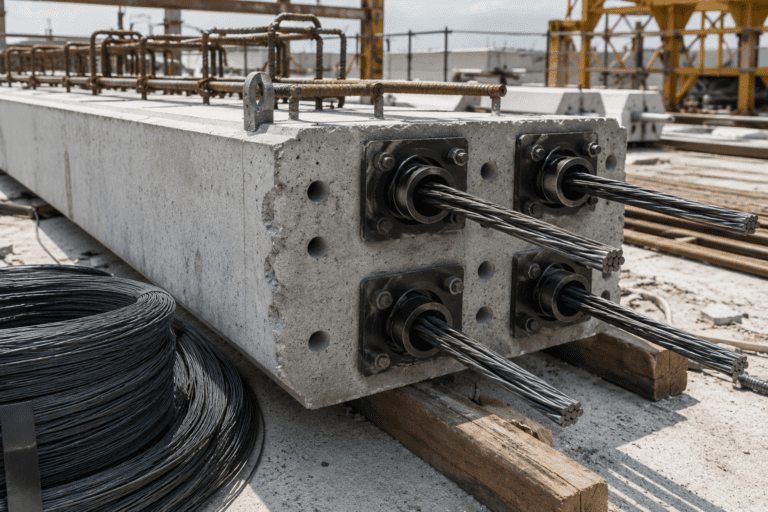
Post-tensioned slabs follow a different jointing logic and need structural engineering input.
ACI 302.1R gives more detailed guidance on slab construction, jointing, isolation joints, and construction joints in its ACI 302.1R slab guide.
Materials
| Material | Where it goes | What it does |
|---|---|---|
| Compressible fiberboard or foam | Expansion and isolation joints | Allows movement and prevents hard contact |
| Backer rod | Behind sealant in sealed joints | Controls sealant depth and shape |
| Polyurethane or polysulfide sealant | Top of many outdoor joints | Keeps water and debris out |
| Hot-pour bitumen sealant | Some pavement joints | Provides flexible sealing in pavement work |
| Mild steel dowel bars | Some pavement and slab joints | Transfers load across the joint |
| PVC or hydrophilic waterstop | Below-grade and water-retaining structures | Helps control water passage |
Table 2. Common joint materials and their functions.
Apply sealant to clean, dry joint faces. The sealant surface is usually set slightly below the top of the slab, not flush with it.
The correct sealant depth depends on joint width and the sealant manufacturer’s shape-factor guidance.
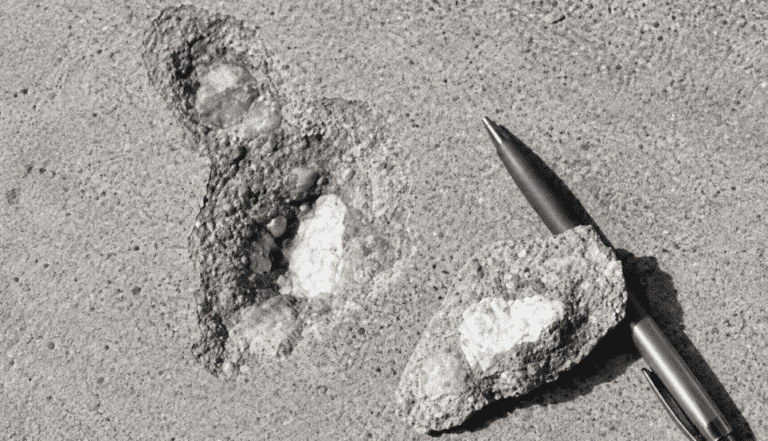
Do not fill a movement joint in concrete with cement mortar or rigid grout. That stops the joint from moving. When the slab expands, the rigid filler can cause concrete spalling or cracking near the joint.
For practical guidance on slab joint types, saw-cut timing, fillers, and sealing, the National Ready Mixed Concrete Association guide on joints in concrete slabs on grade is a useful reference.
Where Each Joint Type Goes
Driveways
Driveways need control joints at regular intervals along the length and across the width.
They also need isolation joints where the driveway meets a garage slab, foundation wall, boundary wall, public sidewalk, or other fixed edge.
The garage threshold is often missed. If the driveway is cast tight against the garage slab or wall, cracks and spalling can appear near the entrance within a few years.
If you are planning a new driveway or slab, use our concrete calculator to estimate concrete volume before ordering.
Patios
Patios need a joint grid that accounts for steps, inspection covers, post bases, downspout outlets, and the house foundation.
Each fixed element needs proper isolation before the pour.
Where the patio meets the house foundation, an isolation joint helps reduce stress from differential movement.
If you plan to install pavers over an existing slab, check old cracks and joints first. Movement can reflect through the new surface. See our guide on installing patio pavers over concrete before covering an old slab.
Sidewalks
Sidewalks usually need contraction joints that create near-square panels.
Isolation joints are needed where the sidewalk meets curbs, utility covers, steps, buildings, or fixed structures.
Long runs in full sun or freeze-thaw climates need closer attention to spacing and sealing.
Industrial Floors
Industrial floors need more careful joint design.
Forklift traffic, racking loads, floor flatness, and repeated wheel impact make joint layout an engineering decision, not just a finishing detail.
Armored joint nosings may be needed to protect joint edges. In shrinkage-compensating concrete, joint spacing may be specified by the mix designer rather than estimated from thickness alone.
Common Mistakes
Using a control joint where an isolation joint is needed
A saw cut creates a weak line. It does not separate the slab from a wall, column, drain frame, or foundation edge.
If the fixed element moves differently from the slab, the slab can still crack.
Cutting saw-cut joints too late
Once random cracks start, cutting the control joints will not redirect them.
The timing depends on concrete strength gain, slab thickness, saw type, weather, and mix design. Waiting until the next morning on a hot, dry day is often too late.
Cutting too shallow
A shallow cut may not initiate a controlled crack.
For many slabs, the minimum saw-cut depth is about one-quarter of the slab thickness. Some heavier applications may need deeper cuts.
Filling movement joints with cement mortar
This stops the joint from working. I have seen problems with homeowners using self leveling concrete and filling movement joints.
When the slab expands, the mortar transfers compression across the joint. The likely result is spalling, edge damage, or cracking near the joint.
Creating long, narrow panels
Long, narrow panels crack more easily.
Keep panels as close to square as the layout allows. Where a narrow strip cannot be avoided, reduce joint spacing in the long direction.
Ignoring concrete workability
Poor workability affects placing, finishing, and slab quality.
Before placing concrete, the concrete slump test helps check whether the mix is within the expected workability range.
Joint Repair
Signs a Joint Has Failed
A movement joint in concrete may need repair when:
- the sealant has cracked, debonded, or pulled away
- weeds are growing through the joint
- grit or debris is packed tightly in the joint
- joint edges are spalling
- one slab panel sits higher than the next
- cracks are forming beside the joint instead of in it
How to Repair
For sealant failure, remove all old sealant and backer material. Clean the joint faces by wire brushing, grinding, grit blasting, or compressed air as needed.
Install fresh backer rod where required. Apply new sealant according to the manufacturer’s instructions.
Do not apply new sealant over failed sealant. It will not bond properly.
For spalled joint edges, saw-cut back to sound concrete. Remove weak material and repair with a suitable polymer-modified or epoxy repair mortar. Heavy wheel traffic may require armored nosings or edge protection.
For faulted panels, sealant repair is not enough. A height difference usually points to loss of support, settlement, or slab movement. Slab lifting, subgrade repair, or replacement may be needed.
If the crack is in a foundation wall or another structural element, do not treat it like a normal slab joint. Start with our foundation crack repair guide before choosing a repair method.
Final Thought
Movement joint in concrete is not a decorative cut. The give breathing room to concrete elements to move.
Use the right joint type. Place it before or during the pour. Cut control joints at the right time. Keep outdoor joints clean and sealed.
Those basics decide whether a slab performs well or develops avoidable cracking problems.
FAQs
What is the difference between a control joint and an expansion joint?
A control joint is a groove or saw cut that weakens the slab at a planned line so shrinkage cracks form there. It does not physically separate the slab sections.
An expansion joint is a full-depth gap with compressible filler that lets two sections move independently. One guides cracking. The other provides separation.
How deep should a control joint be?
For many slabs, the saw cut should be at least one-quarter of the slab depth. For a 100 mm, or 4 inch, slab, that means about 25 mm, or 1 inch.
Some specifications require one-third depth for heavier applications.
Do residential driveways need expansion joints?
Most residential driveways do not need expansion joints between every bay if control joints and isolation joints are placed correctly.
Expansion joints become more important where the driveway meets a garage slab, foundation wall, sidewalk, or other fixed structure.
Can concrete crack even if it has joints?
Yes. Joints reduce random cracking, but they do not guarantee a crack-free slab.
Excess water, weak subgrade, late saw cutting, oversized panels, poor curing, settlement, and heavy loads can still cause cracking.
What happens if you fill a movement joint with cement mortar?
The joint stops working.
Mortar is rigid. It prevents movement and transfers stress across the joint. This can cause spalling, broken edges, or cracking nearby.
Should outdoor joints be sealed?
In most cases, yes.
Sealant helps reduce water entry, debris buildup, weed growth, and freeze-thaw damage. The joint must be clean and dry before sealing.
What is an isolation joint and where does it go?
An isolation joint is a full-depth separation between a slab and a fixed element.
Use it around columns, wall footings, drains, manholes, steps, posts, and foundation edges.
How are movement joints different in post-tensioned slabs?
Post-tensioned slabs are designed differently from ordinary slabs on grade.
Tendons put the slab into compression and can allow longer joint-free areas. But thermal movement, creep, restraint, and edge movement still matter. Saw cuts must also avoid tendons.
Post-tensioned slab jointing should be handled by the structural engineer.