Asphalt vs Concrete Roads: Cost, Design, and Performance
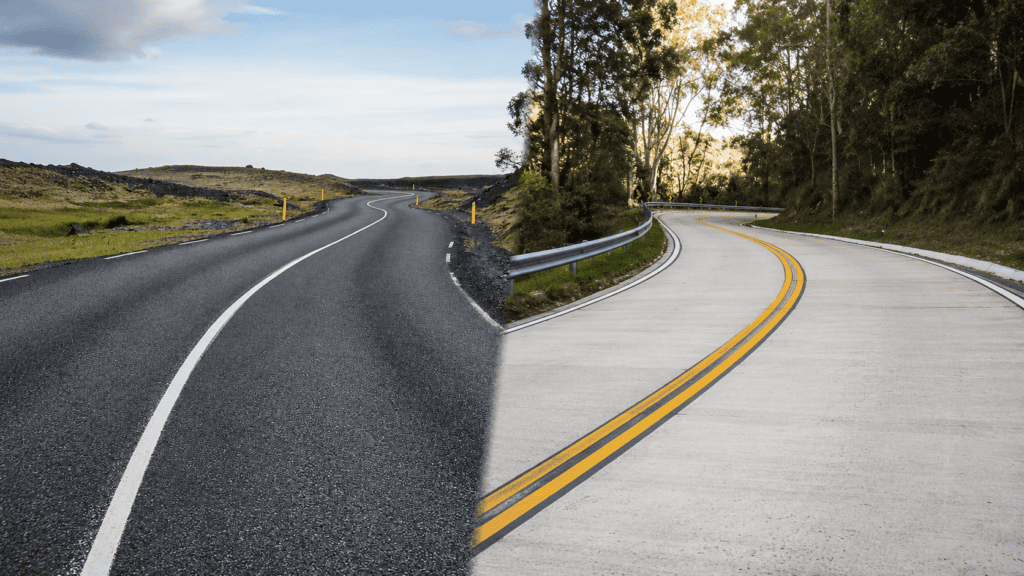
The main difference between asphalt and concrete roads is how they carry traffic loads.
Concrete acts as a stiff slab that spreads wheel loads over a broad area. That is why its often also called rigid pavement.
Asphalt bends more and relies on several layers to reduce stress before it reaches the underlying soil. Its also called flexible pavement.
That basic difference shapes how each road is designed and maintained. It also affects cost and service life.
Asphalt vs Concrete Roads at a Glance
| Factor | Concrete road | Asphalt road |
|---|---|---|
| Pavement type | Rigid pavement | Flexible pavement |
| Initial cost | Often higher | Often lower |
| Construction speed | Slower as concrete must gain strength before opening | Faster to place and reopen |
| Heavy-load performance | Strong resistance to rutting | Depends heavily on mix and layer design |
| Common rehabilitation | Joint repair, grinding, patching, overlays | Crack sealing, milling, patching, overlays |
| Best fit | Heavy-traffic and long-life projects | Fast construction and flexible maintenance |
Rigid vs Flexible Pavement: The Structural Difference
A concrete pavement carries most of the wheel load through the bending strength of the slab.
Because the slab is stiff, it spreads the load over a wider area of the base and subgrade. This reduces the stress reaching the soil below.
An asphalt pavement carries the load through several layers working together as shown in the image below.
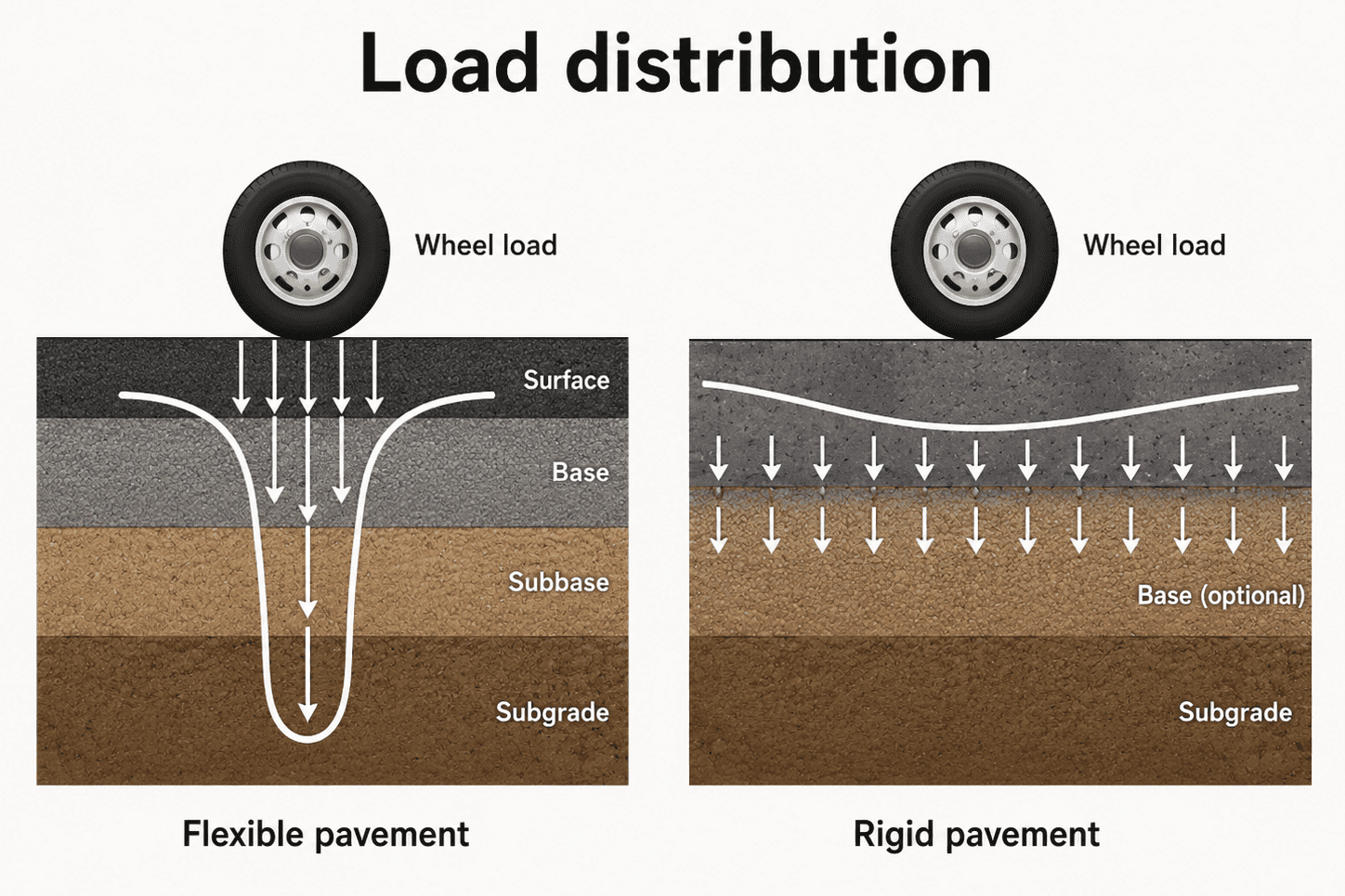
The asphalt surface, lower asphalt course, aggregate base, and subgrade each absorb and spread part of the wheel load. The stress becomes smaller as it moves downward.
This difference affects how each pavement fails.
Concrete pavement can crack when the slab loses uniform support. Poor load transfer at the joints can also cause movement and faulting.
Asphalt pavement is more sensitive to weak lower layers and trapped water. Heat and repeated traffic can then cause rutting, fatigue cracking, or potholes.
In simple terms, concrete spreads the load mainly through slab action. Asphalt spreads it gradually through the full pavement structure.
Traffic, Subgrade, and Pavement Thickness
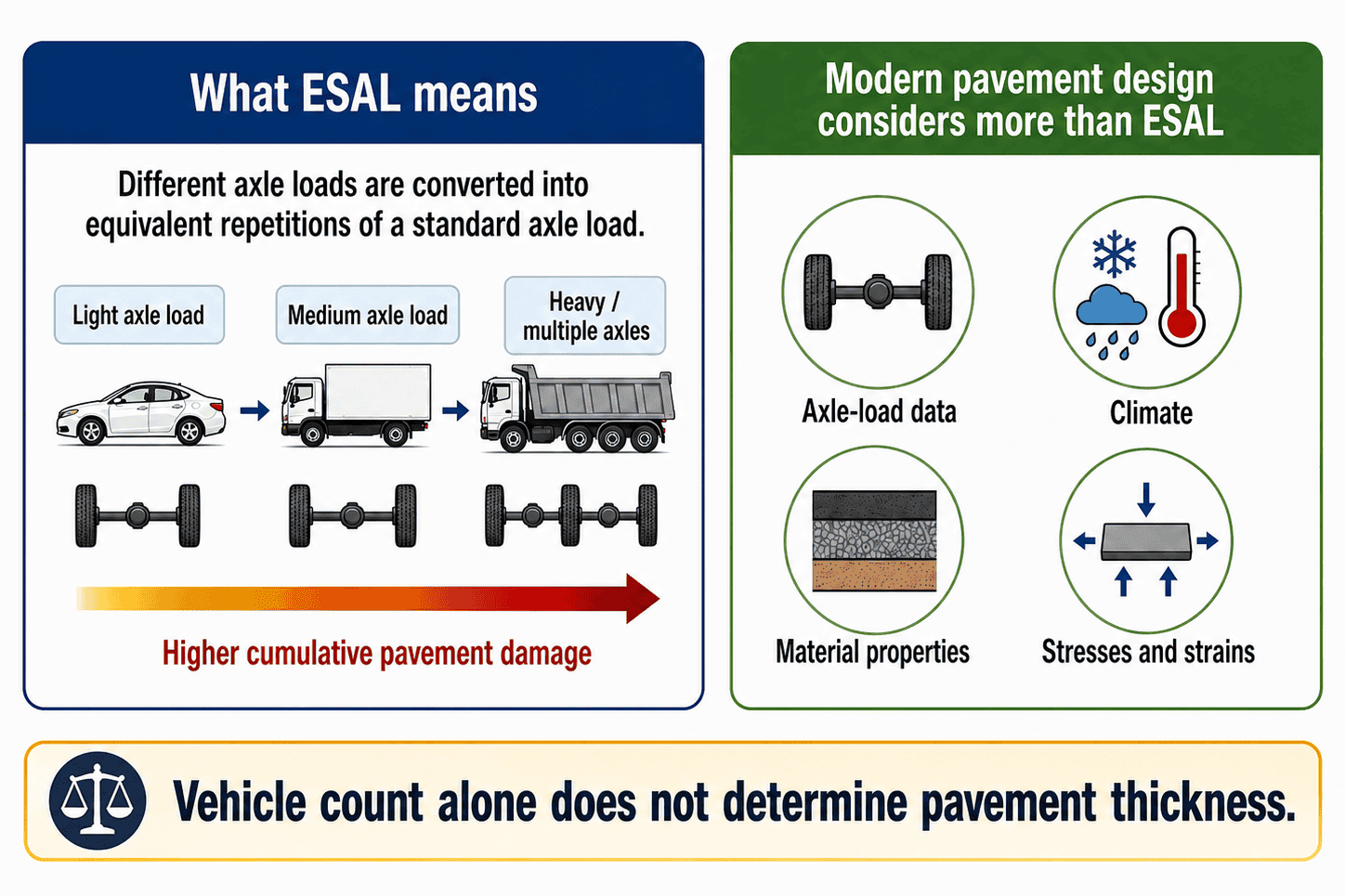
Engineers do not design road thickness from daily vehicle count alone.
Truck percentage, axle weight, axle spacing, traffic growth, and lane distribution matter more than the number of passenger cars.
An Equivalent Single Axle Load, or ESAL, converts different axle loads into repetitions of a standard axle load. It provides a simplified way to estimate cumulative traffic damage.
Modern pavement design can also use detailed axle-load data, climate conditions, material properties, and calculated stresses and strains. This concept is shown image below.
I would not recommend a pavement type or thickness until the traffic and support conditions are understood. A residential street and an industrial truck route require different structures, even when both carry the same number of vehicles per day.
Important design inputs include:
- Traffic and axle loading
- Subgrade strength
- Base and subbase quality
- Drainage
- Frost-susceptible soils
- Material stiffness and strength
- Construction quality
- Required design life
Poor drainage can damage either pavement. Water can weaken the support below asphalt. Beneath concrete, water and fine soil movement can contribute to erosion, pumping, and joint faulting.
There is no useful universal thickness comparison. Concrete and asphalt pavements use different structural systems and must be designed for the actual site.
Concrete Joints and Asphalt Layers
Concrete shrinks as it dries and expands or contracts as its temperature changes. Engineers use planned joints to control where movement and cracking occur.
The main concrete pavement joints include:
- Transverse contraction joints
- Longitudinal joints
- Construction joints
Smooth dowel bars transfer wheel load across transverse joints while allowing the joint to open and close. These joint run parallel to the traffic and its purpose is to separate different traffic lanes and protect against cracking length wise.
Deformed tie bars hold adjacent lanes together across longitudinal joints. They do not perform the same job as transverse dowels.
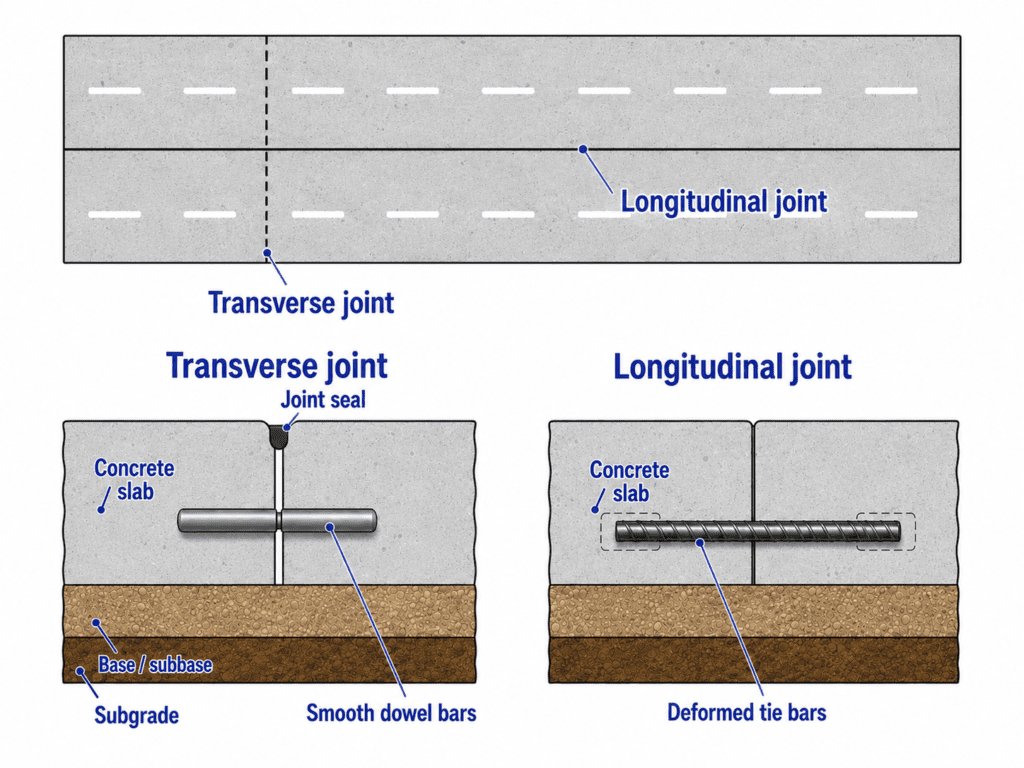
Some load also transfers through aggregate interlock, where rough concrete faces remain in contact below the saw cut.
Asphalt pavement does not use regularly spaced contraction joints like concrete. It still has construction joints and seams where paving lanes meet or work stops.
Initial Cost vs. Life-Cycle Cost
Asphalt often costs less to build and can reopen to traffic sooner. For a residential project, use our Asphalt Driveway Cost Calculator to estimate HMA tonnage, base preparation, removal, grading, drainage, and state-adjusted installation cost.
Concrete usually needs more time before it reaches the required opening strength. That longer closure can add traffic-control costs and increase delays on busy routes.
Initial price only covers the first construction stage. A life-cycle cost analysis, or LCCA, compares all major costs over the same analysis period.
These costs can include:
- Initial construction
- Routine maintenance
- Repairs
- Rehabilitation
- Traffic control
- Work-zone delays
- Remaining pavement value
The graph below shows how pavement condition declines with time. Rehabilitation improves the condition, then a new deterioration cycle begins.
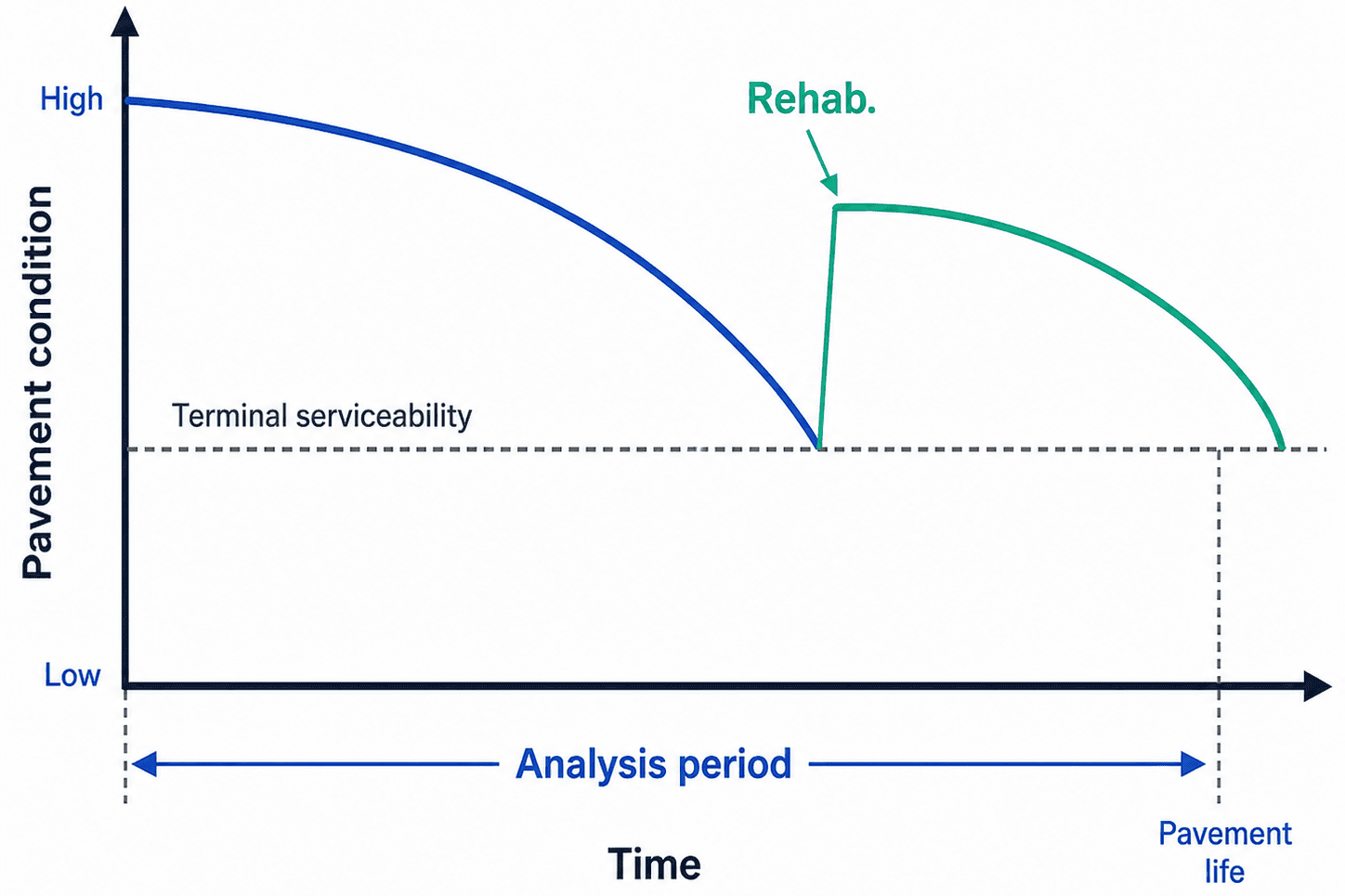
The dotted line represents the condition at which rehabilitation is triggered. The analysis period includes the original pavement and the later treatment.
This timing matters in an LCCA. A pavement with a higher initial cost may still provide good value if it needs fewer closures or less frequent rehabilitation. Asphalt may remain the better option where resurfacing is quick and local costs are low.
In practice, I would compare several realistic maintenance and rehabilitation schedules before choosing between asphalt and concrete.
You can estimate a smaller concrete pavement or slab project with our concrete slab cost calculator.
Durability, Failures, and Repairs
Table below summarized common issues faced in both pavement types and typical contributing factors.
| Pavement | Common distress | Typical contributing factors |
|---|---|---|
| Concrete | Cracking | Poor support, excessive stress, shrinkage, or joint problems |
| Concrete | Joint faulting | Erosion, pumping, or weak load transfer |
| Concrete | Spalling | Joint stress, debris, weak edges, or dowel problems |
| Concrete | Scaling | Freeze-thaw exposure, deicers, poor curing, or weak surface concrete |
| Asphalt | Rutting | High temperatures, heavy traffic, or weak layers |
| Asphalt | Fatigue cracking | Repeated loading and inadequate structural capacity |
| Asphalt | Thermal cracking | Low temperatures and binder aging |
| Asphalt | Potholes | Water, traffic, cracking, and weak support |
Concrete repair is not limited to replacing whole slabs. Common treatments include joint repair, partial-depth patching, full-depth repair, diamond grinding, slab stabilization, and overlays.
Asphalt rehabilitation includes crack sealing, patching, milling, recycling, and overlays.
Fuel and oil resistance
Concrete generally performs better where fuel, oil, or solvents spill regularly.
Petroleum products can soften or dissolve asphalt binder. This matters at bus stops, truck yards, loading areas, fuel stations, and intersections where vehicles brake or wait.
Concrete can still stain or suffer chemical attack, but ordinary fuel spills do not soften it in the same way.
Effect of Climate on Pavement Performance
Hot climates: concrete usually performs better
Concrete is usually the safer choice in very hot regions because it does not soften or rut under heavy traffic.
Asphalt can still perform well, but the binder and mix must be selected for high pavement temperatures. Poorly designed asphalt is more likely to rut or shove in hot weather.
Cold climates: asphalt is often easier to manage
Asphalt is usually better at handling small movements caused by temperature change. It is also easier to patch after winter damage.
Concrete can perform well in freeze-thaw conditions, but it needs proper air entrainment, durable aggregates, good drainage, and careful curing. Poor detailing can lead to scaling, joint damage, and cracking.
Pavement Wet-Weather Traction
Neither material is always better
Surface texture matters more than whether the pavement is asphalt or concrete.
New asphalt often provides good initial grip. Concrete also performs well when it is properly tined, grooved, or diamond ground.
Worn or polished surfaces can become slippery in either material. Drainage and maintenance are just as important as the pavement type.
Noise and Ride Quality
Asphalt is usually quieter at first
Fresh asphalt often produces less tire noise because the surface is smoother and has no transverse joints.
Concrete can become noisier when joints are uneven or the surface texture is too aggressive. Diamond-ground concrete can still provide a quiet and smooth ride.
Concrete often keeps its shape longer
A well-built concrete road can maintain good ride quality for many years. Asphalt may start smoother, but rutting and surface deformation can reduce comfort over time.
For short-term smoothness, asphalt often wins. For long-term shape retention, concrete usually has the advantage.
Environmental Impact (Asphalt vs Concrete)
Asphalt is usually better for recycling
Reclaimed asphalt is widely reused in new pavement mixtures. Milling and recycling are also common during rehabilitation.
Old concrete can be crushed and reused as base material or aggregate, but it is less often reused as a direct replacement for new pavement concrete.
Concrete can be better over a long service life
Concrete has high emissions at the construction stage because cement production is carbon intensive.
Asphalt also has an environmental cost because it uses petroleum binder and must be heated during production.
Concrete becomes more competitive when it lasts longer and needs fewer major repairs. Its impact can also be reduced by replacing part of the Portland cement with slag cement, fly ash, or other approved materials.
For shorter projects or roads that need frequent utility access, asphalt often has the lower overall impact. For heavily trafficked roads with a long service period, concrete can be the better option.
Concrete stays cooler in sunlight
Light-colored concrete usually reflects more sunlight than dark asphalt. This often gives concrete a lower surface temperature in hot and exposed locations.
Shading, moisture, surface texture, and local weather still affect the actual temperature.
Does Concrete Improve Fuel Economy?
Concrete can provide a small advantage for heavy traffic
Concrete deflects less under vehicle loads. This can slightly reduce rolling resistance, especially for heavy trucks in hot weather.
The benefit is usually small and should not be treated as a fixed percentage.
Road smoothness often matters more. A smooth asphalt road can use less fuel than a rough concrete road. On busy freight routes where both surfaces are equally smooth, concrete is more likely to provide the lower rolling resistance.
Which Road Surface Should You Choose?
The table below can provide a general guideline in the decision process.
| Project condition | Concrete is often better when | Asphalt is often better when |
|---|---|---|
| Heavy truck route | Rutting and closures are major concerns | Planned resurfacing is acceptable |
| Residential street | Long service life justifies the cost | Low initial cost matters most |
| Urban road with utilities | Future cutting is unlikely | Frequent utility work is expected |
| Tight schedule | Rapid-strength concrete is available | Fast reopening is the priority |
| Industrial area | Heavy loads and fuel spills are common | Loads and spill exposure are limited |
| Hot climate | Rutting risk is high | A suitable high-temperature mix is available |
| Freeze-thaw climate | Joints, drainage, and curing are well designed | The binder and crack-control plan suit the climate |
The final choice will however depend on few factors such as traffic load, ground support, drainage, climate, local material costs, construction time etc.
FAQs
Are concrete roads better than asphalt roads?
Concrete often suits heavy traffic, industrial exposure, and projects where frequent rehabilitation closures would be costly. Asphalt often suits faster construction, lower initial budgets, and roads that need regular resurfacing or utility access.
Why is asphalt called flexible pavement?
Asphalt pavement deflects more under wheel loads and relies on several layers to distribute traffic stress into the subgrade.
Why do concrete roads have joints?
Joints control where concrete movement and shrinkage cracking occur. Dowel bars can also transfer traffic loads between adjacent slabs.
Which pavement is better for heavy trucks?
Concrete provides strong rut resistance. Asphalt can also carry heavy trucks when its mixture, thickness, base, and drainage are designed for the expected axle loads.
Is asphalt or concrete better in cold weather?
Both can perform well. Asphalt needs a suitable low-temperature binder. Concrete needs freeze-thaw-resistant materials, drainage, proper joints, and good curing.
Can asphalt be placed over concrete?
Yes. An asphalt overlay can rehabilitate an existing concrete pavement after major movement is repaired and the design accounts for joints and reflective cracking.