Septic Tank Inspection: Checklist, Cost & What Inspectors Check
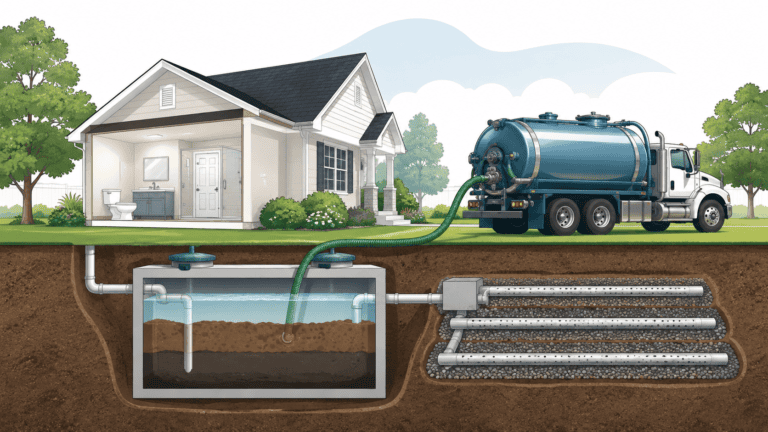
A septic tank inspection includes checking the tank and, in a more complete system inspection, the components that carry and disperse wastewater. An inspector may review records, open the tank, measure sludge and scum, inspect baffles and filters, check the distribution system, evaluate the drain field, and test pumps or alarms where installed.
A septic system can still accept wastewater while a damaged baffle, uneven distribution box, overloaded drain field, or other problem is developing underground. That is why I would not judge a system only by whether the toilets flush.
What Does a Septic Inspector Check?
The exact inspection depends on the system type, access, local requirements, and why the inspection is being performed.
A routine maintenance visit may have a narrower scope than an inspection during a home purchase.
For a thorough septic system inspection, I would expect the following areas to be considered.
| Component | What the inspector checks |
|---|---|
| System records | Age, design, capacity, permits, pumping, and repair history |
| Tank access | Lid, riser, safety, and accessibility |
| Septic tank | Cracks, leaks, corrosion, deterioration, and liquid level |
| Sludge | Depth of settled solids |
| Scum | Thickness of floating material |
| Inlet baffle or tee | Damage, blockage, or missing components |
| Outlet baffle or tee | Condition and protection against solids leaving the tank |
| Effluent filter | Clogging and physical condition, if installed |
| Distribution box | Damage, settlement, and even flow |
| Pumps and controls | Operation where the system uses mechanical equipment |
| Alarms | Function where installed |
| Drain field | Ponding, wet soil, odors, surfacing wastewater, or uneven loading |
EPA inspection guidance includes records review, sludge and scum evaluation, tank and pipe integrity, pumps and controls, the distribution box, and the drain field.
The phrase septic tank inspection can therefore be misleading. The tank is only one part of the onsite wastewater system.
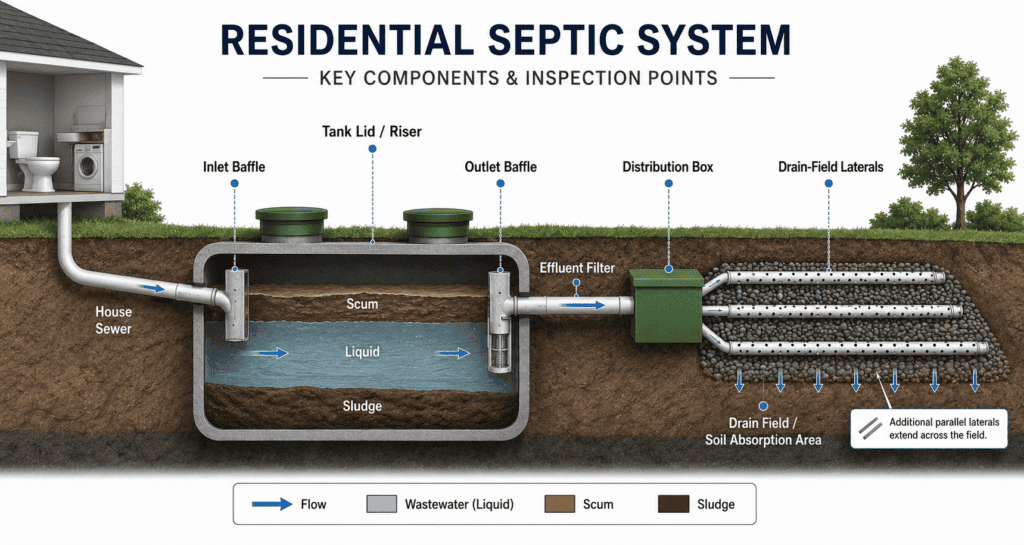
Diagram below shows the key septic system components that are usually part of inspection process.
Septic Tank Inspection Checklist
I would use this checklist to understand the basic scope of an inspection.
Records and Site
- Review available permits and system drawings
- Confirm system age and type
- Check tank capacity if known
- Review pumping and repair history
- Locate the tank and drain field
- Identify pumps, alarms, or treatment equipment
- Walk the site for wet areas, odors, settlement, or surfacing wastewater
Septic Tank
- Open accessible lids safely
- Check the normal liquid level
- Look for evidence of leakage
- Look for signs of previous backup
- Measure sludge and scum
- Inspect accessible tank surfaces
- Check inlet and outlet baffles or tees
- Inspect the effluent filter if installed
If the tank lid remains buried for every service visit, a septic tank riser can make future inspections and pumping much easier.
Distribution and Drain Field
- Inspect the distribution box where accessible
- Check for uneven flow
- Look for damaged or settled components
- Examine the drain field surface
- Check for standing water or unusually wet soil
- Look for surfacing effluent
- Note sewage odors
- Check for obvious vehicle or construction damage
Mechanical Components
Where installed, the inspector may also check:
- pumps
- floats
- alarms
- control panels
- electrical connections
- treatment equipment
A good report should also state what could not be inspected.
It is important to specify the scope of septic tank inspection as it can be very extensive and in turn, costly.
What Happens During a Septic Inspection?
A professional inspection usually follows the wastewater path through the system.
1. Review the System Records
I would start with whatever records are available.
These may include the original permit, as-built drawing, tank size, installation date, previous pumping records, repairs, and inspection reports.
Records help the inspector understand what should exist before judging what is actually found on site.
2. Locate the Tank and Drain Field
The septic tank, access openings, distribution components, and drain field need to be identified.
An existing ground-level riser makes this much easier.
If the tank location is unknown or the lid is deeply buried, locating and excavation can add time and cost.
3. Inspect the Ground Surface
Before opening the tank, I would walk the property.
Useful warning signs include:
- standing water
- sewage odors
- spongy ground
- unusually lush vegetation
- depressions
- erosion
- heavy vehicle loading over the field
- drainage directed toward the absorption area
These signs do not prove a system has failed, but they help identify where closer inspection is needed.
4. Open the Septic Tank
The inspector opens safe, accessible tank covers or risers.
A homeowner should never enter a septic tank. The space can contain toxic gases, oxygen-deficient air, biological hazards, and other serious risks.
5. Check the Liquid Level
The liquid level can reveal useful information.
A low level may indicate leakage.
A high level can justify checking the outlet, downstream piping, or drain field more carefully.
EPA also identifies staining above the outlet pipe as a possible sign that wastewater has previously backed up inside the tank.
6. Measure Sludge and Scum
A functioning septic tank normally contains wastewater. The question is not whether the tank looks “full.”
What matters is how much sludge and scum have accumulated.
EPA recommends pumping when:
| Measurement | EPA pumping guidance |
|---|---|
| Bottom of scum layer | Within 6 in. of the bottom of the outlet |
| Top of sludge layer | Within 12 in. of the outlet |
| Sludge + scum | More than about 25% of the liquid depth |
These measurements help determine when solids are getting too close to the outlet or using too much of the tank’s working volume.
If pumping is due, CED’s Septic Tank Pumping Cost Calculator estimates the cost by tank size, state, access, service condition, and optional work.
7. Inspect Baffles, Tees, and Filters
The inlet and outlet fittings control wastewater movement through the tank.
I pay particular attention to the outlet side because damaged components can allow solids to move toward the drain field.
If an effluent filter is installed, it should also be checked for clogging and damage.
8. Check the Distribution System
Wastewater leaving the tank must be distributed properly.
Where a distribution box is accessible, the inspector can look for:
- cracks
- deterioration
- settlement
- blockage
- unequal flow between outlets
A tilted distribution box can overload one section of a drain field while other sections receive less wastewater.
9. Evaluate the Drain Field
The drain field is not just a network of pipes. The surrounding soil performs an important part of the wastewater treatment.
The inspector looks for surface evidence that the field is no longer accepting or distributing effluent properly.
Warning signs include:
- ponding
- surfacing wastewater
- sewage odors
- persistently wet soil
- uneven drainage
- obvious physical damage
EPA notes that more detailed diagnosis may sometimes include camera inspection of piping or limited excavation to investigate ponding or groundwater effects. These steps are not automatically part of every routine inspection.
If you are planning a new or replacement field rather than diagnosing an existing one, CED’s Septic Drain Field Size Calculator estimates absorption area and trench length from design flow and soil loading rate.
10. Test Pumps and Alarms
Not every septic system operates entirely by gravity.
Systems may use:
- pump tanks
- dosing pumps
- floats
- alarms
- control panels
- aerobic or other treatment equipment
These components create additional inspection and maintenance requirements.
11. Document the Findings
I would expect a useful report to identify:
- what was inspected
- what was inaccessible
- observed defects
- system condition
- measurements taken
- additional testing recommended
- repairs that should be considered
A septic tank inspection documents observable conditions at one point in time.
It does not guarantee how many years a drain field has left or prove that every buried component is defect-free.
How Much Does a Septic Inspection Cost?
A basic septic inspection may cost only a few hundred dollars, while a more involved real-estate or diagnostic inspection can cost much more.
National consumer pricing sources currently show very broad ranges because “septic inspection” can describe different levels of work.
A reasonable way to think about cost is by scope:
| Inspection situation | Cost position |
|---|---|
| Basic routine inspection | Lower |
| Detailed tank and system inspection | Moderate |
| Buried access or difficult locating | Higher |
| Pumping included | Higher |
| Camera or diagnostic work | Higher |
| Real-estate inspection with additional testing | Potentially much higher |
Cost can increase with:
- buried lids
- unknown tank location
- excavation
- multiple tanks
- mechanical equipment
- pumping
- camera work
- formal reports
- hydraulic testing
- difficult access
For example, Penn State Extension reports a 2026 base range of about $350 to $700 for a specific PSMA/NOF real-estate inspection in south-central Pennsylvania. Required pumping can raise the combined total to roughly $625 to $1,200, and a hydraulic load test can add more. Those figures describe that inspection program and region, not a nationwide price schedule.
That is why I would get a quote based on the inspection scope, not one national average.
Does a Septic Tank Need to Be Pumped for an Inspection?
Not always.
For routine inspection, leaving the system at its operating liquid level can help the inspector evaluate sludge, scum, leakage, and wastewater behavior.
Pumping can provide better access to portions of the tank that are normally submerged and may be required under a particular inspection protocol or local rule.
Real-estate procedures vary widely.
Ask the inspector whether pumping is required, why it is needed, and whether it is included in the quoted price.
Do not assume that pumping and inspection are the same service.
Septic Tank Inspection vs. Septic System Inspection
These terms are often used loosely.
| Septic tank inspection | Broader septic system inspection |
|---|---|
| Focuses mainly on the tank | Follows wastewater through the system |
| Checks liquid level | Evaluates tank plus downstream components |
| Measures sludge and scum | May evaluate distribution and drain field |
| Checks tank fittings | May include pumps, alarms, and controls |
| Limited assessment of the disposal area | Includes drain-field observations |
There is no universal national definition of a “full” septic inspection.
I would always ask exactly which components are included.
What Problems Can a Septic Inspection Find?
Homeowners often ask what can “fail” a septic inspection.
There is no single nationwide pass/fail standard, but an inspection can reveal conditions that need maintenance, repair, additional testing, or replacement.
Tank Damage
Possible problems include:
- cracks
- leakage
- damaged joints
- corrosion
- deteriorated concrete
- unsafe lids
A tank does not need to collapse before its condition becomes important.
Broken Baffles or Tees
Missing or damaged fittings can interfere with wastewater separation and increase the chance of solids leaving the tank.
Excessive Sludge or Scum
This may simply mean routine pumping is overdue.
The greater concern is whether solids have already moved into downstream components.
Distribution Problems
A damaged or tilted distribution box can send too much flow to one trench or part of the drain field.
Pump or Alarm Problems
A failed pump, float, alarm, or control can stop a mechanical system from operating as intended.
Drain-Field Distress
EPA lists sewage backups, slow drains, standing water, spongy bright-green grass, and sewage odors among warning signs of septic malfunction.
These signs deserve further investigation rather than a quick assumption that pumping alone will solve the problem.
What Happens If an Inspection Finds a Problem?
An unfavorable finding does not automatically mean replacing the entire septic system.
I would separate a component problem from a system-level failure.
A clogged filter may need cleaning.
A broken baffle may be repairable.
A failed pump can often be replaced.
A tilted distribution box may need repair or leveling.
A leaking or structurally deteriorated tank can require replacement.
A severely malfunctioning drain field can require much more extensive work.
If the inspection points toward major replacement, CED’s Septic Tank Installation Cost Calculator can help estimate tank, drain-field, excavation, permit, and replacement costs.
Septic Inspection When Buying a House
I consider septic inspection particularly important when buying a home that is not connected to a public sewer.
A general home inspection does not automatically mean the entire onsite wastewater system has been evaluated.
Before buying, I would want to know:
- system type
- system age
- permitted capacity
- tank location
- drain-field location
- last pumping date
- previous repairs
- mechanical equipment present
- condition of accessible components
- visible condition of the drain field
- which components were not inspected
Penn State Extension specifically recommends a specialized septic inspection during real-estate transactions because important defects may remain hidden underground even when the property looks normal from the surface.
I would also avoid treating an inspection result as a remaining-life guarantee.
A system can be operating on inspection day without anyone being able to promise how long its drain field will continue to perform.
If records do not clearly identify tank capacity, CED’s Septic Tank Size Calculator can help you understand typical planning capacity based on bedrooms and wastewater flow. Local records and permit requirements still control the actual system.
How Often Should a Septic System Be Inspected?
EPA says the average household septic system should generally be inspected at least every three years by a septic service professional.
Systems with electrical float switches, pumps, or mechanical components typically need more frequent inspection, often annually.
Local regulations, system type, manufacturer requirements, and operating permits can require a different schedule.
How Long Does a Septic Inspection Take?
There is no useful national inspection time.
A simple gravity system with known records and ground-level access can be evaluated much faster than a complex property where the tank must first be located and excavated.
Time can increase because of:
- buried lids
- unknown tank location
- multiple tanks
- pumping
- camera work
- mechanical equipment
- hydraulic testing
- difficult terrain
- inaccessible components
I would judge an inspection by its scope and findings rather than assuming a longer visit is automatically better.
Who Can Perform a Septic Inspection?
Requirements vary by state and locality.
Depending on the jurisdiction and inspection purpose, the work may be performed by a septic professional, onsite wastewater specialist, certified inspector, licensed operator, installer, or another authorized person.
Real-estate transactions may have more specific requirements.
Before hiring an inspector, I would ask:
- What components will you inspect?
- Are you licensed or certified where required?
- Is tank pumping included?
- Will you inspect the drain field?
- Do you test pumps and alarms?
- Will I receive a written report?
- What is excluded?
- Does your inspection meet local real-estate requirements?
Those questions tell you much more than simply asking whether someone “does septic inspections.”
Septic Inspection vs. Pumping
Inspection and pumping solve different problems.
Inspection evaluates the condition and operation of the system.
Pumping removes accumulated wastewater, sludge, and scum from the tank.
An inspection may show that pumping is due.
Pumping, however, does not prove that the distribution box, pumps, piping, or drain field are working correctly.
I treat them as related maintenance services, not substitutes.
FAQs
Can I inspect a septic tank myself?
You can watch for surface warning signs and keep maintenance records, but opening and evaluating septic components involves wastewater, heavy lids, hazardous gases, and technical judgment. I would use a qualified septic professional for a meaningful inspection.
Can a septic system pass an inspection and still fail later?
Yes. An inspection reports observable conditions at a particular time. It cannot guarantee future performance or remaining drain-field life.
Does a home inspector inspect the septic system?
Some do, but inspection scope and qualification vary. Confirm whether the tank, distribution system, drain field, pumps, and other components are actually included.
Can an inspection identify a failing drain field?
It can identify visible or operational warning signs such as surfacing wastewater, ponding, odors, unequal distribution, or saturated areas. Additional investigation may be needed for conditions that are not visible from the surface.
Is a septic inspection required when selling a house?
There is no single nationwide requirement. State, county, local health authority, lender, and transaction requirements can differ.
Is septic pumping the same as a septic inspection?
No. Pumping removes tank contents. Inspection evaluates the condition and operation of the system. They can occur during the same service visit but serve different purposes.
Sources
- U.S. Environmental Protection Agency — Frequent Questions on Septic Systems
- U.S. Environmental Protection Agency — How to Care for Your Septic System
- U.S. Environmental Protection Agency — Resolving Septic System Malfunctions
- Penn State Extension — On-Lot Septic System Inspections During Real Estate Transactions