Glass Fiber Reinforced Concrete (GFRC)
Glass fiber reinforced concrete (GFRC) is a cement-based composite reinforced with alkali-resistant glass fibers. The fibers improve crack control and flexural performance. GFRC is commonly used for façade panels, architectural details, countertops, and complex molded products. It is also called GRC.
Glass fiber significantly improve the tensile strength of normal concrete but also can negatively affect workability and compressive strength.
This guide explains how Glass fiber reinforced concrete performs and will help you decide if its suitable for your project.
GFRC at a Glance
| Feature | Typical GFRC |
|---|---|
| Matrix | Portland cement, fine sand, water, and admixtures |
| Reinforcement | Alkali-resistant glass fibers |
| Main processes | Spray-up and premix |
| Common products | Cladding panels, cornices, countertops, decorative units |
| Main benefit | Thin sections with complex shapes and lower panel weight |
| Main limitation | Performance depends heavily on fabrication and connection quality |
| Common US term | GFRC |
| Common international term | GRC |
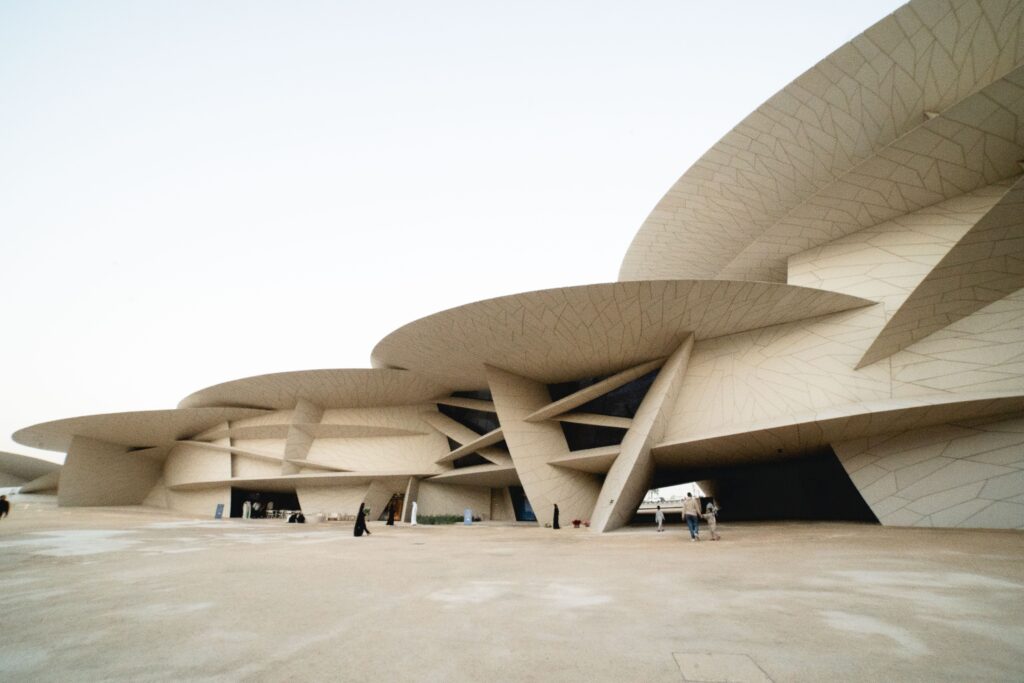
What Is GFRC?
GFRC is a cement-based composite reinforced with short alkali-resistant glass fibers. The mix usually contains Portland cement, fine sand, water, and admixtures.
GFRC is primarily used for non-load-bearing architectural and decorative applications, including façade panels, cladding, cornices, countertops, planters, and molded details.
The US standard ANSI/PCI 128-24 covers framed and unframed GFRC panels made by spray-up or premix methods.
| Term | Meaning |
|---|---|
| GFRC or GRC | Glass fibers dispersed through a cement-based matrix |
| Fiberglass | Glass fibers held in a polymer resin |
| GFRP | Glass fiber reinforced polymer used for bars, sheets, and structural profiles |
| Fiber cement | Factory-made cementitious board or siding |
| Glass fiber concrete | A broad phrase that may refer to GFRC, depending on context |
How Glass Fibers Reinforce Concrete
Cement-based materials are strong in compression but weak in tension.
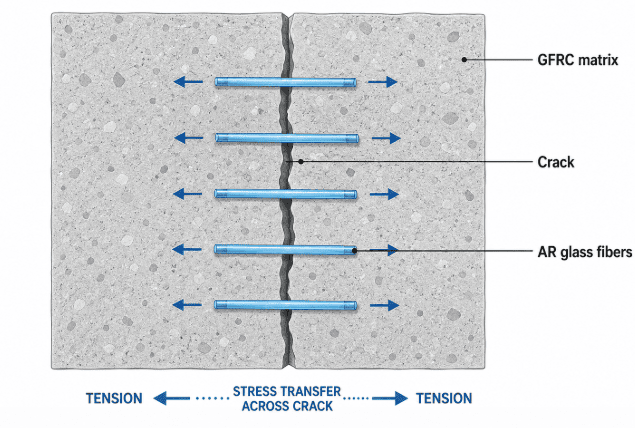
When the matrix begins to crack, fibers crossing the crack transfer stress between both sides. This fiber-bridging action slows crack opening and improves flexural performance.
Shrinkage, thermal movement, restraint, impact, poor curing, weak anchors, or fabrication defects can still produce cracks. See what causes concrete to crack for the main cracking mechanisms.
Why GFRC Requires Alkali-Resistant Glass
Hydrated Portland cement creates a highly alkaline pore solution.
Ordinary glass fibers can lose strength in that environment. GFRC therefore uses alkali-resistant glass fibers, commonly called AR glass.
A PCI architectural guide specification calls for AR fibers with at least 16% zirconia and chopped lengths of 1 to 2 inches for the specified panel system. Premix products may use shorter fibers based on the qualified process.
“Glass fiber” on a product label is not enough. Check the AR-glass standard, zirconia content, fiber sizing, and compatibility with the manufacturer’s approved mix.
What Is GFRC Made Of?
| Ingredient | Function |
|---|---|
| Portland cement | Forms the binding matrix |
| Fine silica sand | Controls texture, stability, and workability |
| Water | Hydrates the cement |
| AR glass fiber | Bridges cracks and improves flexural response |
| Water reducer | Improves flow without adding excess water |
| Acrylic polymer | May assist curing and improve workability |
| Pozzolan | Can refine the matrix and support long-term performance |
| Pigment | Provides integral color |
| Decorative aggregate | Creates exposed or textured finishes |
GFRC backing mixes usually use fine sand rather than the coarse stone found in conventional concrete. This helps the mix pass through spray equipment and fit into thin sections.
The visible face coat may contain pigment or decorative aggregate. The fiber-reinforced backing provides most of the GFRC skin’s flexural capacity.
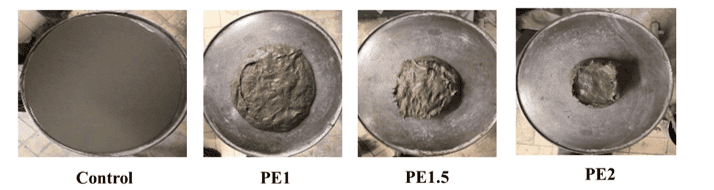
The addition of glass fibers reduces workability so mix should be designed properly. I have done my own research on glass fibers. Below are the flow results and you can clearly see the difference. At 2% fiber content there was almost no flow.
How Is GFRC Made in Practice?
Manufacturers use two main methods.
Spray-Up GFRC
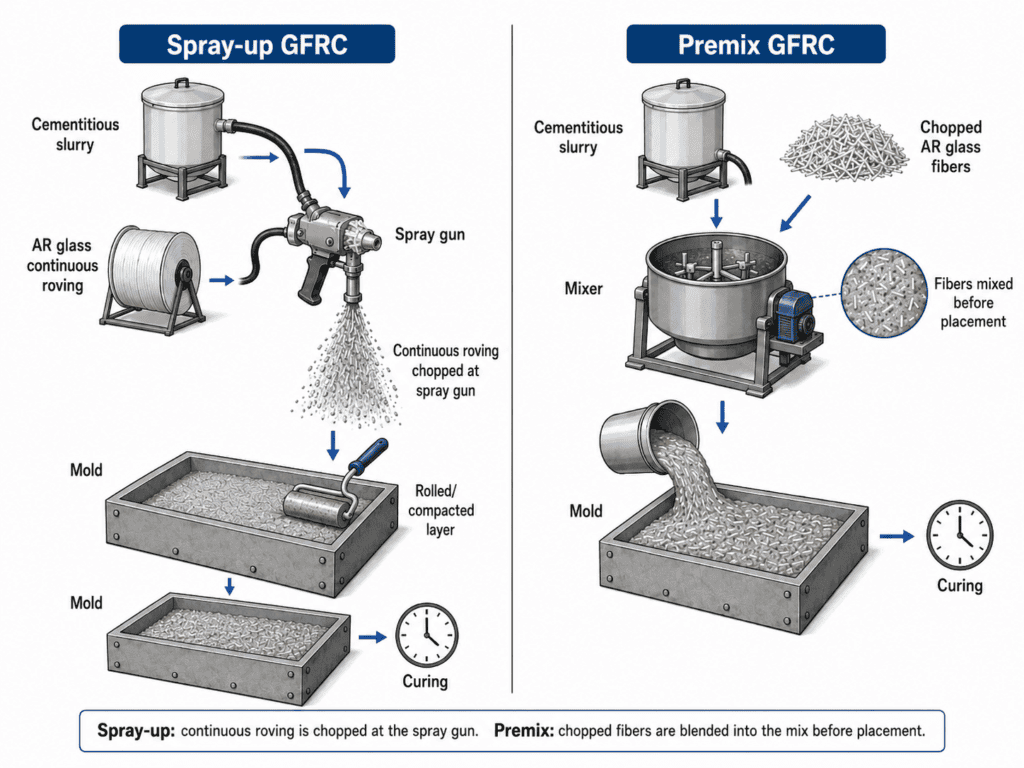
A pump sends cementitious slurry to a spray gun.
The gun chops continuous AR glass roving and sprays the strands with the slurry into a mold.
Workers build the panel in layers. They roll each layer to remove trapped air, wet the fibers, consolidate the matrix, and control thickness.
Spray-up typically allows longer fibers and higher fiber content. It is commonly used for large façade panels and thin architectural skins. you can see the this in action in the video below where facade panels are constructed using Spray up GFRC.
Premix GFRC
The manufacturer blends chopped fibers into the wet mix before placement.
The material can then be cast, vibrated, pumped, or sprayed into the mold.
Premix works well for smaller units, detailed shapes, and repetitive products. Mixing and pumping limit practical fiber length and content, so premix usually has lower flexural capacity than a well-made spray-up product.
Spray-Up vs Premix
| Factor | Spray-up | Premix |
|---|---|---|
| Fiber addition | Chopped at the spray gun | Added during mixing |
| Fiber length | Usually longer | Usually shorter |
| Fiber content | Generally higher | Generally lower |
| Typical use | Large panels and thin skins | Smaller molded products |
| Main quality risk | Poor spray calibration or rolling | Fiber clumping or placement voids |
PCI requires uniform fiber distribution, consolidation, thickness checks, controlled curing, and production testing. The guide specification also treats the face mix, GFRC backing, bonding pads, frames, anchors, and connections as parts of one panel system.
How Glass Fibers Affect Concrete Properties
GFRC properties vary with the production method, mix, fiber content, curing, age, moisture condition, and test procedure.
The following table summarize the effect of glass fibers addition in concrete.
| Property | Effect of glass fibers |
|---|---|
| Density | Changes little. GFRC products are lighter mainly because they use thinner sections. |
| Compressive strength | May increase or decrease depending on dosage, dispersion, and workability. |
| Tensile and flexural strength | Usually improves because fibers bridge cracks and transfer tensile stress. |
| Crack resistance | Improves by limiting crack opening and propagation. |
| Workability | Decreases as fiber content and length increase. A superplasticizer may be needed. |
| Water absorption | Depends mainly on compaction, curing, and the water-cement ratio. |
Is GFRC Really 75% Lighter Than Concrete?
A completed GFRC panel can weigh much less than a conventional precast panel.
The material itself is not 75% less dense.
Most of the weight reduction comes from using a thin GFRC skin instead of a much thicker precast concrete section. The supporting frame and anchors allow that thin skin to resist the required panel loads.
GFRC therefore saves weight through section efficiency and system design.
This differs from foam concrete, which reduces material density by introducing a large volume of air voids.
To estimate the actual weight for your dimensions and thickness, use our GFRC weight calculator. It calculates skin weight, weight per square foot, and optional steel-frame and hardware weight.
How a GFRC Façade Panel Works
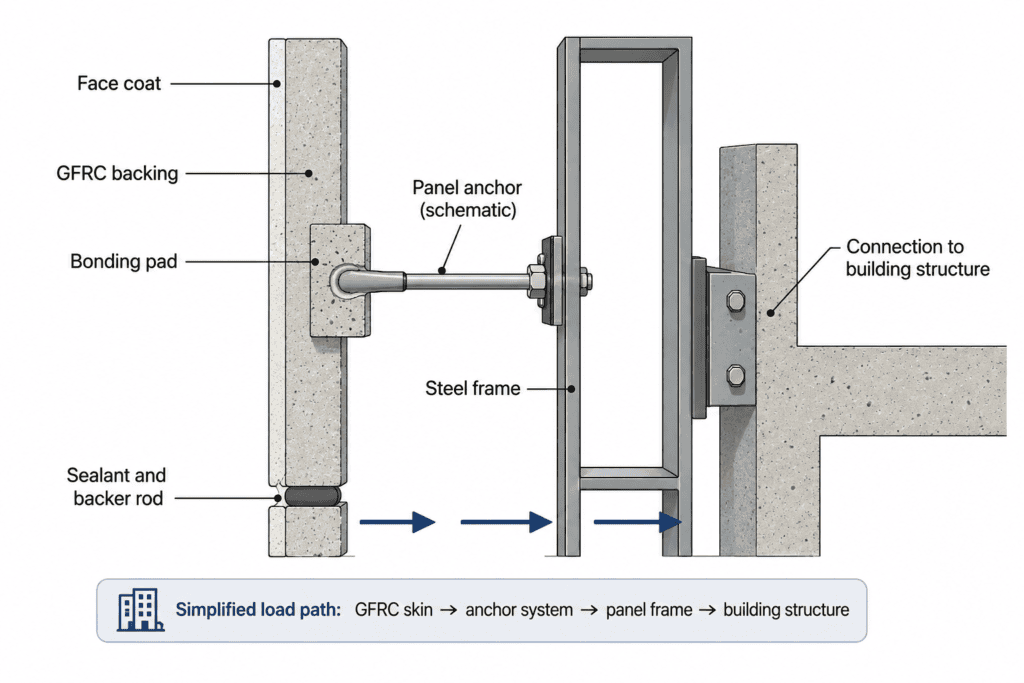
A framed GFRC panel commonly includes:
- An architectural face coat
- Fiber-reinforced GFRC backing
- Bonding pads
- Flex anchors
- Gravity or seismic anchors where required
- A steel stud or structural steel frame
- Connections to the building structure
- Sealant joints between panels
Flex anchors transfer load between the skin and frame while allowing limited differential movement.
That movement matters because GFRC and steel respond differently to moisture and temperature. A connection that is too rigid can restrain the skin and increase cracking risk.
The frame and connections must also accommodate wind pressure, self-weight, seismic effects, handling loads, erection loads, building deflection, and construction tolerances. PCI requires structural analysis, panel sections, frame details, anchor details, joint details, and connection hardware to appear in the shop drawings.
Is GFRC Structural?
As mentioned GFRC usually is not designed to be a structural element. It is more commonly used for Architectural elements.
Architectural GFRC usually does not act as the building’s primary beam, slab, column, or foundation system.
Distributed glass fibers also do not replace reinforcing bars in ordinary structural concrete. Rebar provides continuous tensile reinforcement, anchorage, and defined load paths that short fibers cannot reproduce.
Common GFRC Applications
GFRC works best where the project needs a thin section, lower cladding weight, a detailed mold, or repeated architectural units.
Common applications include:
- Exterior cladding and rainscreen panels
- Cornices, fascias, and soffits
- Column covers and window surrounds
- Decorative screens and curved features
- Cast-stone details
- Historic restoration pieces
- Planters and landscape elements
- Fireplace surrounds
- Concrete countertops
- Artificial rock features
PCI’s guide specification identifies wall units, window-wall units, mullions, column covers, fascia units, cornices, and soffits as typical panel applications.
GFRC Advantages and Limitations
| Advantages | Limitations |
|---|---|
| Thin, relatively lightweight panels | Sensitive to production quality |
| Detailed shapes and deep profiles | Requires qualified AR fibers |
| Wide range of colors and finishes | Shrinkage and movement need careful detailing |
| No conventional rebar in the thin skin | Frames and anchors may govern performance |
| Lower transportation and lifting demand | Repairs can remain visible |
| Efficient for repeated molds | One-off molds may be expensive |
GFRC does not automatically provide a low-cost solution.
A simple repeated panel can be efficient. A one-off restoration piece with a complex mold, custom pigment, steel frame, mockup, and difficult erection can be expensive.
GFRC Durability, Water, and Fire
Well-made GFRC can perform in exterior exposure.
Durability depends on the AR fibers, matrix quality, curing, surface finish, anchors, frame protection, panel joints, drainage, and exposure conditions.
GFRC is not automatically waterproof.
Water can enter through cracks, porous finishes, failed sealant, open joints, or poorly detailed interfaces. Exterior assemblies still need flashings, drainage paths, and a suitable air and water barrier.
The cementitious skin is noncombustible, but any fire-resistance rating applies to the complete tested assembly. Insulation, polymers, sealants, framing, connections, and backup construction can affect the result.
GFRC vs Conventional Precast Concrete
| Factor | GFRC | Conventional precast |
|---|---|---|
| Typical section | Thin cementitious skin | Thicker concrete section |
| Reinforcement | Distributed AR glass fibers | Rebar, mesh, or prestressing steel |
| Weight | Lower for similar cladding area | Higher |
| Main role | Cladding and architectural features | Cladding or structural elements |
| Shape flexibility | Excellent | Good, but heavier |
| Supporting frame | Common | May not be required |
| Main quality concern | Fiber delivery, rolling, and anchors | Concrete production and reinforcement placement |
Choose GFRC when weight, shape, finish, or mold repetition controls the decision.
Choose conventional precast when the element needs greater mass, structural depth, impact resistance, or traditional reinforced concrete behavior.
GFRC Standards and Quality Control
Important US references include:
- ANSI/PCI 128-24: GFRC panel design, manufacture, and installation
- ASTM C947-03(2023): Flexural properties
- ASTM C948-81(2023): Density, water absorption, and porosity
- ASTM C1229-94(2023): Glass fiber content
- ASTM C1230-96(2023): Bonding-pad tension testing
- ASTM C1560-03(2023): Accelerated aging
- ASTM C1666/C1666M-08(2023): AR glass fiber requirements
GFRC is a strong candidate when the project needs a concrete or stone appearance, lower façade weight, curved or detailed shapes, repeated molds, and access to a qualified manufacturer.
Consider another system when the element must act as a primary structural member, needs high mass or heavy impact resistance, or cannot accommodate engineered frames, anchors, joints, and fabrication testing. </details>
Final Takeaway
GFRC combines a fine cementitious matrix with alkali-resistant glass fibers.
It works especially well for thin façade panels, cornices, column covers, restoration pieces, countertops, and complex molded shapes.
The mix alone does not determine performance. A successful GFRC system needs controlled fiber delivery, consolidation, curing, testing, anchors, framing, joints, and building connections.
For architectural panels, review the entire assembly rather than the visible skin.
FAQs
Is GFRC the Same as GRC?
Yes. Both terms normally describe glass fiber reinforced concrete. GFRC is more common in the United States.
Does GFRC Contain Rebar?
The thin GFRC skin normally relies on distributed AR glass fibers.
A complete panel may still contain a steel frame, anchors, inserts, and connection hardware.
How Thick Is a GFRC Panel?
There is no universal thickness.
The required skin, face coat, bonding pads, ribs, frame spacing, and connections depend on panel size, geometry, loads, process, and manufacturer test data.
Is GFRC Stronger Than Regular Concrete?
GFRC provides useful flexural capacity in a thin section.
Conventional reinforced concrete remains more suitable for most beams, slabs, columns, foundations, and other primary structural members.
Can GFRC Be Used Outdoors?
Yes.
Exterior performance depends on the qualified mix, curing, finish, anchors, joints, sealants, drainage, and complete wall design.
What Is the Difference Between GFRC and Fiberglass?
GFRC uses a cement-based matrix.
Fiberglass uses a polymer resin matrix. The two materials have different properties, manufacturing methods, fire behavior, and connection systems.