Foundation Repair in Lebanon, TN: Costs, Warning Signs & Repair Options
Foundation problems in Lebanon can come from more than one cause. Uneven soil moisture, drainage problems, crawl-space support issues, settlement, and the local limestone setting can all contribute to movement.
A crack does not automatically mean your house needs piers.
The first step is to determine what is the cause of foundation movement. The repair should match the cause.
How Much Does Foundation Repair Cost in Lebanon, TN?
Foundation repair can range from a few hundred dollars for a limited crack repair to well over $10,000 when a house needs several piers, wall stabilization, or major structural work.
For early planning, these CED 2026 ranges are useful:
| Repair | Typical planning range |
|---|---|
| Crack injection | $350–$1,500 per crack |
| Push pier | $1,250–$3,000 per pier |
| Helical pier | $2,000–$4,000 per pier |
| Crawl-space support jack | $250–$800 each |
| Wall anchor or carbon strap | $400–$1,000 each |
| Larger structural repair | Often $10,000–$20,000+ |
These are our planning ranges and not actual bids.
Many variables can change the overall foundation repair cost, including:
- the type and severity of the foundation problem
- the number and depth of piers required
- access around or below the house
- structural engineering requirements
- drainage or waterproofing work
- permit and inspection requirements
- concrete, landscaping, drywall, or flooring restoration after the repair
CED’s current foundation repair calculator uses the same type of method-and-quantity approach rather than pretending there is one fixed repair price.
Pier count can change a quote quickly.
Six helical piers at $2,000–$4,000 each represent roughly $12,000–$24,000 before other project costs.
That is why two foundation repair quotes should not be compared by total price alone.
One contractor may be proposing four support points. Another may be proposing eight plus drainage or structural restoration.
If you are seeing foundation cracks, sloping floors, wall movement, or signs of settlement, speak with a foundation repair professional serving Lebanon and Wilson County.
Call Now: (888) 664-3492Why Foundation Problems Occur in Lebanon
Lebanon sits in a limestone-dominated part of Middle Tennessee.
That matters because soil, rock, and water all affect how a shallow foundation behaves.
Clay-Rich Soils Can Occur Over Limestone
The USDA describes the Talbott soil series, found in the Nashville Basin, as a moderately deep soil formed in clayey material weathered from limestone.
Its typical profile contains clay-rich subsoil, moderately slow permeability, and limestone bedrock about 20 to 40 inches below the surface. Some areas also have karst topography.
Soil conditions can however change from one lot to the next. Fill, grading, drainage, and depth to rock can also change how a site behaves.
Clay soil is usually more susceptible to uneven moisture than sandy soil.
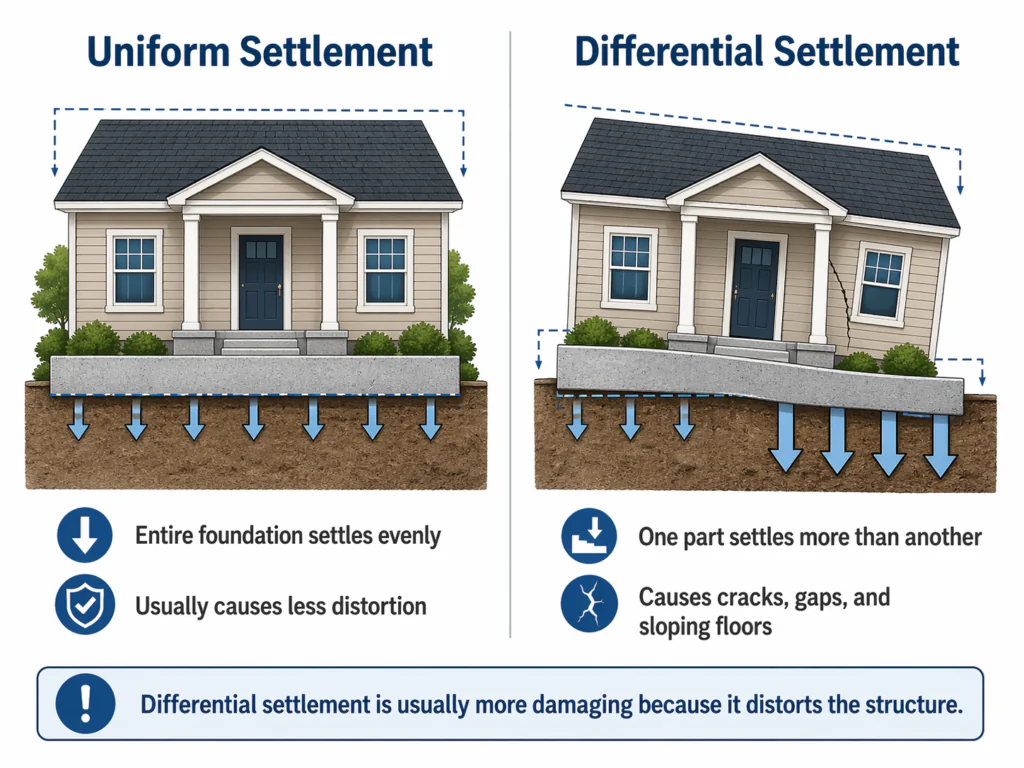
Clay-rich soils can change volume as their moisture content changes. If soil along one side of the house stays wetter while another side dries more, the resulting differential movement can show up as wall cracks, sticking doors, or sloping floors.
Lebanon Also Has a Limestone and Karst Setting
The U.S. Geological Survey identifies Lebanon Limestone as a recognized geologic unit named from exposures at Lebanon in Wilson County.
Karst can develop where limestone dissolves and creates an irregular subsurface.
As discussed above clay movement comes from soil volume changing as moisture changes. On the other hand karst develops from dissolution of soluble rock.
Most foundation cracks in Lebanon are not sinkhole problems.
But unusual, progressive, or highly localized settlement deserves proper investigation because local ground conditions can be more variable than a simple uniform soil profile.
Rainfall Makes Drainage Important
Lebanon has its own NOAA climate station.
The 1991–2020 normals show about 54.45 inches of precipitation per year.
Rainfall itself does not damage a foundation.
The problem is where the water goes.
A downspout dumping beside one corner of the house can keep that area wetter than the rest of the perimeter. Poor grading can direct runoff toward the house. Water can also collect near crawl-space walls or low spots.
Over time, those conditions can contribute to uneven soil moisture, erosion, softening of fill, or pressure against below-grade walls.
If you couple poor drainage with a tricky soil profile like clay, that is a problematic combination.
Signs Your Foundation May Need Repair
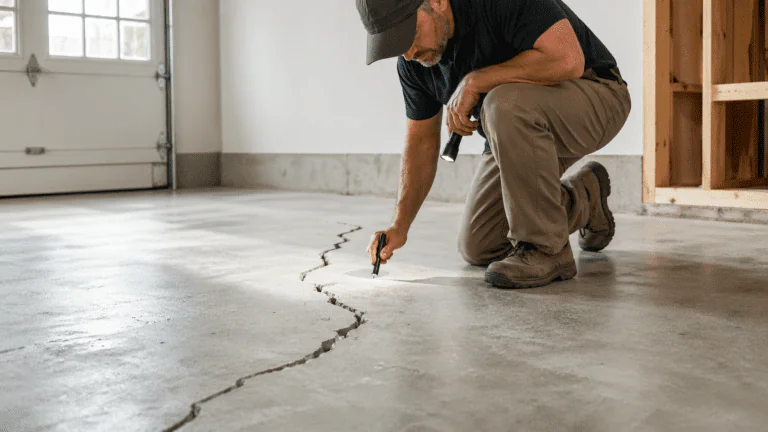
One symptom by itself rarely proves that a foundation is failing.
Look for a pattern.
| What you see | What it may indicate | What to do |
|---|---|---|
| Stair-step cracks in brick or block | Differential movement | Investigate if widening or recurring |
| Several sticking doors or windows | Frame distortion | Look for other movement signs |
| Sloping or sagging floors | Crawl-space support or foundation movement | Find where the movement starts |
| Narrow vertical concrete crack | Shrinkage or older movement may be possible | Monitor unless changing or leaking |
| Horizontal foundation-wall crack | Lateral soil or water pressure | Check whether the wall is bowing |
| Growing gap above a door or window | Differential movement | Investigate if progressive |
| Water collecting near the house | Drainage problem | Correct the water source |
| Sagging floor above a crawl space | Beam, joist, post, or footing issue | Inspect the support system |
The most useful question is often:
Is the condition changing?
A crack that has looked the same for years is different from one that keeps widening.
Movement across the crack matters too. If one side has shifted relative to the other, that can be more significant than a narrow surface crack with no displacement.
For a deeper guide to crack patterns, see Foundation Crack Repair. CED’s foundation crack guide makes the same distinction between stable cracks and cracks associated with active movement.
Match the Repair to the Problem
Foundation repair is not one procedure.
Different problems need different solutions.
| Problem | Common repair direction |
|---|---|
| Differential settlement | Push or helical piers where deeper support is needed |
| Sagging crawl-space floor | Beam, joist, footing, or supplemental support repair |
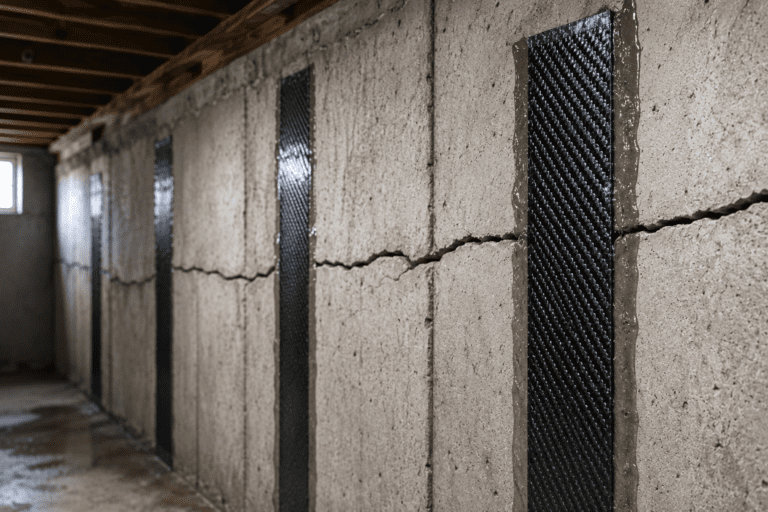
| Bowing foundation wall | Carbon fiber, anchors, or steel bracing depending on movement |
| Settled nonstructural slab | Mudjacking or polyurethane lifting |
| Stable concrete crack | Injection or sealing where appropriate |
| Water concentrated near foundation | Drainage correction |
A few distinctions matter.
Slab lifting is not underpinning. Raising a garage slab or walkway does not automatically correct settlement of a load-bearing footing.
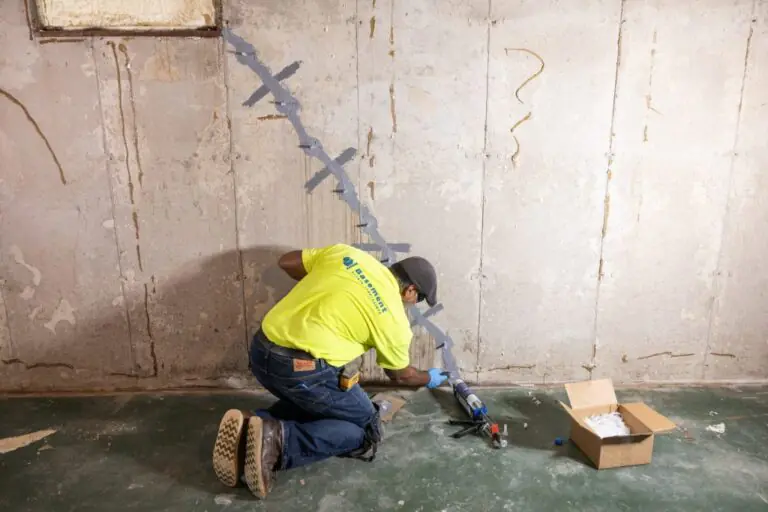
Crack repair is not structural stabilization. Sealing a crack may stop water entry, but it does not solve active movement.
Drainage correction is not a structural repair. It may reduce future moisture problems, but it cannot restore support that has already been lost.
Contractors may also describe stabilization work as house leveling. Lifting is not always possible or advisable, and stabilization does not automatically mean the house will be returned to its original elevation.
For deeper structural settlement, see Foundation Settlement Repair.
Fix the Water Problem When Water Is the Cause
Check how water moves around the house.
Look at:
- gutters
- downspouts
- ground slope
- standing water
- low areas beside the foundation
- crawl-space moisture
- plumbing leaks
Water should move away from the structure instead of collecting beside it.
If drainage is contributing to movement, correcting it may help stop the problem from getting worse.
But drainage work cannot reliably lift or stabilize a foundation that has already lost structural support.
Sometimes both problems need to be addressed.
Before You Hire a Foundation Repair Contractor
What a Good Foundation Inspection Should Include
A useful foundation inspection should do more than point at a crack and recommend a product.
Ask the contractor to show you what was measured.
That may include:
- floor elevations
- crack locations
- wall movement
- crawl-space supports
- moisture conditions
- exterior drainage
- locations of proposed piers or anchors
If the repair involves several piers or major wall stabilization, the written proposal should explain why each support location is needed.
When an Independent Engineer Helps
Not every small crack needs a structural engineer.
An independent evaluation becomes more useful when:
- cracks continue to grow
- a wall is visibly bowing
- several symptoms appear together
- floors are noticeably sloped
- previous repairs failed
- contractors recommend very different repairs
- a large underpinning project is proposed
- unusual ground movement is suspected
A foundation contractor can inspect the property and propose a repair system.
An independent structural engineer can be useful when you want the structural significance and likely cause evaluated separately from the company selling the repair.
Check Lebanon Permit Requirements
Lebanon’s Building Inspection & Permitting department handles inspections and code compliance within the city.
The city lists common inspection types such as slab prep, in-slab work, framing, and other construction inspections, and notes that additional inspections may be required depending on project scope and complexity.
Do not assume every minor crack repair requires a permit.
For structural underpinning, major wall work, pier installation, or similar repairs, confirm the current requirements with the City of Lebanon before work begins.
Verify Tennessee Contractor Licensing
Tennessee requires a contractor’s license before bidding, offering a price, or negotiating a project of $25,000 or more when acting as the prime contractor.
The state’s contractor classifications specifically include:
- BC-5 Foundations
- BC-19 Concrete
For projects below $25,000, Tennessee advises homeowners to check local building-code and licensing requirements. The state also recommends verifying professional licenses before hiring.
Compare the Scope, Not Just the Price
A useful foundation repair proposal should tell you:
- what the contractor believes is moving
- what repair is proposed
- how many piers, anchors, straps, or supports are included
- where those supports will be installed
- whether the goal is stabilization, lifting, or both
- whether engineering is included
- whether permits are included
- whether drainage work is included
- what restoration is included
- what the warranty covers
One distinction deserves special attention:
Stabilization and lifting are not the same thing.
A contractor may install piers to reduce future settlement without promising to return the house to its original elevation.
That should be clear before work starts.
If one contractor recommends six piers and another recommends fourteen, ask why.
The answer should be based on measured movement, load path, support locations, and the proposed repair strategy.
A long warranty is not automatically a better warranty either.
Check whether it transfers to a future owner and whether drainage problems, plumbing leaks, soil movement, or work by another contractor can affect coverage.
FAQs
How much does foundation repair cost in Lebanon, TN?
A limited crack repair may cost a few hundred dollars, while repairs involving several piers can run well into five figures. As a planning figure, helical piers commonly fall around $2,000–$4,000 per pier, while larger structural projects can exceed $10,000.
Does Lebanon, Tennessee have clay soil?
Clay-rich limestone-derived soils occur in the Nashville Basin. USDA describes Talbott soils as clayey soils formed from limestone residuum, but soil conditions vary from one property to another.
Does Lebanon have sinkhole or karst conditions?
Karst occurs in limestone terrain in Middle Tennessee. That does not mean an ordinary foundation crack is caused by a sinkhole. Progressive or unusual localized settlement should be evaluated based on the actual site conditions.
Should I hire a structural engineer before foundation repair?
Not for every minor crack. An engineer is more useful when movement is progressive, walls are bowing, several symptoms occur together, previous repairs failed, or contractors are proposing expensive or conflicting structural repairs.