Air Entrained Concrete: Benefits, Uses and Strength Effects
Air-entrained concrete contains millions of microscopic air bubbles created with an air-entraining admixture. These bubbles give freezing water space to expand, reducing the internal pressure that can cracking. Exterior concrete exposed to freezing temperatures or deicing salts usually requires entrained air for long-term durability.
If exterior concrete must survive freezing winters, its air content is just as important as its specified compressive strength.
This guide explains how air entrainment works, the recommended air content, its effect on strength, field testing methods, and when it should or should not be used.
How Air Entrained Concrete Works
Rain, melting snow, and groundwater gradually introduce moisture into concrete capillary pores.
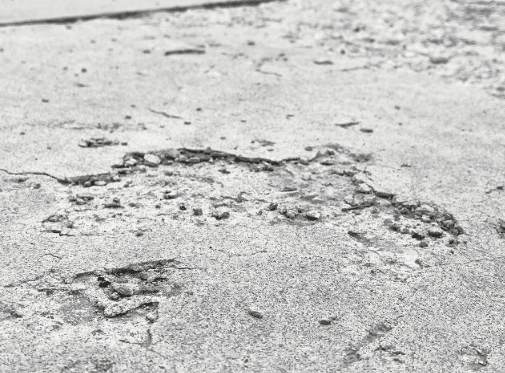
When this moisture freezes, it expands. If there is no nearby space available, hydraulic pressure develops inside the hardened cement paste.
The damage develops through repeated freezing and thawing. small cracks can develop first which can worsen after few freeze-thaw cycles.
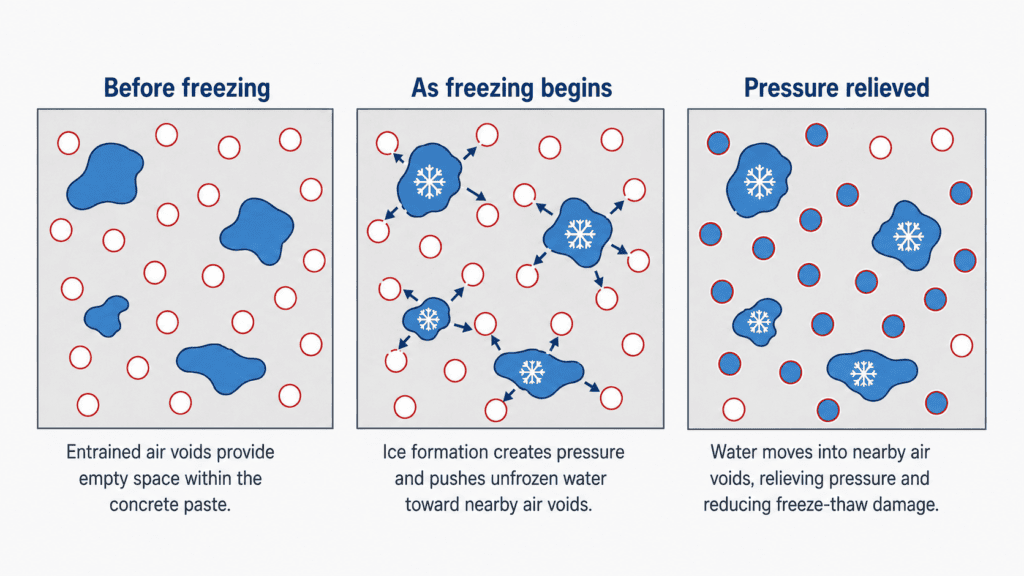
An air-entraining admixture changes this behavior by forming a stable system of microscopic bubbles during mixing as shown in image below.
As water begins to freeze, it moves toward and expands into these empty voids. This reduces the pressure acting on the surrounding cement paste and improves resistance to freeze-thaw deterioration. There are many studies that support this finding[1,2,3].
The total amount of air is important, but it does not tell the whole story.
Bubble size, spacing, and distribution also affect performance.
A few large air pockets offer little freeze-thaw protection. Millions of small, closely spaced voids provide a much shorter path for pressurized water.
Entrained Air vs Entrapped Air
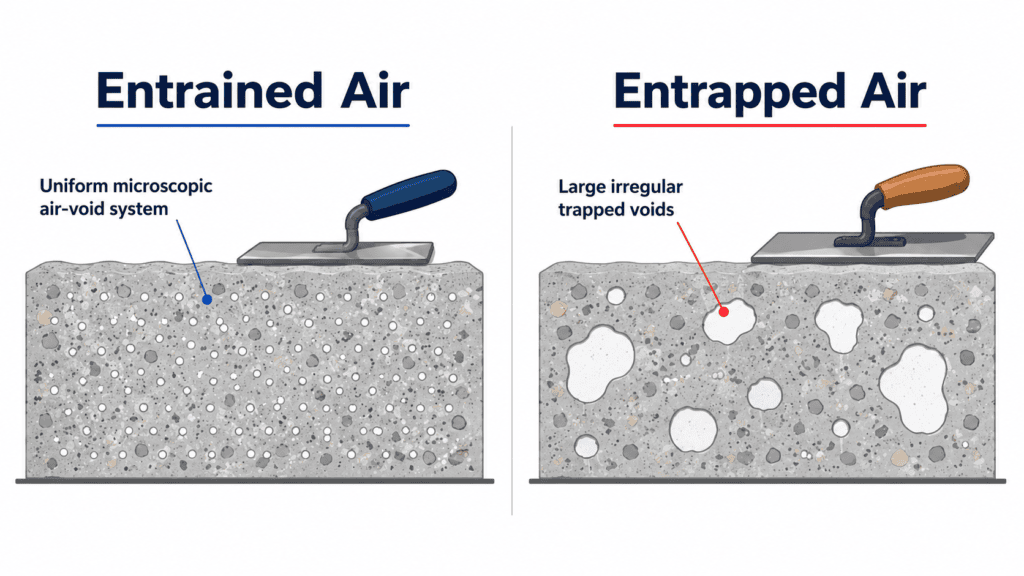
Entrained and entrapped air are not the same.
Entrained air is intentionally created with an admixture. The bubbles are microscopic, stable, and distributed throughout the cement paste.
Entrapped air forms accidentally during mixing and placement. These voids are larger, irregular, and often associated with inadequate consolidation.
Proper consolidation removes large trapped pockets without eliminating the air-void system needed for durability.
Prolonged or unnecessary vibration is different. It can change the air content, encourage segregation, and reduce the stability of the concrete near the surface.
Concrete should be vibrated only long enough to fill the forms, surround the reinforcement, and remove visible trapped air.
Benefits of Air Entrained Concrete
Resists Freeze-Thaw Damage
Freeze-thaw resistance is the main reason entrained air is specified.
Concrete without an adequate air-void system can begin scaling after repeated winter exposure, even when its compressive strength meets the project requirement.
Correctly proportioned air-entrained concrete withstands these cycles much better.
Improves Resistance to Deicing Salts
Deicing chemicals make winter exposure more severe.
They keep concrete wet, increase the number of freeze-thaw cycles near the surface, and contribute to scaling.
Entrained air improves resistance to this damage, but it works as part of a durability system. Low permeability, suitable strength, proper drainage, and adequate curing remain important.
Concrete used for exterior flatwork exposed to freezing and deicing salts is often specified with total air in the general range of 5% to 8%, depending on the aggregate size and exposure.
Makes Fresh Concrete Easier to Place
Microscopic bubbles reduce internal friction within the fresh mixture.
I usually explain this effect by imagining the air bubbles as small rolling balls which help the mixture to flow easily.
The concrete often feels more cohesive and moves more easily around reinforcement and into form corners. Still you have to perform slump test before placement.
Reduces Bleeding and Segregation
Entrained air improves the stability of fresh concrete.
It reduces the tendency of solid particles to settle and limits the movement of bleed water toward the surface.
This is particularly useful in mixtures that would otherwise feel harsh or lack sufficient fine material.
Less bleeding does not mean finishing should start early. Finishing operations should still wait until visible bleed water has disappeared.
Improves Long-Term Durability
Many exterior concrete failures are durability failures rather than strength failures.
The concrete reaches its specified 28-day strength but still deteriorates because it remains saturated, was poorly cured, or lacks adequate freeze-thaw protection.
Maintaining the specified air content from batching through placement is one of the most direct ways to improve the service life of concrete exposed to winter weather.
Required Air Content
The required air content depends mainly on exposure severity and the nominal maximum size of the coarse aggregate.
Concrete made with smaller aggregate contains more mortar and cement paste. It therefore requires a higher total air content to protect that paste.
The following values are common ACI-318 based targets. The project specification always takes priority.
| Nominal maximum aggregate size | Moderate freeze-thaw exposure | Severe exposure or deicing salts |
|---|---|---|
| 3/8 in. | 6.0% | 7.5% |
| 1/2 in. | 5.5% | 7.0% |
| 3/4 in. | 5.0% | 6.0% |
| 1 in. | 4.5% | 6.0% |
| 1 1/2 in. | 4.5% | 5.5% |
| 2 in. | 4.0% | 5.0% |
| 3 in. | 3.5% | 4.5% |
These values reflect the principle that the required air content falls as aggregate size increases.
Air content should be designed properly.
Too little air leaves the concrete vulnerable to freeze-thaw damage.
Too much air reduces strength and could create finishing problems.
How Air Content Affects Concrete Strength
Entrained air reduces compressive strength when the other mixture proportions remain unchanged.
As a general rule, each one-percentage-point increase in air content reduces 28-day compressive strength by about 3% to 5%.
For example, an unintended increase from 5% to 7% air could reduce strength by roughly 6% to 10% if no other part of the mixture changes.
The concrete producer accounts for the target air content when proportioning the mixture. The water-cementitious materials ratio, aggregate proportions, and admixtures are selected to provide both the required durability and compressive strength.
Reducing specified air simply to obtain higher cylinder strength is usually a poor trade-off for exterior concrete.
The small strength gain does not compensate for the potential loss of freeze-thaw durability.
Strength and durability must be considered together.
Effect on Finishing and Appearance
Air entrained concrete produces less bleed water, which can make the correct finishing time harder to judge. Always wait until visible bleed water has disappeared before finishing the surface.
It works well with broomed, floated, and textured exterior finishes. It is also suitable for exposed aggregate concrete used on driveways, patios, and walkways in cold climates. The microscopic bubbles remain inside the concrete and do not normally affect its finished appearance.
High air content is less suitable for dense hard-troweled or polished finishes. Repeated troweling can trap air and moisture beneath the surface, increasing the risk of blisters or delamination.
After curing, a sealed concrete surface can reduce water absorption and help preserve the finish. Sealing adds surface protection, but it does not replace the freeze-thaw resistance provided by entrained air.
Factors That Affect Air Content
Air content is not controlled by admixture dosage alone. It also depends on the following factors.
Aggregate size and grading
Smaller aggregate and higher mortar content generally require more entrained air. Changes in aggregate grading also affect the stability and distribution of the bubbles.
Cement and supplementary cementitious materials
Different cement sources respond differently to the same admixture dosage. Unburned carbon in some fly ashes can absorb air-entraining admixtures and increase the dosage needed to reach the target.
Mixing and transport
Air content can rise or fall as mixing continues. Truck speed, haul duration, and the condition of the mixer all influence the value delivered to the project.
Pumping
Concrete does not always have the same air content before and after a pump. The change depends on the pump arrangement, pressure, mixture stability, and placement conditions.
Temperature
Changes in concrete temperature affect air stability and admixture demand. The producer might need to adjust the dosage as weather and material temperatures change.
Water and other admixtures
Water reducers, accelerators, retarders, and changes in jobsite water influence the fresh mixture. It is recommended to confirm compatibility through trial batches.
Consolidation
Normal vibration removes entrapped air. Excessive vibration or repeated handling could also alter the designed air content.
How Air Content Is Tested
Air content is normally checked alongside slump, concrete temperature, and unit weight.
Together, these tests provide a quick indication of whether the delivered concrete still matches the approved mixture. Two methods are listed here.
ASTM C231 Pressure Method
ASTM C231/C231M measures fresh-concrete air content by observing the change in volume when pressure is applied.
It is the most common field method for normal-weight concrete made with relatively dense aggregates.
The method is not suitable for lightweight, highly porous, or some slag aggregates because air inside the aggregate particles affects the pressure response.
ASTM C173 Volumetric Method
ASTM C173/C173M uses water, agitation, and volume measurements to determine total air content.
It is the appropriate method for concrete containing lightweight, porous, or vesicular aggregate because air within the aggregate particles does not distort the result in the same way as the pressure method.
The volumetric test takes longer and requires careful rolling and agitation. Incomplete agitation can produce an inaccurate result.
Where Air-Entrained Concrete Should Be Used
Air-entrained concrete is generally needed when concrete will become wet and experience repeated freezing and thawing.
Typical applications include driveways, sidewalks, exterior stairs, bridge decks, highway pavements, airport pavements, curbs, gutters, parking areas, and exposed retaining walls.
It is also important where deicing chemicals will be applied or carried onto the concrete by vehicle tires.
Where It Is Usually Not Required
Air entrainment is generally unnecessary for interior concrete that remains dry and is protected from freezing.
Typical examples include many basement slabs, warehouse floors, interior foundations, and slabs inside heated buildings.
Hard-troweled interior floors require particular care.
ACI states that total air content for hard-troweled interior concrete floors should not exceed 3%. Higher air contents make the surface more difficult to finish and increase the risk of blistering, peeling, or delamination.
An exterior sidewalk might require entrained air, while an adjacent hard-troweled interior floor might be ok with normal concrete.
Conclusion
Air entrainment is one of the simplest ways to improve the durability of exterior concrete in freezing climates.
The microscopic bubbles provide space for freezing water to expand before damaging the cement paste.
This protection comes with a small strength reduction, but a properly designed mixture accounts for that effect. For concrete exposed to freezing temperatures or deicing salts, the durability gained is usually far more important than the strength lost.
FAQs
Does air entrained concrete have lower strength?
Yes, when all other mixture proportions remain unchanged. Each additional percentage point of air generally reduces compressive strength by about 3% to 5%. A properly proportioned mixture accounts for this reduction and still achieves the specified design strength.
Is air entrained concrete waterproof?
No. Entrained air improves freeze-thaw resistance. It does not seal the concrete or stop water penetration.
Is air entrained concrete required for driveways?
It is normally recommended where the driveway will experience freezing temperatures, snow, or deicing chemicals.
Can air-entrained concrete be pumped?
Yes. Air-entrained concrete is regularly pumped, but the pumping system can change the measured air content.
What happens if the air content is too low?
The concrete might not have enough closely spaced voids to relieve pressure during freezing. This increases the risk of scaling, internal cracking, and premature deterioration.
What happens if the air content is too high?
Excessive air reduces compressive strength. It can also make some finishes more difficult and increase the risk of surface problems, particularly on hard-troweled interior slabs.
How is air added to concrete?
An air-entraining admixture is added during batching. Products used for this purpose in the United States are commonly specified under ASTM C260/C260M.