Deep Foundations: 7 Types and When Engineers Use Them
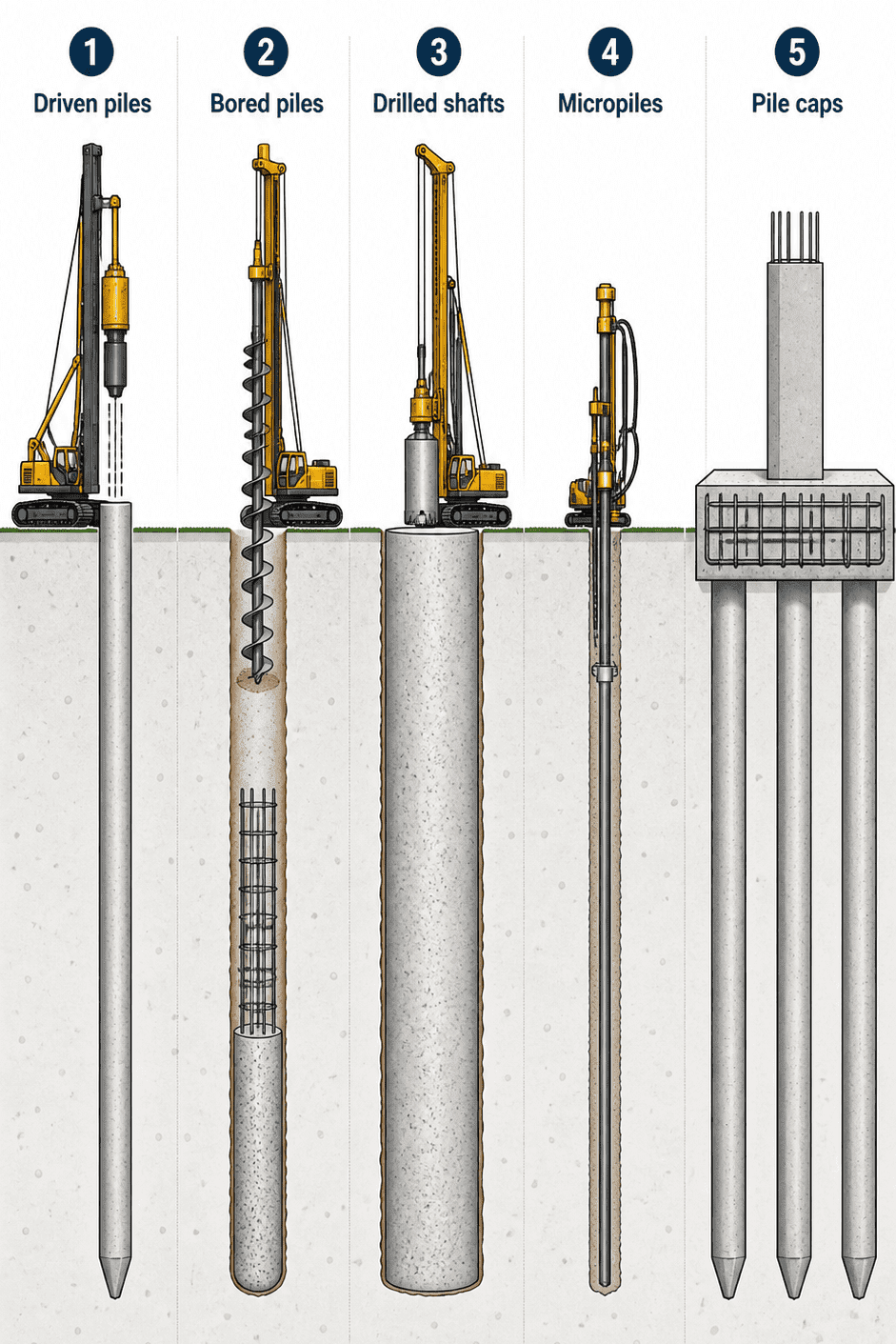
Deep foundations transfer building loads through weak surface soil to stronger soil or rock below. Engineers use them when shallow foundations may settle, tilt, or fail. Common types include driven piles, bored piles, drilled shafts, caissons, micropiles, CFA piles, and pile groups.
The real question is simple: how deep must the foundation go before the ground becomes reliable?
Deep Foundation Types at a Glance
Swipe sideways to view the full table on mobile.
| Deep foundation type | How it works | Common use |
|---|---|---|
| Driven piles | Hammered or vibrated into the ground | Bridges, marine works, heavy buildings |
| Bored piles | Hole is drilled and filled with reinforced concrete | Urban buildings, deep soil support |
| Drilled shafts | Large drilled concrete foundations | Bridges, towers, large columns |
| Caissons | Large units sunk into place | Bridge piers, marine structures |
| Micropiles | Small drilled and grouted piles | Underpinning, repairs, tight access |
| CFA piles | Auger drills while concrete is pumped during withdrawal | Fast urban piling work |
| Pile groups | Several piles joined by a pile cap | Heavy columns and bridge piers |
When Are Deep Foundations Used?
Deep foundations are often considered when shallow footings cannot safely support the structure, especially where soil movement may lead to foundation settlement or long-term movement.
Typical situations include:
- soft clay or loose sand near the surface
- filled or disturbed ground
- high groundwater
- expansive or collapsible soil
- heavy building loads
- bridge, tower, or industrial loads
- scour risk near rivers or coastal areas
- limited space for wide shallow footings
- nearby structures that make excavation risky
A shallow foundation spreads load near the surface. A deep foundation bypasses weak soil and transfers load deeper into the ground.
If you are trying to understand building movement, settlement, or cracking, also read our foundation repair guide.
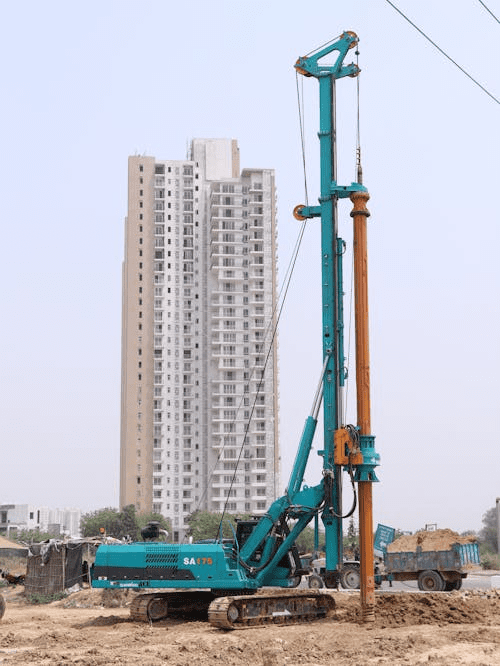
1. Driven Piles
Driven piles are long elements forced into the ground using impact hammers, vibration, or pressing systems.
They may be made from:
- precast concrete
- steel H-sections
- steel pipe
- timber
Driven piles carry load through side friction, end bearing, or both.
They work well for bridges, waterfront structures, industrial buildings, and open sites where noise and vibration are acceptable.
Precast concrete piles are often prestressed to improve their load capacity and resistance to handling stresses during installation.
Main advantage: fast installation.
Main drawback: vibration and noise near existing buildings.
2. Bored Piles
Bored piles are made by drilling a hole and filling it with reinforced concrete.
They are common in cities because they create less vibration than driven piles.
Basic process:
- drill the hole
- support the borehole if needed
- place reinforcement cage
- pour concrete
- connect the pile head to the structure
Bored piles can carry high loads, but construction quality matters. Poor base cleaning, unstable boreholes, or weak concrete placement can reduce capacity.
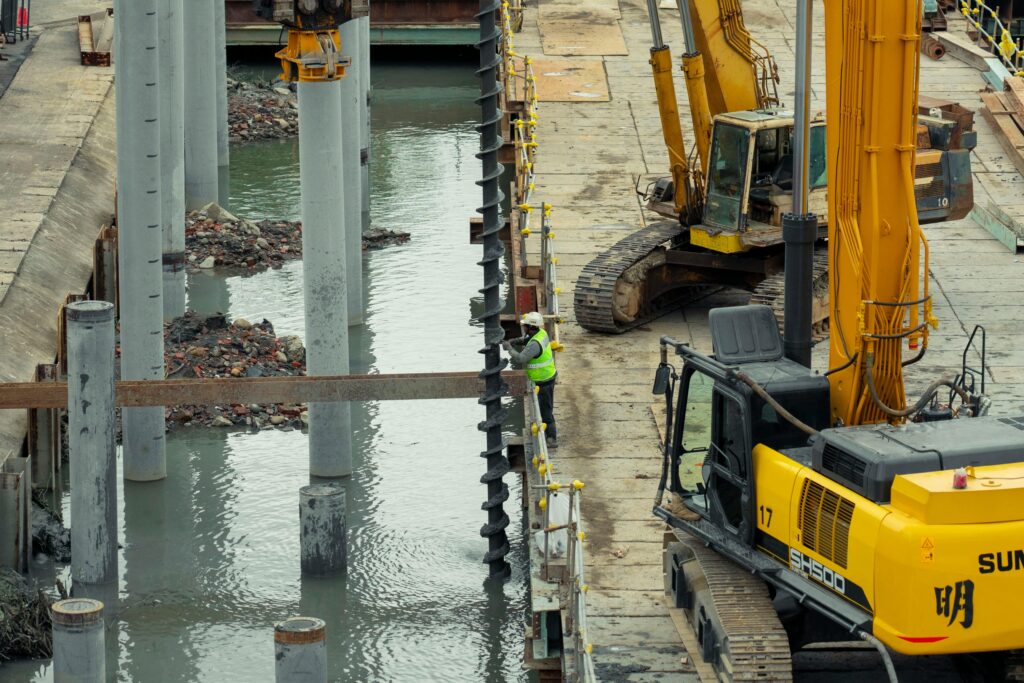
3. Drilled Shafts
Drilled shafts are large-diameter cast-in-place concrete foundations.
They are often used for:
- bridges
- towers
- large columns
- heavy structures
- high lateral loads
A drilled shaft can transfer load through side resistance, end bearing, rock socket resistance, or a combination of these.
They are useful when one large foundation element can replace several smaller piles.
For a more technical reference on drilled shafts, the FHWA provides detailed guidance on design, construction, inspection, and quality control for transportation foundations.
4. Caisson Foundations
Caissons are large foundation units sunk into the ground or below water level.
They are mainly used for:
- bridge piers
- river crossings
- marine structures
- harbour works
Common caisson types include open caissons, box caissons, and pneumatic caissons.
Caissons are not common in ordinary residential work. They are usually used in major civil engineering projects.
5. Micropiles
Micropiles are small-diameter drilled and grouted piles. They usually contain steel reinforcement.
They are useful where large piling rigs cannot work.
Common uses include:
- underpinning existing foundations
- foundation repair
- seismic strengthening
- slope stabilisation
- restricted-access sites
- retrofit projects
Micropiles are flexible, but they are not usually the cheapest option for open new-build sites.
6. CFA Piles
CFA means continuous flight auger.
A CFA pile is installed by drilling with a hollow auger. Concrete is pumped through the auger as it is withdrawn, then reinforcement is inserted into the fresh concrete.
CFA piles are popular because they are fast and create less vibration than driven piles.
They are often used for:
- urban buildings
- medium to heavy loads
- noise-sensitive sites
- suitable clay and sand conditions
The key risk is construction control. The contractor must manage drilling speed, concrete pressure, and auger withdrawal carefully.
7. Pile Groups and Pile Caps
Many structures do not rely on one pile. They use several piles connected by a reinforced concrete pile cap.
The pile cap collects load from the column or wall and distributes it to the piles below.
Pile groups are used when:
- one pile cannot carry the full load
- settlement control is important
- lateral resistance is needed
- column loads are high
- bridge piers need strong support
Pile spacing, group action, reinforcement, and soil behaviour all affect performance.
Shallow vs Deep Foundations
Swipe sideways to view the full table on mobile.
| Feature | Shallow foundation | Deep foundation |
|---|---|---|
| Load transfer | Near surface | Deeper soil or rock |
| Examples | Spread footing, strip footing, mat | Piles, drilled shafts, caissons |
| Best for | Good surface soil | Weak surface soil or heavy loads |
| Cost | Usually lower | Usually higher |
| Equipment | Standard excavation tools | Specialist piling or drilling rigs |
| Main risk | Bearing failure or settlement | Installation quality and deep soil uncertainty |
The Deep Foundations Institute also publishes technical resources and committee work on bored piles, drilled shafts, pile testing, and foundation construction best practices.
Deep foundations do not replace soil investigation. They make it more important because the design depends on what exists below the normal excavation depth
How Engineers Choose a Deep Foundation Type
Engineers compare:
- soil profile
- groundwater level
- structural loads
- settlement limits
- lateral loads
- access for equipment
- vibration limits
- nearby buildings
- local contractor experience
- testing requirements
- cost and construction risk
For example, driven piles may suit an open bridge site. Micropiles may suit a tight basement underpinning job. CFA piles may suit an urban building where vibration must stay low.
The best deep foundation type depends on both design and construction conditions.
Common Mistakes
Avoid these mistakes:
- choosing a pile type before soil investigation
- assuming deeper always means safer
- ignoring groundwater
- ignoring lateral loads
- comparing piling quotes without checking scope
- skipping pile testing
- using high-vibration methods near fragile buildings
- treating all deep foundation types as the same
The ground decides whether the foundation works. The drawings only explain the plan.
When to Call a Geotechnical Engineer
Call a geotechnical engineer when the site has weak soil, unknown fill, settlement risk, groundwater issues, heavy loads, slopes, or possible need for piles or underpinning.
You should also get professional advice if:
- cracks are linked with settlement
- the building is near a retaining wall
- the site is on a slope
- expansive clay is present
- nearby excavation may affect the structure
- the project involves bridges, towers, or heavy equipment loads
For movement-related building problems, also read our stability of structure guide.
FAQs
What are deep foundations?
Deep foundations transfer structural loads to deeper soil or rock when the upper soil cannot safely support the structure.
What are the main deep foundation types?
The main deep foundation types are driven piles, bored piles, drilled shafts, caissons, micropiles, CFA piles, and pile groups.
Is piling the same as deep foundation?
Piling is one type of deep foundation work. All piles are deep foundations, but not all deep foundations are piles. Drilled shafts and caissons also fall under deep foundations.
Are deep foundations used for houses?
Yes, but only when needed. Houses may require deep foundations on weak soil, filled ground, expansive clay, coastal sites, steep slopes, or settlement-prone areas.
Are deep foundations expensive?
Yes, but only when needed. Houses may require deep foundations on weak soil, filled ground, expansive clay, coastal sites, steep slopes, or settlement-prone areas.
Can deep foundations stop settlement?
They can reduce settlement risk by transferring loads to stronger soil or rock. Poor design or poor installation can still cause problems.
Final Thoughts
Deep foundations are used when surface soil cannot safely support a structure.
The main deep foundation types are driven piles, bored piles, drilled shafts, caissons, micropiles, CFA piles, and pile groups. The right choice depends on soil, load, groundwater, access, settlement limits, and construction risk.
For weak soil, heavy loads, slopes, bridges, towers, and settlement-sensitive sites, deep foundations often become the safest option