Concrete Countertop Calculator
Use this concrete countertop calculator to estimate how much concrete you need for a kitchen counter, island, or bathroom vanity. Enter the length, depth, and thickness to calculate concrete volume, bag quantities, finished weight, and material cost. You can also account for sink cutouts, L-shaped layouts, thickened edges, and waste.
Concrete Countertop Calculator
Find concrete volume, bags, finished weight, and optional DIY cost.
Use for one rectangular counter or island.
For L- and U-shaped layouts, measure from the outside corners. The calculator deducts shared corners once. For separate pieces, measure each piece on its own.
Enter your mix’s stated yield. Openings must be rectangular, fully through the slab, and not overlap one another or a shared corner.
Step 2 (optional): Edge, backsplash & cost
Leave optional lengths and prices blank or at zero if they do not apply.
Add only the extra concrete below the main slab, not the full edge thickness.
Top area is included automatically. Add edge or underside area only if you intend to seal it. Use your product’s coverage per coat.
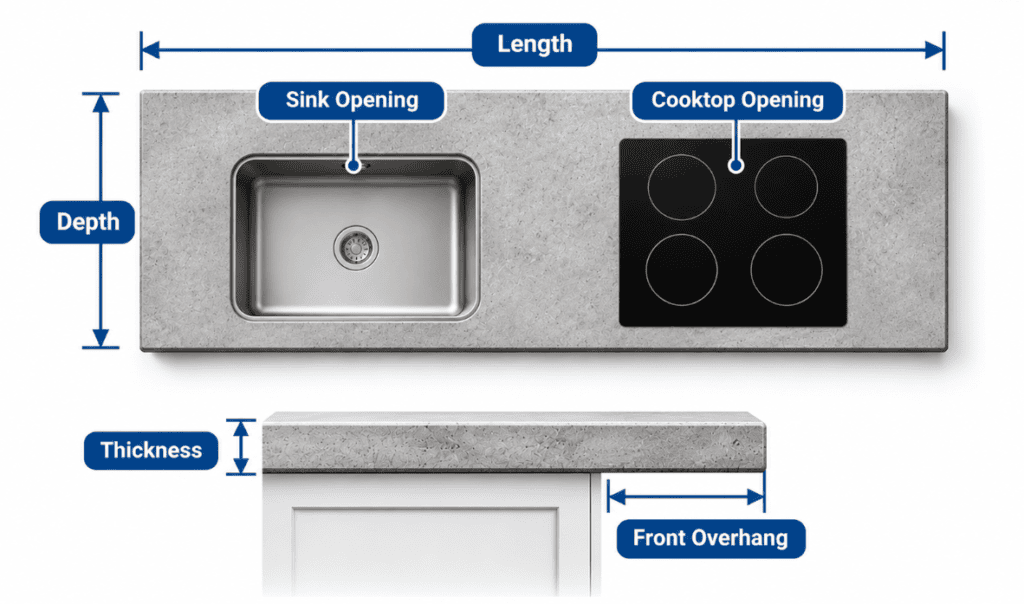
Enter your countertop dimensions in feet and inches. Select the layout and add any sink or cooktop openings. Check diagram below for common counter top as a reference. For the most accurate bag count, use the mixed-concrete yield printed on your chosen product.
The calculator shows:
- Area (sq ft): Finished countertop area after deducting full-depth openings.
- Concrete volume (ft³ and yd³): Concrete required for the finished shape, before waste.
- Bags needed: Whole bags to purchase, including waste.
- Finished weight (lb): Estimated weight of the cast concrete.
- Material cost ($): Concrete mix cost and any additional expenses entered.
For example, an 8 ft × 25 in countertop that is 1.5 inches thick needs 2.08 cubic feet of concrete. With 10% waste, you need four 80 lb bags if each yields 0.60 cubic feet.
How Much Concrete Do I Need for a Countertop?
Multiply the countertop length, depth, and thickness to calculate its volume.
When all dimensions are in inches:
Concrete volume (ft³) = Length × Depth × Thickness ÷ 1,728
For an 8-foot kitchen countertop:
- Length: 96 inches
- Depth: 25 inches
- Thickness: 1.5 inches
Volume = 96 × 25 × 1.5 ÷ 1,728
Concrete needed = 2.08 ft³
Add a 10% allowance for mixing and placement losses:
2.08 × 1.10 = 2.29 ft³
This is the volume to use when estimating how many bags to purchase.
For rectangular counters, the calculation is straightforward. For L-shaped or U-shaped layouts, divide the countertop into rectangles and avoid counting shared corners twice.
Concrete needed for common countertop sizes
The table assumes a 1.5-inch thickness, 10% waste, and a mix yield of 0.60 ft³ per 80 lb bag.
| Countertop size | Concrete volume | 80 lb bags |
|---|---|---|
| 4 ft × 22 in bathroom vanity | 0.92 ft³ | 2 |
| 6 ft × 25 in kitchen counter | 1.56 ft³ | 3 |
| 8 ft × 25 in kitchen counter | 2.08 ft³ | 4 |
| 10 ft × 25 in kitchen counter | 2.60 ft³ | 5 |
| 6 ft × 36 in kitchen island | 2.25 ft³ | 5 |
Volumes exclude waste. Bag counts include 10% waste and are rounded up to whole bags. These examples have no openings or thickened edges.
For other concrete projects, our Concrete Calculator estimates cubic yards and bag quantities for slabs, footings, and similar pours.
How Many 80 lb Bags of Concrete Do I Need?
Divide the concrete volume, including waste, by the mixed-concrete yield per bag. Round the result up to the next whole bag.
Bags needed = Volume including waste ÷ Yield per bag
According to the QUIKRETE Countertop Mix technical data sheet, one 80 lb bag produces approximately 0.60 cubic feet of mixed concrete.
At that yield, the theoretical coverage is:
| Countertop thickness | Coverage per 80 lb bag |
|---|---|
| 1 inch | 7.2 sq ft |
| 1.5 inches | 4.8 sq ft |
| 2 inches | 3.6 sq ft |
| 2.5 inches | 2.9 sq ft |
| 3 inches | 2.4 sq ft |
Coverage excludes waste. These figures show volume only. They do not mean the selected mix is suitable for every thickness.
For example, a 20-square-foot countertop that is 1.5 inches thick requires 2.50 ft³ of concrete. Add 10% waste, and the purchase volume becomes 2.75 ft³.
2.75 ÷ 0.60 = 4.58 bags
You would purchase five bags.
Do not estimate yield from bag weight alone. Different countertop mixes can have different yields, aggregate sizes, and placement requirements. Use the manufacturer’s published data.
Concrete Countertop Thickness and Weight
Conventional cast concrete countertops commonly use thicknesses around 1.5 to 2 inches. The appropriate thickness depends on the mix, reinforcement, openings, and supporting structure.
For example, the SAKRETE Concrete Countertop Mix data sheet specifies full-depth applications of at least 2 inches. Other products and engineered systems may have different requirements.
How much does a concrete countertop weigh?
Normal-weight concrete is commonly estimated at 150 pounds per cubic foot.
Finished weight (lb) = Net concrete volume (ft³) × Density (lb/ft³)
| Thickness | Estimated weight per sq ft |
|---|---|
| 1 inch | 12.5 lb |
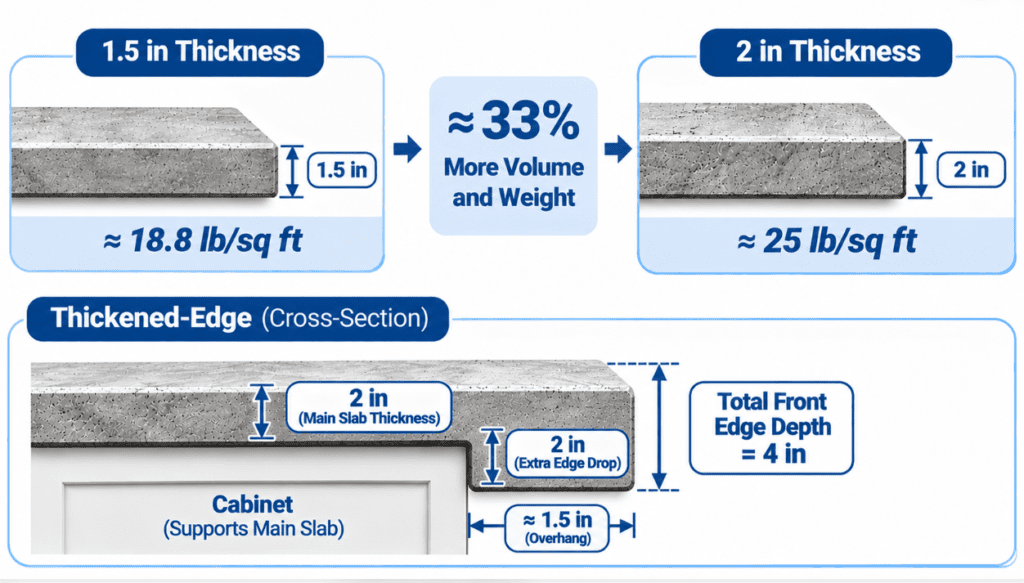
| 1.5 inches | 18.8 lb |
| 2 inches | 25.0 lb |
| 2.5 inches | 31.3 lb |
| 3 inches | 37.5 lb |
An 8 ft × 25 in countertop, 1.5 inches thick, weighs approximately 313 pounds before sink cutouts or added edge details.
Increasing the thickness from 1.5 to 2 inches increases both concrete volume and finished weight by about 33%. This is illustrated in diagram below.
The calculator uses the net concrete volume for weight. It does not count material lost during mixing or finishing.
A weight calculation does not confirm that the countertop or cabinets can safely carry the load. Check reinforcement, cabinet support, spans, and overhangs before casting. Large openings and narrow sections may require special reinforcement.
How to Calculate an L-Shaped Concrete Countertop
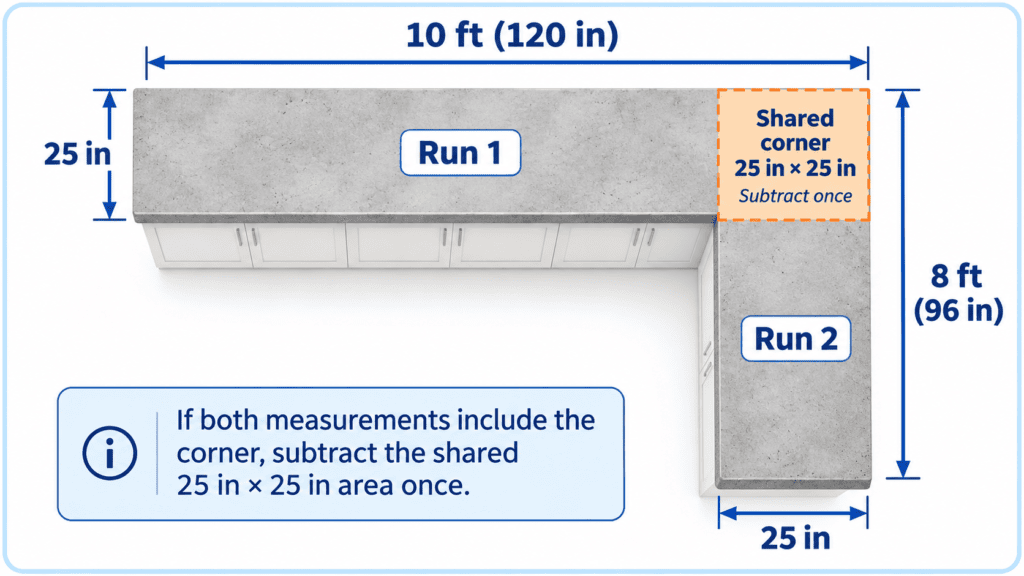
An L-shaped countertop usually consists of two rectangular runs. If both measurements include the corner, subtract the overlapping area once.
Consider these dimensions:
- First run: 10 ft × 25 in
- Second run: 8 ft × 25 in
- Thickness: 1.5 inches
The combined area before correcting the corner is:
(120 × 25) + (96 × 25) = 5,400 in²
Both runs include the same 25 × 25-inch corner.
Overlapping area = 25 × 25 = 625 in²
Net area = 5,400 − 625 = 4,775 in²
Concrete volume = 4,775 × 1.5 ÷ 1,728
Concrete needed = 4.14 ft³
After adding 10% waste, the required purchase volume is approximately 4.56 ft³. At 0.60 ft³ per bag, you need eight 80 lb bags.
For U-shaped layouts, divide the countertop into rectangular runs and account for both corner overlaps. A countertop made from separate pieces should be measured piece by piece.
How Do Sink and Cooktop Cutouts Affect Concrete Volume?
A full-depth sink or cooktop opening reduces the amount of concrete needed.
For a rectangular opening:
Cutout volume (ft³) = Length × Width × Thickness ÷ 1,728
Subtract the cutout volume from the gross countertop volume.
Example: 10-foot countertop with a sink cutout
Suppose you have:
- Countertop: 120 × 25 × 1.5 inches
- Sink opening: 22 × 18 inches
Gross volume = 2.60 ft³
Sink opening volume = 22 × 18 × 1.5 ÷ 1,728 = 0.34 ft³
Net volume = 2.60 − 0.34 = 2.26 ft³
With 10% waste, the purchase volume is approximately 2.49 ft³. That requires five 80 lb bags at the assumed yield.
Use the opening dimensions supplied by the sink or cooktop manufacturer, not the overall appliance dimensions.
An integral concrete sink or recessed drainboard needs a different calculation because some concrete remains below the recess.
Do Thickened Edges and Backsplashes Need Extra Concrete?
Yes. A built-up edge or cast concrete backsplash adds material beyond the main countertop slab.
For a rectangular thickened edge:
Extra volume (ft³) = Edge length × Edge thickness × Extra depth ÷ 1,728
Use inches for all three dimensions.
For example, a 96-inch-long front edge that is 1 inch thick and extends 1 inch below the main slab adds:
96 × 1 × 1 ÷ 1,728 = 0.056 ft³
The main countertop calculation already includes the concrete within the original slab thickness. Only add the extra material below it.
For a separate rectangular backsplash, calculate its length × height × thickness. Add that volume to the total.
Curved edges and unusual profiles require their actual cross-sectional dimensions. Do not apply an arbitrary percentage to represent a thickened edge.
Concrete Countertop Cost Calculator
The concrete mix is only part of a DIY countertop budget. Forms, reinforcement, polishing supplies, pigment, and sealer can add to the cost.
The calculator uses your entered bag price rather than assuming a nationwide concrete mix price.
For example, if your countertop needs five bags and the store charges $25 per bag:
Concrete mix cost = 5 × $25 = $125
The $25 price is an example, not a current national average.
When estimating the complete material budget, include:
- Concrete countertop mix
- Mold boards, edge forms, and release agent
- Reinforcement specified for the design
- Optional color pigments
- Grinding and polishing supplies
- Countertop sealer
- Adhesives and installation supplies
Tools, delivery, taxes, removal of an existing countertop, and labor may add to the total.
A professional quote usually covers more than materials. Ask whether it includes templating, casting, reinforcement, finishing, delivery, and installation.
For comparison, our Concrete Slab Price Calculator shows how material and installation expenses affect larger concrete projects.
What Concrete Mix Should You Use for Countertops?
A countertop-specific mix is a practical choice for conventional wet-cast countertops. These products are formulated for countertop casting and may offer better flow and finishing properties than general-purpose concrete mixes.
Regular concrete mixes can contain coarse aggregate that makes them harder to place in thin or detailed forms. Check the aggregate size and product instructions before using one.
Glass fiber reinforced concrete (GFRC) is another option. GFRC countertops may use thinner structural sections with built-up edges, but they rely on a different material system and fabrication method.
Do not apply conventional wet-cast bag yields or thickness assumptions to GFRC without checking the manufacturer’s specifications.
If you are planning a GFRC countertop, our GFRC Weight Calculator can help estimate the weight using the appropriate panel dimensions, thickness, and density.
Before buying concrete, confirm the recommended thickness, yield, mixing instructions, reinforcement requirements, and curing procedure.
Common Concrete Countertop Calculation Mistakes
- Measuring cabinet depth instead of countertop depth: Include the finished front overhang when measuring the slab.
- Counting an L-shaped corner twice: Deduct the shared corner if both run measurements include it.
- Using the wrong bag yield: Check the actual product rather than assuming all bags cover the same area.
- Ignoring cutouts or thickened edges: Openings remove concrete, while built-up edges can add it.
- Choosing thickness based only on appearance: Verify the mix requirements, reinforcement, and supports before casting.
Make a simple top-view sketch before ordering materials. Mark the finished dimensions, openings, overhangs, and planned joints. It is easier to correct a measurement before building the form.
Calculator Methodology and Assumptions
This calculator uses geometric volume formulas for rectangular sections, cutouts, and added edge or backsplash details.
It subtracts openings, adds any extra concrete, applies the waste percentage, and divides the purchase volume by the selected bag yield.
Finished weight uses the net cast volume, without waste. The default concrete density is 150 lb/ft³, although actual density depends on the mix.
The calculator assumes the entered measurements describe the finished countertop. It does not determine reinforcement, allowable overhangs, cabinet capacity, structural strength, or safe handling methods.
Technical References
- QUIKRETE Countertop Mix Technical Data Sheet: Mix yield, placement, and curing instructions.
- SAKRETE Concrete Countertop Mix Technical Data Sheet: Product yield, minimum placement thickness, and mixing requirements.
- Concrete Countertop Institute: Technical education on countertop materials and fabrication.
FAQs
How many bags of concrete do I need for a 10-foot countertop?
A 10 ft × 25 in countertop that is 1.5 inches thick needs approximately 2.60 ft³ of concrete. With 10% waste, five 80 lb bags are required at a yield of 0.60 ft³ per bag.
How much does a 2-inch concrete countertop weigh?
At an assumed density of 150 lb/ft³, a 2-inch-thick countertop weighs about 25 pounds per square foot. A 20-square-foot countertop therefore weighs approximately 500 pounds before deducting openings.
Can I use regular concrete mix for a countertop?
You can use a suitable conventional concrete mix if its aggregate size, thickness requirements, and placement properties fit the project. A countertop-specific mix is generally a better starting point for detailed wet-cast work.
Should I subtract the sink opening?
Yes, if the opening passes through the full thickness. For an integral concrete sink or partial-depth recess, deduct only the volume where concrete is absent.
How much extra concrete should I buy?
A 10% allowance is a practical starting estimate for a straightforward pour. Complex forms or difficult placement may need a different allowance. Round the final bag count up to whole bags.
Last reviewed: November 21, 2026.
Disclaimer: This calculator provides material planning estimates. Follow the selected product’s instructions and seek qualified advice for reinforcement, support, and complex countertop designs.