Concrete Spalling: Causes, Repair & When to Worry
Concrete spalling is the breaking or detachment of concrete, often caused by rebar corrosion, freeze-thaw exposure, salts, or poor concrete quality. Small surface spalls can often be repaired, but damage involving corroded reinforcement, delamination, or structural members needs closer evaluation.
The biggest mistake I see is patching spalled concrete without first finding the cause. In this article, we will look at the main causes of concrete spalling and how it is typically repaired.
Spalling vs Scaling vs Delamination vs Popouts
Concrete spalling is often confused with scaling, delamination, and popouts. The difference between them must be understood as the repair options are different for each. You can see the image below to see the difference.
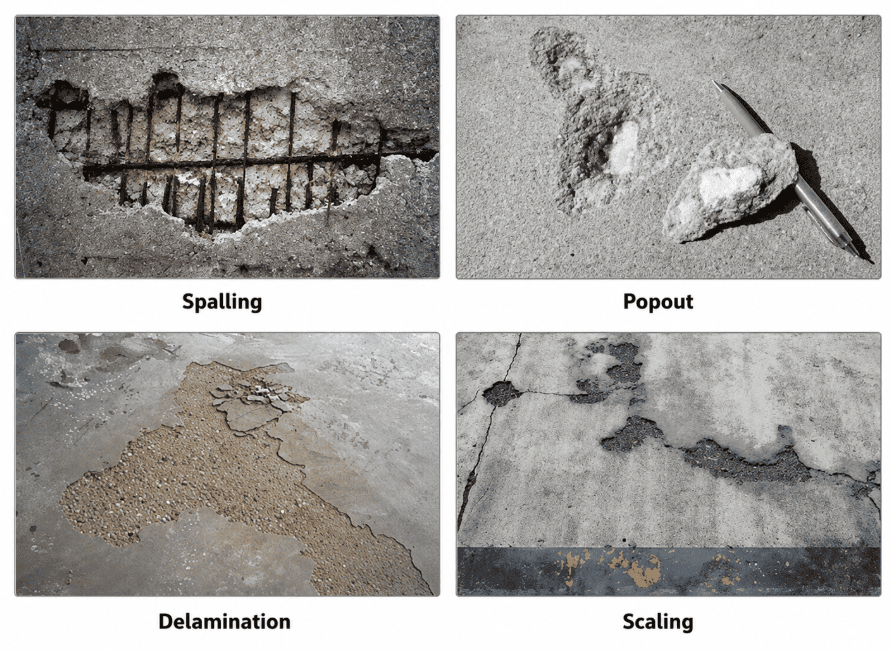
Scaling is usually shallow. You often see it across driveways, sidewalks, and other exterior slabs after repeated winter exposure.
Delamination is easier to miss. The surface may look intact while a separated layer exists underneath. Tapping the area often produces a hollow or “drummy” sound compared with solid concrete.
That separated layer can later break away and become a visible spall.
The table below shows how you can identify the correct problem.
| Damage | What it looks like | What is happening |
|---|---|---|
| Spalling | Irregular pieces or chunks are missing | Concrete has detached from the surface or concrete cover |
| Scaling | Thin flakes and shallow surface loss | The near-surface mortar is deteriorating |
| Delamination | Surface may still look intact | A layer of concrete has separated below the surface |
| Popout | Small isolated cone-shaped pit | A localized aggregate particle has expanded or broken away |
What Causes Concrete Spalling?
1. Reinforcement Corrosion
Rebar corrosion is one of the most important causes of spalling in reinforced concrete.
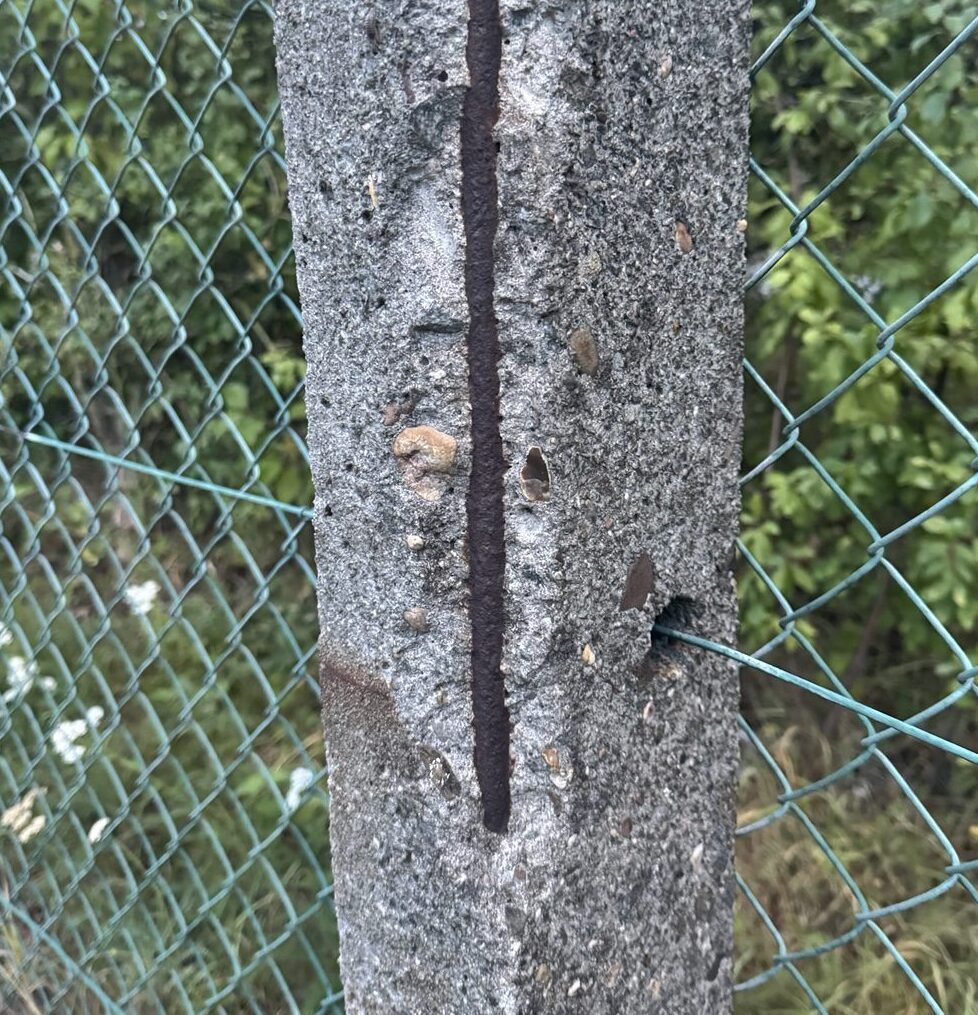
Concrete normally provides an alkaline environment that protects embedded steel. That protection can break down when carbonation reaches the reinforcement or enough chloride penetrates the concrete.
Chlorides commonly come from deicing salts and marine exposure.
As steel corrodes, corrosion products build around the bar and create pressure against the concrete cover. Cracks develop along the reinforcement, the cover separates, and pieces eventually break away.
A typical progression is:
Rust staining, cracks following the line of reinforcement, and exposed rusty bars are strong clues.
ACI 546R-23 treats condition assessment and identification of the deterioration mechanism as part of concrete repair rather than treating only the visible defect.
2. Freeze-Thaw Damage
Exterior concrete in cold climates repeatedly gets wet, freezes, and thaws.
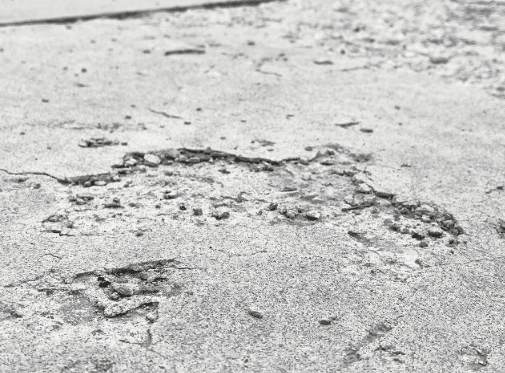
Problems develop when the concrete becomes sufficiently saturated. Freezing creates pressures within the pore system, and repeated cycles can gradually damage the concrete.
The first visible sign is often scaling rather than a deep spall.
Proper air entrainment improves freeze-thaw resistance by providing microscopic voids that help relieve freezing pressures. Good drainage also reduces the amount of time the concrete stays saturated.
3. Deicing Salts
Deicing chemicals can worsen concrete deterioration in more than one way.
At the surface, exposure can contribute to scaling under severe freeze-thaw conditions. Chlorides can also penetrate deeper into reinforced concrete and eventually contribute to corrosion of the steel.
That is why a rough driveway surface and a spall above rusty reinforcement should not automatically receive the same repair.
4. Poor Placement, Finishing, or Curing
Some surface problems begin when the concrete is placed.
Common contributors include:
- excessive water in the mix
- adding water during finishing
- finishing while bleed water remains
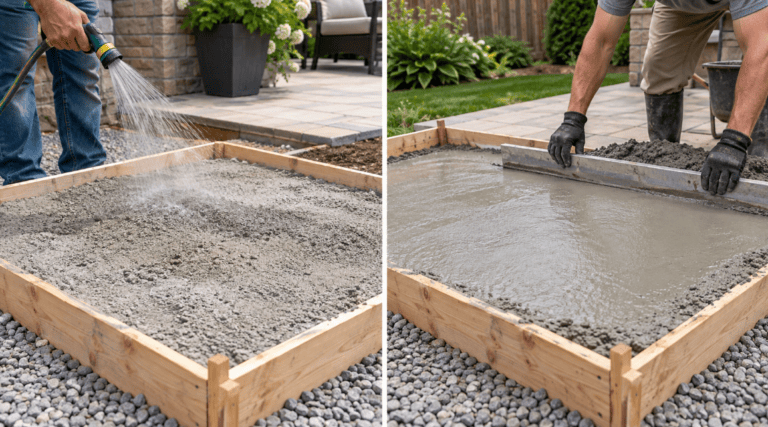
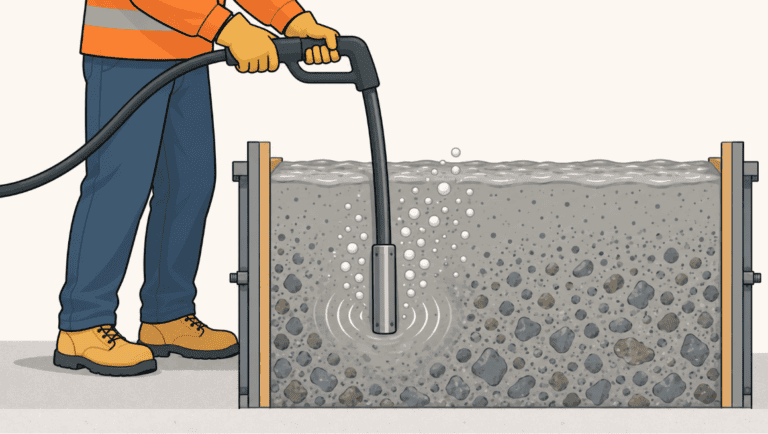
- poor consolidation
- inadequate curing
- unsuitable air entrainment for the exposure
These conditions can leave weak surface concrete or increase permeability, making later moisture, salt, and winter exposure more damaging.
If the problem is cracking rather than actual concrete loss, see our guide to what causes concrete to crack. Cracking and spalling can occur together, but they are not the same defect.
5. Insufficient Concrete Cover
Concrete cover protects reinforcing steel from the surrounding environment.
When the cover is too thin, carbon dioxide, moisture, oxygen, and chlorides have a shorter path to the reinforcement. Existing cracks can also provide easier routes into the concrete.
Thin cover does not guarantee corrosion, but it reduces the protection available to the steel.
6. Impact, Joint Problems, Chemical Attack, and Fire
Not every spall is caused by corrosion or weather.
Impact, abrasion, aggressive chemicals, alkali-silica reaction, severe heat, and stresses around joints can also break concrete away.
Joint-edge spalling deserves particular attention. Hard debris trapped in a moving joint, poor load transfer, or incorrect joint detailing can damage the slab edges.
If the joint itself is sound but the surface seal has failed, our expansion joint sealant guide explains which flexible products suit concrete joints.
Our guide to movement joints in concrete explains how control, expansion, isolation, and construction joints differ.
Read the Damage: What Is the Concrete Telling You?
You can often narrow down the likely problem from the damage pattern. The table below will help you with this.
| What you see | Possible explanation | What to check next |
|---|---|---|
| Thin flakes across an exterior slab | Scaling or freeze-thaw deterioration | Is the concrete underneath still hard and sound? |
| Deep irregular pieces missing | Spalling | Determine why the concrete detached |
| Rust stains | Reinforcement corrosion | Look for cracking along rebar |
| Long straight cracks | Corrosion may be following reinforcement | Check nearby areas for delamination |
| Hollow sound around the damage | Delamination | Damage may extend beyond what you can see |
| Damage along a joint | Joint or mechanical deterioration | Inspect the joint and slab edges |
| Small cone-shaped pits | Popouts | Examine the exposed aggregate |
| Loose concrete after a fire | Thermal damage | Have the affected member evaluated |
I would not judge severity from depth alone.
A large shallow defect on a ground-supported driveway may be mainly a durability issue. I would be more concerned about spalling on a beam or column, especially if the reinforcement is exposed or corroded.
How Serious Is Concrete Spalling?
Location matters as much as appearance.
A small localized defect in a patio, sidewalk, or ground-supported driveway is generally less concerning when the surrounding concrete remains solid and reinforcement is not exposed.
Get the damage evaluated when you see:
- exposed reinforcement
- significant rust staining
- repeated spalling after earlier repairs
- widespread hollow-sounding areas
- major cracking around the spall
- visible loss of reinforcement section
- rapidly increasing deterioration
Use more caution with beams, columns, balconies, elevated slabs, parking structures, retaining structures, and other load-bearing concrete.
Loose overhead concrete is also a falling-object hazard even when the structure itself remains stable.
If concrete on your driveway, patio, slab, or other surface is breaking away or deteriorating, call (877) 729-6897 now to discuss the repair with a local concrete professional.
Call Now: (877) 729-6897How to Repair Spalling Concrete
The repair should match the cause and condition of the remaining concrete. There is no universal depth or percentage of damage that automatically means the concrete must be replaced.
Use this table as a quick guide:
| Condition | Typical repair approach |
|---|---|
| Small localized spall with sound surrounding concrete | Local patch repair |
| Widespread shallow scaling with sound concrete below | Resurfacing may be suitable |
| Spall with corroded reinforcement | Remove unsound concrete and address the steel |
| Widespread delamination | Locate and remove all unsound areas |
| Repeated damage from water or salts | Correct the exposure as part of the repair |
| Extensive weak or deteriorated concrete | Larger repair or replacement may be more practical |
| Structural member with damaged reinforcement | Engineer-designed repair may be required |
Once the repair approach is clear, the work should follow a controlled sequence. The goal is to remove all unsound concrete, deal with any reinforcement damage, and rebuild the area on a sound, properly prepared substrate.
1. Identify the Cause
I would start with examining the exposure and damage pattern.
Check for corrosion, freeze-thaw deterioration, leaking joints, standing water, impact damage, weak concrete, or another identifiable source.
Do this before choosing a repair product.
2. Find the Full Extent of Unsound Concrete
The damaged area can extend beyond the visible spall.
Tapping or sounding the surrounding surface can help locate delaminated concrete. Sound material normally produces a sharper response, while separated areas often sound dull or hollow.
FHWA guidance for partial-depth concrete repairs makes the same point. The damaged area often extends beyond what you can see, so remove concrete until you reach sound material.
3. Remove Loose and Unsound Concrete
Remove fractured, loose, and delaminated material until you reach sound concrete.
A patch bonded to weak substrate is only as reliable as the concrete left underneath it.
Removal methods should also avoid unnecessary damage to the remaining concrete and reinforcement.
4. Prepare the Repair Surface
Clean the repair area and produce the surface condition required by the selected repair material.
Dust, weak cement paste, oil, coatings, and other contaminants can reduce bond.
Avoid thin feathered edges where the repair material requires a defined edge.
ICRI identifies surface preparation as an important factor in repair performance. It notes that poor preparation can lead directly to repair failure and additional repair work.
5. Evaluate Exposed Reinforcement
Do not automatically cover exposed steel with repair mortar.
Remove loose corrosion products as required by the repair procedure and check the condition of the bar.
A bar with light surface corrosion is different from reinforcement with significant section loss, poor bond, or damage in a critical structural location. Those conditions may require a designed repair.
6. Select a Compatible Repair Material
Depending on the application, repair materials may include cementitious mortars, polymer-modified mortars, flowable repair materials, or products designed for vertical, overhead, or structural repair.
Do not select a product only because it has the highest compressive strength.
Other factors such as shrinkage, bond compatibility, placement method, and curing requirements also matter.
7. Place and Cure the Repair
Follow the selected repair system for substrate moisture condition, bonding requirements, allowable thickness, placement, finishing, and curing.
Good curing is particularly important for cement-based repairs.
ACI’s horizontal spall repair procedure follows the same general sequence: evaluate the repair, remove deteriorated concrete, prepare the area, place the repair material, and cure it.
Why Concrete Spall Repairs Fail
Repair failures usually come back to diagnosis, preparation, or workmanship.
The repair area was too small. Delaminated concrete remained outside the patch.
The substrate was weak. New material bonded to concrete that was already deteriorating.
Reinforcement condition was overlooked. The surface was restored without dealing with damaged steel.
Surface preparation was poor. Dust, contamination, weak paste, or inadequate profile reduced bond.
The repair material did not suit the application. Shrinkage, stiffness, thickness limits, or exposure conditions worked against the repair.
Placement or curing was poor. Even a suitable material can fail when installation does not follow its requirements.
The source of deterioration remained. A leaking joint, bad drainage, or aggressive exposure continued after the patch was finished.
A successful repair does more than fill the missing concrete. It leaves sound material behind and removes or controls the reason the damage developed.
How to Prevent Concrete Spalling
For new concrete, durability starts with the mixture, detailing, and construction.
Use concrete suited to the exposure. Provide adequate cover to reinforcement. Consolidate it properly, finish it at the right time, and cure it correctly.
Where freeze-thaw exposure is expected, appropriate air entrainment matters.
Drainage is just as important. Concrete that repeatedly stays saturated is more vulnerable to freeze-thaw damage and the movement of aggressive substances into the concrete.
For existing exterior concrete:
- correct areas where water ponds
- keep joints and drains working
- repair failed joints and significant cracks
- limit unnecessary deicing salt exposure
- investigate rust staining early
- repair loose concrete before the damaged area grows
A penetrating sealer may reduce water and chloride ingress on an appropriate sound surface. It will not rebond delaminated concrete or repair a spall that already exists.
See our guide to sealed concrete before choosing a sealer for a driveway, patio, garage floor, or other concrete surface.
Sources
- ACI 546R-23 — Guide to Concrete Repair
- ACI RAP-7 — Spall Repair of Horizontal Concrete Surfaces
- FHWA — Partial-Depth Repairs for Concrete Pavement
- ICRI — Concrete Surface Preparation Guidance
Concrete Spalling FAQs
Can I repair spalling concrete myself?
Small, shallow spalls in nonstructural concrete may be suitable for DIY repair if the surrounding concrete is sound and reinforcement is not damaged.
Spalling involving structural members, widespread delamination, overhead concrete, or corroded reinforcement deserves professional assessment.
Can I paint or seal over spalling concrete?
Not before repairing it.
Paint and sealer need a sound substrate. Coating loose or delaminated concrete does not stop the damaged layer from breaking away.
Can new concrete start spalling?
Yes. Early deterioration can occur when the concrete has a weak surface, was improperly finished or cured, experienced early freezing, or has another construction or material defect.
Spalling soon after construction deserves investigation rather than being dismissed as normal aging.
Will concrete spalling continue to spread?
It can.
If moisture, corrosion, freeze-thaw action, joint pressure, or another active cause remains, deterioration can extend into adjacent concrete. The rate depends on the mechanism and exposure.
Is exposed aggregate always a sign of spalling?
No.
Exposed aggregate can be an intentional decorative finish. In spalled concrete, aggregate becomes visible because the surrounding concrete has unintentionally broken or worn away.