Concrete Popouts: Causes, Prevention & How to Repair Them
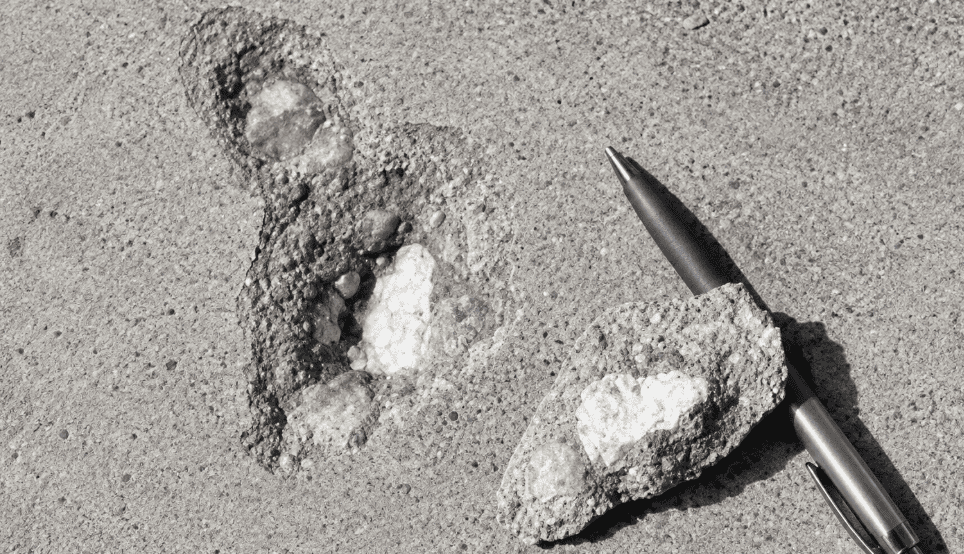
Concrete popouts are small, usually cone-shaped pits that form when an aggregate particle just below the surface fractures or expands and breaks away the concrete above it.
You will most often see them on driveways, sidewalks, patios, garage slabs, and other concrete flatwork. A few isolated popouts are usually cosmetic. A large number can point to poor aggregate durability or, in some cases, a chemical reaction within the concrete.
What Causes Concrete Popouts?
Concrete popouts develop when a troublesome aggregate particle sits close to the surface and creates enough pressure to break away the thin layer of concrete above it.
There are two main causes:
- Physical popouts from porous or unsound aggregate, often after moisture and freezing.
- Chemical popouts from alkali-silica reaction (ASR).
Physical Popouts From Porous or Unsound Aggregate
Most physical popouts start with an aggregate particle that has high absorption and low density.
The particle absorbs water. When that water freezes, pressure builds inside its pores. If the particle sits close to the surface, it can fracture and push out a small cone of concrete as shown in the diagram below.
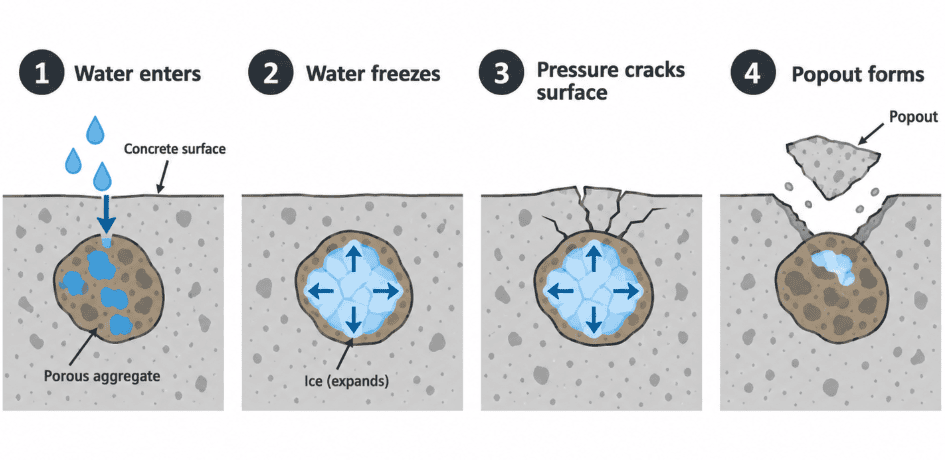
These popouts are most common on moist exterior flatwork exposed to freezing and thawing and often appear during the first year. ACI and NRMCA identify this as the typical physical popout mechanism.
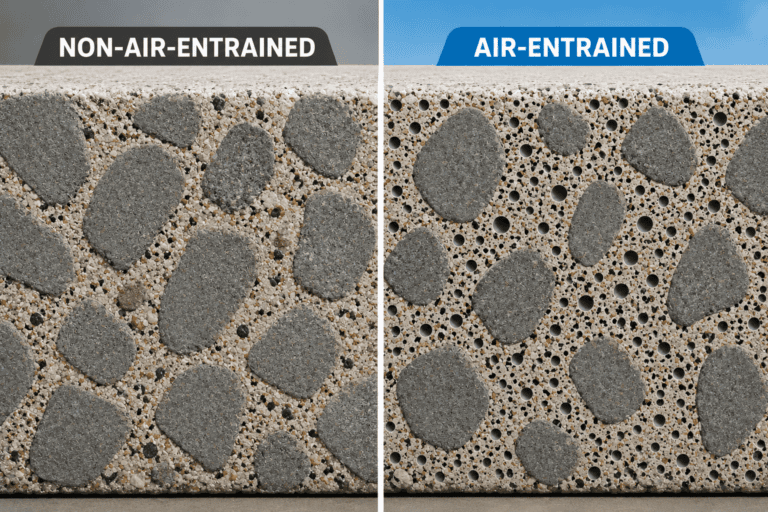
Air entrainment can improve the freeze-thaw resistance of the cement paste but cant be substitute for poor aggregate.
Low-density porous chert is a well-known popout risk.
NRMCA identifies low-density chert as the most common particle associated with physical popouts in some natural aggregate deposits. FHWA also links low-density chert, unsound shale, and unsound carbonate particles with this type of surface damage.
Clay balls and other moisture-sensitive contaminants are also undesirable. They can absorb water and swell, although NRMCA notes that they do not always create enough pressure to produce a true popout.
In practical terms:
- Low-density porous chert: high popout risk.
- Unsound shale: undesirable and associated with popouts.
- Clay balls: undesirable contaminants that can swell and weaken the surface.
- Durable aggregate with a proven service record: preferred.
The aggregate must also be close to the surface. Deeper particles have much more concrete around them to resist the pressure, while a near-surface particle only needs to fracture a thin concrete cover.
Chemical Popouts From Alkali-Silica Reaction
Popouts can also result from alkali-silica reaction (ASR).
ASR occurs when reactive silica in certain aggregates reacts with alkalis in the concrete in the presence of moisture. The reaction forms an expansive product that can generate enough pressure to detach the concrete above a near-surface particle.
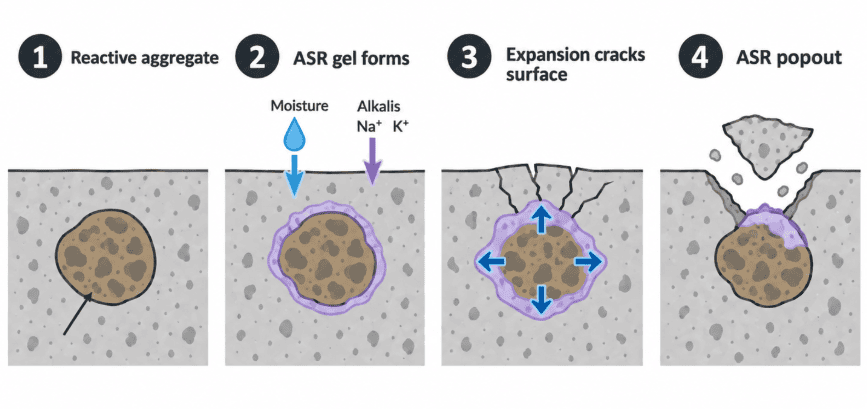
FHWA identifies ASR of chert and shale particles as another source of popouts. ASR-related popouts may leave the reactive aggregate exposed at the bottom of the cavity, and visible gel around the popout is a strong indication of ASR.
These chemical popouts can appear much sooner than freeze-thaw popouts. ACI notes that ASR popouts may develop within hours to a few weeks, while physical freeze-thaw popouts usually appear within the first year.
How to Prevent Concrete Popouts
The best prevention starts before the concrete reaches the jobsite.
1. Use Aggregate With a Good Durability Record
The most effective way to prevent physical popouts is to avoid aggregate known to contain susceptible particles.
For concrete exposed to freezing and thawing, FHWA recommends using field performance history, petrographic examination, and appropriate durability testing when the aggregate source is questionable.
This matters most where appearance is important, such as:
- architectural flatwork;
- pool decks;
- decorative patios;
- exposed driveways;
- finished floors.
2. Keep the Water-Cementitious Ratio Low
A lower water-cementitious ratio produces stronger, less permeable concrete.
Less permeable concrete reduces the amount of moisture that reaches susceptible aggregate particles.
NRMCA specifically recommends a lower water-cementitious ratio as one way to reduce physical popouts.
Do not add extra water simply to make the concrete easier to place or finish.
3. Do Not Finish While the Concrete Is Bleeding
Wait until bleed water has left the surface before final finishing.
Working water back into the concrete creates a weaker surface and increases permeability.
4. Cure the Surface Properly
Good curing helps the surface concrete gain strength and reduces permeability.
That gives the concrete above a susceptible aggregate particle more resistance to localized pressure.
5. Consider a Smaller Maximum Aggregate Size
Smaller susceptible particles generate smaller local stresses.
This is not normally a decision a homeowner makes at the jobsite. It is a mix-design consideration for the producer or engineer.
6. Control ASR When Reactive Aggregate Is Present
If ASR is the concern, the solution is different from a physical freeze-thaw popout.
The preferred approach is to use non-reactive aggregate where practical.
NRMCA also identifies suitable supplementary cementitious materials, including Class F fly ash and slag cement, as options for reducing ASR potential in appropriate mixtures.
Can a Concrete Sealer Stop Popouts?
NRMCA includes surface sealing as one measure that can reduce the frequency of physical popouts by limiting water movement into the concrete. It also makes clear that these measures do not necessarily eliminate popouts.
See our guide to sealed concrete if you are choosing a penetrating or film-forming treatment.
A sealer cannot remove a porous or reactive particle that is already inside the slab.
If a driveway has only a few physical popouts, reducing future moisture exposure may help.
If popouts are widespread or appear alongside map cracking, diagnose the cause before relying on a sealer.
If cracking is the main problem rather than small surface cavities, see main causes of cracking in concrete.
How to Repair Concrete Popouts
You can usually repair a few isolated popouts without replacing the slab.
The important part is removing the problem particle rather than simply filling the visible crater.
Repair Small Popouts in 5 Steps
- Remove the remaining weak aggregate.
Chip out loose material and any remaining portion of the particle that caused the popout. - Clean the cavity.
Remove dust, fragments, dirt, and other material that could interfere with the repair bond. - Expose sound concrete.
Do not place repair mortar over weak or crumbling edges. - Fill the cavity with a suitable repair material.
NRMCA lists dry-pack mortar, epoxy mortar, and other proprietary concrete repair materials as options. Follow the repair product manufacturer’s instructions. - Finish and cure the patch.
Bring the patch flush with the surrounding surface and cure it as required for the repair material.
Expect some color difference.
Matching an older concrete slab exactly is difficult, even when the repair itself performs well.
What If There Are Hundreds of Popouts?
Do not start patching hundreds of holes before finding the cause.
NRMCA recommends assessing the cause and potential for future deterioration before undertaking a large repair program. If individual repairs are impractical, a thin bonded concrete overlay may be an option after the underlying problem has been evaluated.
Covering active deterioration without diagnosing it first can leave you repairing the surface again later.
When Should Popouts Be Investigated?
You do not need laboratory testing for two small pits in a driveway.
Investigation makes more sense when popouts are numerous, unusual, or accompanied by other deterioration.
A concrete materials specialist may examine:
- aggregate fragments;
- concrete cores;
- crack patterns;
- ASR gel or reaction products;
- the condition of the surrounding paste;
- the mineral composition of the aggregate.
A petrographic examination is particularly useful when the cause is unclear.
ACI states that petrographic examination can determine the root cause of popout or popoff damage and help assess the potential for future deterioration.
For a homeowner, professional investigation becomes worthwhile when you see widespread popouts combined with map cracking, expansion, recurring deterioration, or other signs that the problem extends deeper than the surface.
Are Concrete Popouts a Structural Problem?
A few isolated concrete popouts are usually cosmetic, not structural.
NRMCA states that most popouts do not affect the structural performance or long-term service life of a concrete slab. ACI gives similar guidance and describes typical physical popouts as a cosmetic issue.
A small popout does not mean your driveway or patio is failing.
The concern increases when you see:
- dozens or hundreds of popouts;
- new popouts continuing to form;
- map or pattern cracking;
- widespread scaling or spalling;
- unusual expansion or movement;
- gel or persistent damp spots around the cavities;
- exposed reinforcement;
- deeper concrete deterioration.
A large number of popouts also leaves more of the surface open to water and chemicals. NRMCA warns that this can make other forms of deterioration easier to develop.
So the number and pattern matter much more than a single small crater.
Concrete Popout vs. Popoff, Scaling, and Spalling
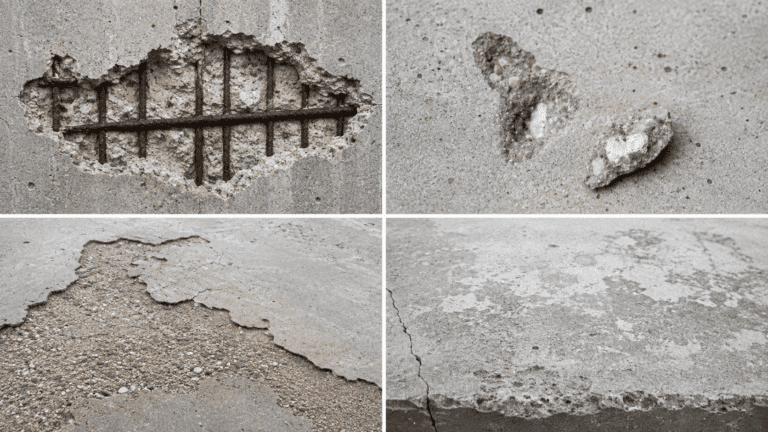
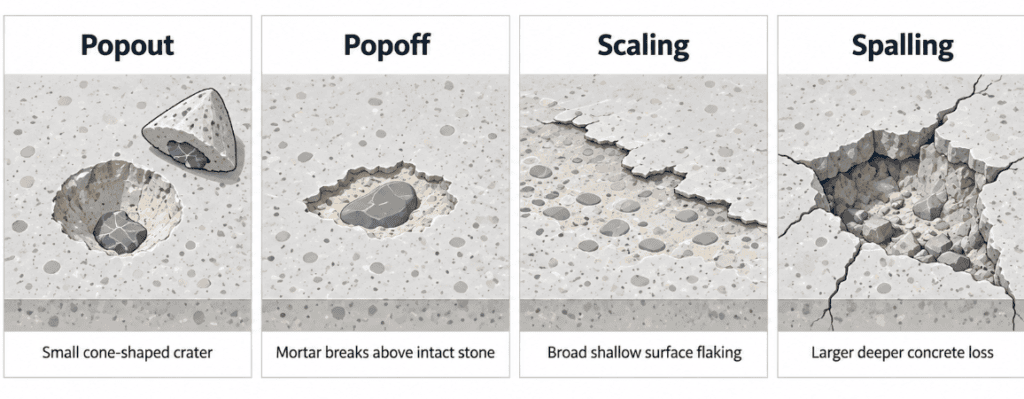
Several concrete defects can look similar from a distance.
The easiest way to separate them is to look at what actually broke away.
| Defect | What it looks like | What usually failed |
|---|---|---|
| Popout | Small, often cone-shaped crater | Aggregate particle and concrete above it |
| Popoff | Mortar flakes away over an exposed stone | Mortar above an intact aggregate particle |
| Scaling | Shallow surface flakes over a larger area | Surface paste or mortar |
| Spalling | Larger or deeper pieces of concrete break away | Concrete section, often from deterioration or internal pressure |
Popout vs. Popoff
The difference between these two is especially useful during inspection.
In a popout, the aggregate particle fractures. Part of that aggregate commonly remains attached to the broken cone or visible at the bottom of the cavity.
In a popoff, the aggregate remains intact and the mortar above it breaks away.
ACI specifically uses this distinction when diagnosing concrete surface damage. It also notes that improper finishing, inadequate curing, and weak surface mortar can contribute to popoffs.
Popout vs. Scaling
Scaling affects the surface over a broader area.
Instead of individual cone-shaped pits, the top layer starts to flake or peel away. FHWA distinguishes scaling from popouts by noting that scaling deteriorates the paste and exposes otherwise intact coarse aggregate, while popouts involve localized fractured aggregate particles.
Popout vs. Spalling
Spalling generally involves larger or deeper sections of concrete.
It can result from reinforcement corrosion, freeze-thaw deterioration, impact, chemical reactions, or other mechanisms.
If your slab is losing larger patches rather than isolated pits, see our guide to concrete spalling, its causes, and repair.
Do Popouts Mean the Concrete Mix Was Bad?
Not necessarily.
One or two popouts do not prove that the concrete mix was defective or that the contractor did poor work.
Concrete aggregate specifications allow small quantities of some naturally occurring particles that can later produce isolated popouts. NRMCA notes that ASTM C33 places limits on these materials but does not require aggregate to contain absolutely none of them.
That makes an important practical difference.
A driveway can meet normal material requirements and still develop an occasional aggregate popout.
However, frequent or widespread popouts are not something to dismiss.
If large numbers appear across a new slab, the aggregate source may contain too many popout-susceptible particles for the intended surface or exposure.
Poor construction practices can also make surface problems worse, particularly:
- adding unnecessary water;
- finishing while bleed water remains;
- poor curing;
- producing a weak or permeable surface.
The pattern of damage tells you much more than the presence of one isolated pit.
FAQs
Do Concrete Popouts Keep Getting Bigger?
An individual popout normally stops once the affected aggregate particle and the concrete above it have broken away.
Other susceptible particles in the slab can still create new popouts later. This can make the damage appear to spread across the surface.
Why Did Popouts Appear After the First Winter?
The first winter often exposes porous aggregate to the freeze-thaw conditions needed to trigger a physical popout.
A saturated particle freezes, develops internal pressure, and fractures the thin concrete above it. ACI notes that these physical popouts commonly become visible within the first year after placement.
Can New Concrete Develop Popouts Within a Few Days?
Yes.
Early popouts are more likely to involve a chemical reaction such as localized ASR or another moisture-sensitive particle than repeated freeze-thaw exposure.
NRMCA reports that some ASR popouts can occur within a few days after concrete placement.
Can You Repair a Concrete Popout Yourself?
A homeowner can usually patch a few small, stable popouts with an appropriate concrete repair product.
Do not treat widespread popouts the same way. When new cavities keep appearing or the slab also has significant cracking or expansion, identify the deterioration mechanism before making extensive repairs.