Concrete Slab Foundation Repair: Signs, Causes, & Costs
Concrete slab foundation repair is needed when a slab cracks, sinks, lifts, becomes uneven, or loses soil support underneath. Common warning signs include floor cracks, wall cracks, sticking doors, uneven floors, trim gaps, and water collecting near the house.
Slabs can crack because of shrinkage, soil movement, poor drainage, plumbing leaks, expansive clay, erosion, poor compaction, or differential settlement. That is why repair should start with diagnosis, not just crack filling.
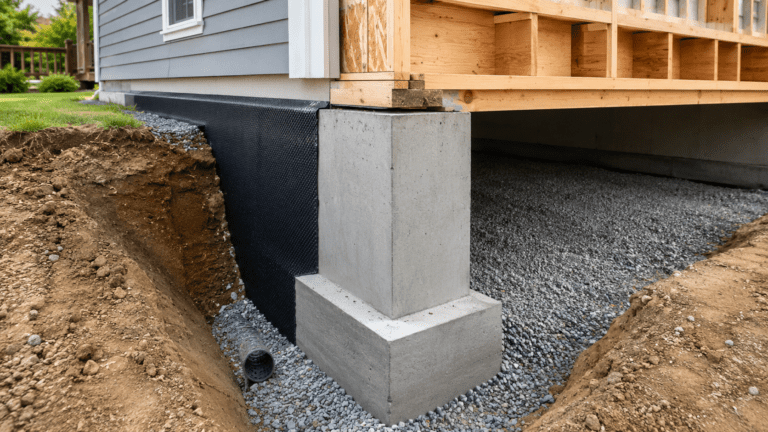
Foundation type also matters. Some homes use a footing and stem wall foundation instead of a simple slab-on-grade system. Other use pier and beam setup, so make sure you identify your foundation type first.
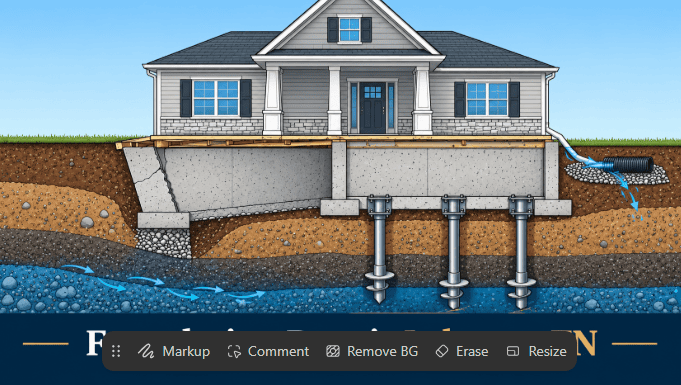
The chart below shows the most common slab foundation problems and the repair options usually considered first.
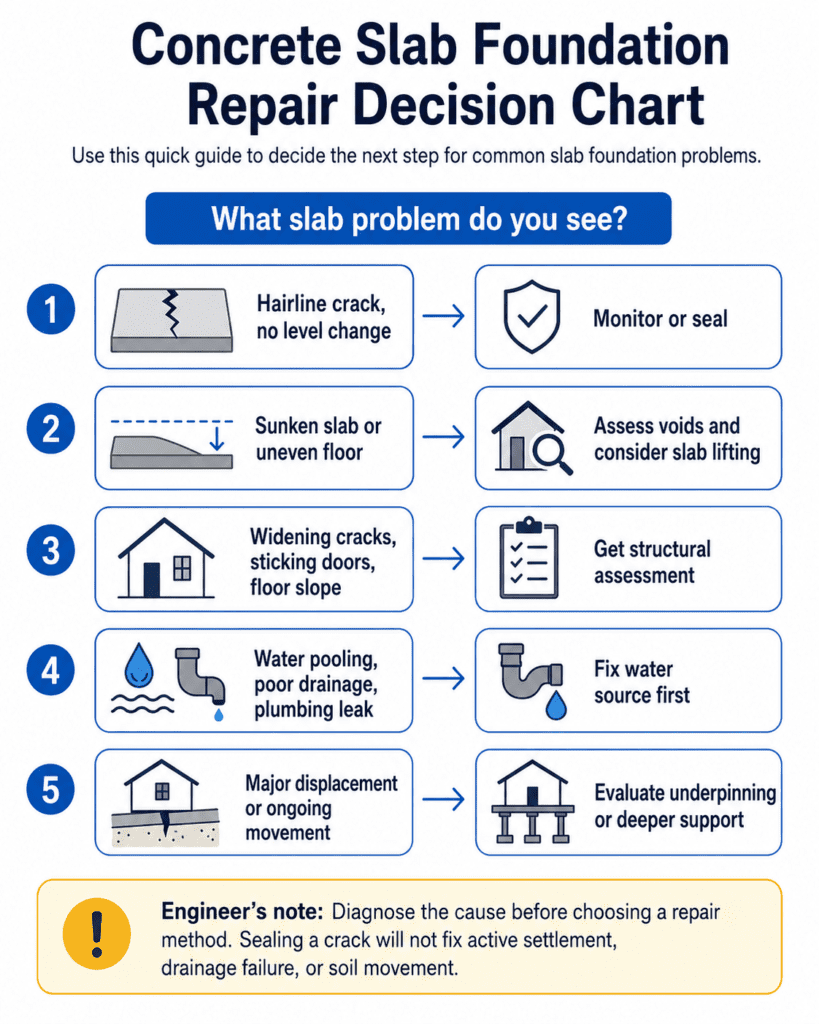
This chart is only a quick guide. If the slab is moving, floors are sloping, or cracks are widening, the cause should be diagnosed before choosing a repair method.
If your main concern is visible cracking, see our foundation crack repair guide.
What Is Concrete Slab Foundation Repair?
Concrete slab foundation repair means repairing, stabilising, lifting, sealing, or supporting a concrete slab foundation that has cracked, moved, settled, lifted, or lost support from the soil below.
Common slab foundation repair methods include:
- crack sealing
- epoxy or polyurethane injection
- drainage correction
- slab lifting
- void filling
- mudjacking
- polyurethane foam injection
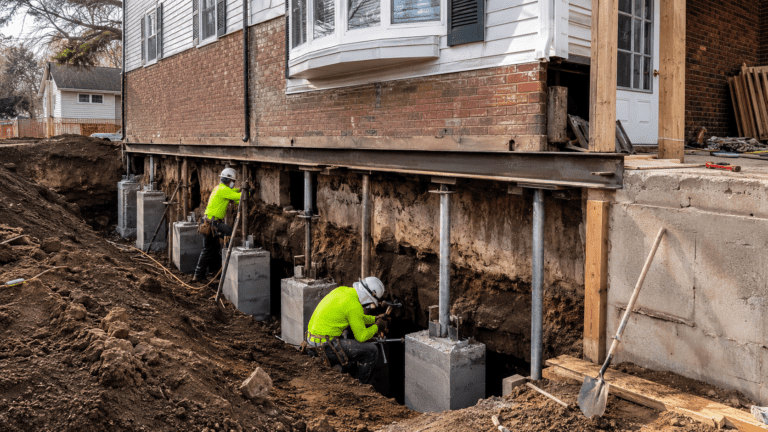
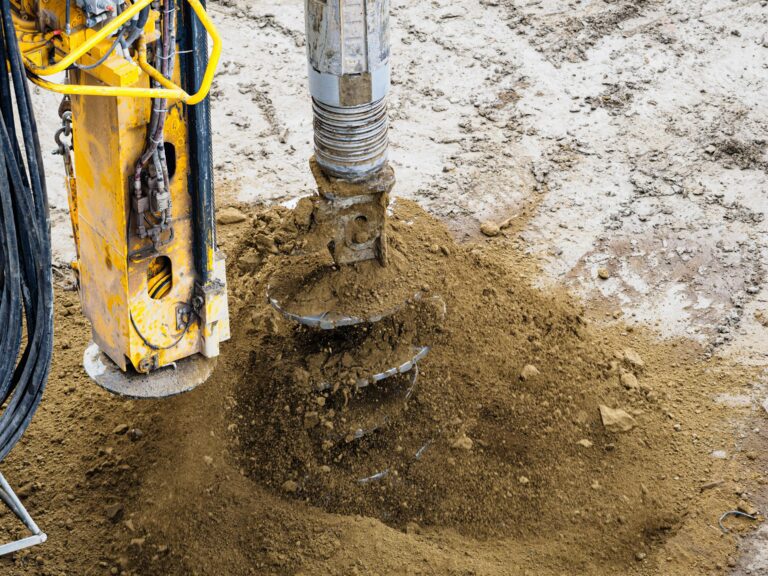
- helical piers
- push piers
- underpinning
- plumbing leak repair
- soil stabilisation
The correct method depends on the cause of the damage. A simple shrinkage crack may only need sealing. A sinking slab may need lifting or void filling. A slab affected by active settlement may need deeper structural support.
A concrete slab foundation is not just concrete. It is a system made of the slab, soil, moisture conditions, drainage, loads, and sometimes reinforcement. If one part of that system changes, the slab can crack or move.
Slab Foundation Cracks: When Are They Serious?
Not every concrete slab crack is structural. Concrete can crack because of normal shrinkage, temperature changes, drying, restraint, or minor concrete movement.
However, slab foundation cracks are more concerning when they are:
- widening over time
- uneven on both sides
- diagonal or connected with wall cracks
- allowing water entry
- associated with sinking or sloping floors
- repaired before but reopened
- located near doors, walls, or load-bearing areas
- accompanied by gaps around windows or doors
A hairline crack may be mostly cosmetic. A crack with vertical displacement, widening, or connected building movement may indicate foundation settlement or loss of soil support.
If cracks are widening, floors are sinking, or parts of the slab are moving, call (888) 664-3492 to discuss the problem with a local foundation repair professional.
Call Now: (888) 664-3492Common Signs of Slab Foundation Problems
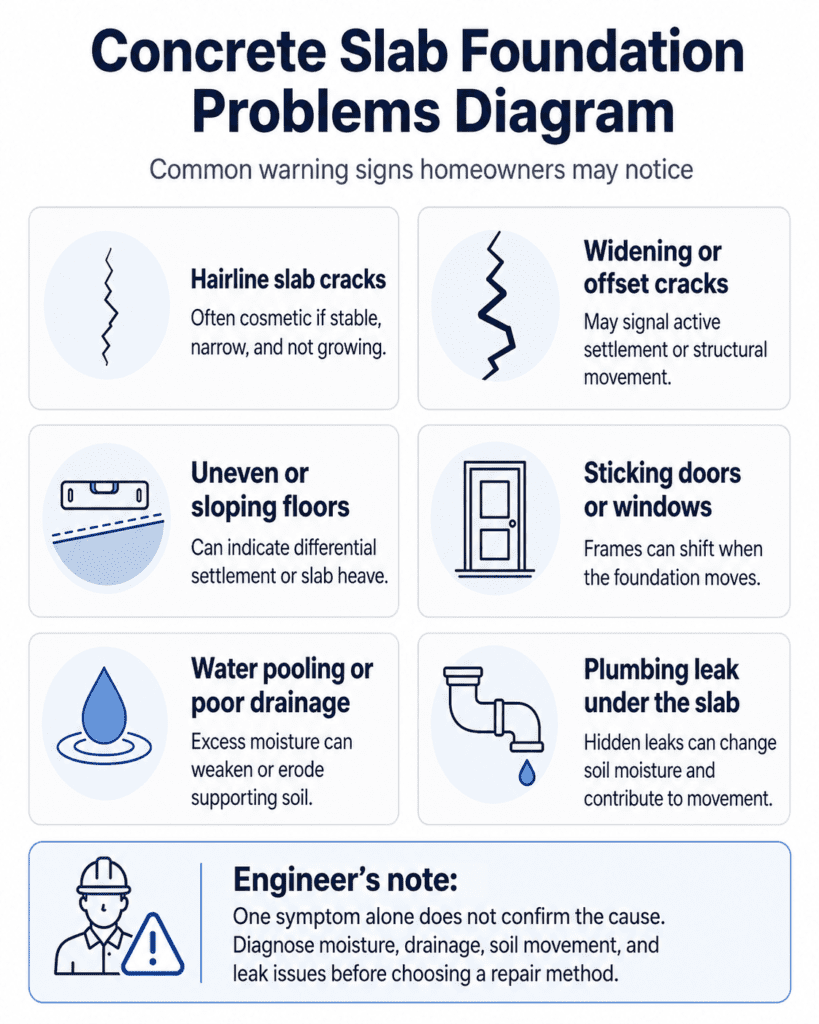
Concrete slab foundation problems often appear gradually. Homeowners may notice small symptoms first, then realize several issues are connected. The main problems are also summarized in Figure 2 below.
1. Cracks in the concrete floor
Cracks in exposed slab areas, garages, basements, or tiled floors may indicate shrinkage, settlement, heave, or soil movement.
2. Uneven or sloping floors
If part of the floor feels lower, sunken, or sloped, the slab may have settled or lost support underneath.
3. Doors or windows that stick
When a slab moves unevenly, the frame above it can distort. This may cause doors and windows to stick or become misaligned.
4. Cracks in walls above the slab
Drywall or plaster cracks above doors, windows, or corners may be connected to slab movement below.
5. Gaps around skirting boards, trim, or walls
Gaps can form when the slab moves relative to the wall framing or finishes.
6. Tile cracks
Floor tiles may crack when the slab below moves, bends, or settles.
7. Water near the foundation
Poor drainage can soften, erode, expand, or shrink the soil supporting the slab.
8. Repaired cracks that return
If a crack reopens after patching, the slab may still be moving.
9. Plumbing leak symptoms
Unexpected water bills, warm floor spots, damp areas, or unexplained moisture may indicate a leak below the slab.
What Causes Concrete Slab Foundation Problems?
Concrete slab foundation problems usually come from soil movement, moisture change, poor construction, or changes in support below the slab.
Poorly compacted soil
If soil was not compacted properly before construction, it can compress over time. This may create settlement below the slab.
Expansive clay soil
Clay soils can shrink when dry and swell when wet. This repeated movement can crack or lift slab foundations.
Poor drainage
Short downspouts, negative grading, blocked gutters, and ponding water can create uneven moisture around the slab. Poor drainage can soften, erode, expand, or shrink the soil supporting the slab. Building Science Corporation explains that a subslab drainage pad provides a capillary break so ground moisture cannot move upward into the slab by capillary action.
Plumbing leaks below the slab
A leak under the slab can soften soil, wash out support, or cause localised movement.
Soil erosion or voids
Water movement below the slab can remove soil and create empty spaces. The slab may then crack or sink into the unsupported area.
Tree roots and moisture demand
Large trees close to the house can affect soil moisture, especially in clay soils. The issue is usually not roots “breaking” the slab directly, but moisture imbalance and soil shrinkage.
Poor slab design or construction
Thin slabs, poor reinforcement placement, weak concrete, inadequate base preparation, or poor curing can increase cracking risk.
Added loads or structural changes
Heavy additions, removed walls, new openings, or changed load paths can affect how the slab and soil carry loads.
Many homeowners ask, “Can I just repair the crack?” The better question is, “Why did the crack happen?” If water, soil movement, or settlement is still active, crack repair alone is not a real solution.
Concrete Slab Foundation Repair Methods
The right repair depends on the cause, severity, and whether the slab is still moving.
| Problem | Possible repair |
|---|---|
| Minor stable crack | Crack sealing or monitoring |
| Leaking crack | Polyurethane injection or waterproofing repair |
| Structural crack | Epoxy injection or engineer-designed repair |
| Local slab settlement | Slab lifting or void filling |
| Soil washout below slab | Void filling and drainage correction |
| Active foundation settlement | Piers, underpinning, or deeper support |
| Plumbing leak below slab | Leak repair before slab repair |
| Poor drainage | Grading, gutters, downspout extensions, drainage correction |
Crack sealing
Crack sealing is used for minor, stable cracks. It can reduce water entry and improve appearance, but it does not stabilise an actively moving foundation.
Epoxy injection
Epoxy injection can bond structural cracks in concrete. It is useful when the crack is stable and the goal is to restore continuity in the concrete.
Polyurethane injection
Polyurethane injection is often used for water-related cracks because it can expand and seal leakage paths. It is usually more flexible than epoxy.
Slab lifting
Slab lifting raises sunken concrete areas. It may be done using mudjacking or polyurethane foam injection.
Void filling
Void filling is used when empty spaces exist below the slab. The goal is to restore support under the concrete.
Mudjacking
Mudjacking pumps a cementitious or slurry material below the slab to lift and support it. It can be effective but adds weight and may not be ideal in every soil condition.
Polyurethane foam lifting
Polyurethane foam lifting uses expanding foam below the slab. It is lightweight and can be less disruptive, but suitability depends on the slab condition and soil support.
Helical piers or push piers
Piers transfer foundation loads deeper into more stable soil or bearing layers. They are used when settlement is more serious or ongoing.
Underpinning
Underpinning strengthens or extends the foundation support. It is usually used for more severe structural movement.
Drainage correction
Drainage repair is often one of the most important steps. If water is causing soil movement, lifting or sealing the slab without fixing drainage may only provide temporary relief.
Concrete Slab Foundation Repair Cost
Concrete slab foundation repair cost depends on the repair method, severity of damage, access, soil conditions, foundation type, local labour rates, permits, and whether engineering assessment is needed.
Minor crack sealing may be relatively inexpensive. Slab lifting, pier installation, underpinning, drainage correction, or structural stabilisation can cost much more.
| Repair type | Typical cost level | Notes |
|---|---|---|
| Minor crack sealing | Low | Best for stable, non-structural cracks |
| Epoxy or polyurethane injection | Low to medium | Depends on crack length and leakage |
| Drainage correction | Low to high | Can involve grading, gutters, drains, or waterproofing |
| Slab lifting | Medium | Cost depends on area and amount of lift |
| Void filling | Medium | Used when support below slab is missing |
| Pier installation | High | Usually priced per pier or support point |
| Underpinning | High | More structural and site-specific |
| Engineering inspection | Medium | Useful before expensive repairs |
The cheapest repair is not always the best repair. The best repair is the one that addresses the cause of movement.
If a contractor gives a major repair quote without explaining the cause of slab movement, ask for more detail. A good repair proposal should explain the problem, the method, the expected result, and what is excluded.
Use the calculator to estimate slab foundation repair costs based on the repair method and project size.
For new slab installation costs alongside repair, see our concrete slab price calculator.
If your slab is cracked, sinking, uneven, or losing support, call (888) 664-3492 now to discuss repair options with a local foundation repair professional.
Call Now: (888) 664-3492Should You Repair a Slab Crack Yourself?
You may be able to seal a small, stable, non-structural crack yourself if there is no displacement, leakage, widening, or related building movement.
However, DIY repair is not recommended when:
- the crack is widening
- one side of the crack is higher than the other
- water is entering
- floors are sloping
- doors or windows are sticking
- cracks appear in walls above
- the crack has reopened after previous repair
- there are signs of plumbing leakage
- the repair quote involves piers or underpinning
DIY crack filler can hide the symptom but not solve settlement, heave, erosion, or poor drainage.
When Should You Call a Structural Engineer?
You should consider calling a structural engineer before major concrete slab foundation repair if:
- cracks are widening
- floors are sinking or sloping
- doors and windows are misaligned
- there is visible differential movement
- multiple symptoms appear together
- you are buying a house with slab cracks
- contractor quotes differ widely
- the repair cost is high
- piers or underpinning are recommended
- the cause of movement is unclear
A contractor may be excellent at installing a repair system, but an independent engineer can help confirm whether that system is actually needed.
Slab Foundation Diagnosis Checklist
Before choosing a repair method, ask these questions:
| Question | Why it matters |
|---|---|
| Is the crack old or new? | New cracks may indicate active movement |
| Is the crack widening? | Widening suggests ongoing movement |
| Is there vertical displacement? | One side higher than the other is more serious |
| Are floors sloping or sinking? | This may indicate settlement or voids |
| Are doors and windows sticking? | The frame may be distorted |
| Is water collecting near the house? | Moisture changes can move soil |
| Are there plumbing leak signs? | Leaks can undermine the slab |
| Has the crack been repaired before? | Reopened cracks suggest the cause remains |
| Is the repair quote expensive? | Independent review may save money |
Final Engineering Advice
Concrete slab foundation repair should begin with diagnosis, not with a repair product. A crack, uneven floor, or sticking door is only a symptom. The important question is whether the slab is stable, still moving, affected by water, or losing soil support underneath.
If the problem is minor and stable, monitoring or limited crack repair may be enough. If cracks are widening, floors are sinking, doors are becoming misaligned, or several warning signs appear together, get a professional inspection before paying for major repair.
Do not let anyone sell you piers, foam lifting, injection repair, or underpinning before the cause of movement is understood.
FAQs
What is concrete slab foundation repair?
Concrete slab foundation repair is the process of sealing, lifting, stabilizing, supporting, or correcting a concrete slab foundation that has cracked, settled, lifted, or lost soil support.
Are slab foundation cracks serious?
Some slab cracks are minor and caused by shrinkage. Cracks are more serious when they widen, leak, show vertical displacement, or appear with sloping floors, sticking doors, or wall cracks
How do you repair a cracked slab foundation?
The correct repair depends on why the slab cracked. Stable hairline cracks may be sealed or injected. Sinking slabs may need lifting or void filling. Active settlement may require piers, underpinning, drainage correction, or soil-related repair. If the slab appears to be sinking unevenly, see our foundation settlement repair guide.
Can a slab foundation be lifted?
Yes, some sunken slab areas can be lifted using mudjacking or polyurethane foam injection. However, lifting is only suitable when the slab and soil conditions allow it.
Is slab foundation repair permanent?
It can be long-lasting if the cause is correctly addressed. If drainage, soil movement, plumbing leaks, or active settlement remain unresolved, the problem may return.
Is epoxy good for slab cracks?
Epoxy can be useful for stable structural cracks, but it is not ideal for every situation. If the crack is leaking or still moving, polyurethane injection or a different repair may be more suitable.
Should I call a contractor or engineer first?
For minor cracks, a contractor may be enough. For widening cracks, uneven floors, expensive repairs, or unclear causes, an independent structural engineer should be considered before major work.
The best concrete slab foundation repair is the one that addresses the cause of movement, not just the visible damage.